

Why can kites fly so high?
Have you ever tried to explain why a paper kite soars upward when you hold its string and run forward? If you can answer that question, you will also understand why airplanes and maple seeds can fly, and you will get some insight into the strange movements of the boomerang.
All of these are phenomena of the same kind. Air itself, a dangerous obstacle to the flight of bullets, is what helps maple seeds, paper kites and even airplanes weighing many tons glide through the sky.
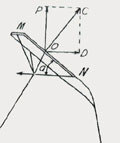
Explaining why a kite rises.
To explain why a paper kite rises, let's use the simple diagram below. Suppose the line MN is a cross-section of the kite. When we fly the kite and pull the string, it moves at a tilt because of the weight of its tail. Suppose the direction of this motion is from right to left. Let alpha be the angle at which the kite's plane is tilted relative to the horizontal. Now let's consider which forces act on the kite.
The air, of course, resists the motion, exerting a certain pressure perpendicular to the plane. In the diagram, this pressure is represented by the arrow OC, perpendicular to MN. Using the parallelogram rule, OC can be resolved into two forces, OD and OP. Force OD pushes the kite backward and therefore reduces its initial speed. Force OP, meanwhile, pulls the kite upward. It offsets the kite's weight and, if large enough, can overcome that weight and lift the kite higher. That is exactly why a kite rises when we pull its string forward.
An airplane is also a kite of sorts; the only difference is that the pulling force of our hand is replaced by the thrust of a propeller or a jet engine, which drives the airplane forward and thus makes it fly just like a paper kite.
