How to tell the king cobra, the common cobra and the oriental rat snake apart
Many accidents happen because people can't tell these snakes apart.
The king cobra, the oriental rat snake and the common cobra are three snakes with many distinct features, yet unless you're an expert or a snake catcher, it's easy to mix them up.
The most dangerous mix-up is confusing the king cobra with the oriental rat snake (non-venomous but fairly aggressive). This article covers the basics to help you quickly identify these three snakes.
Note: the king cobra is a protected species in Vietnam. Hunting, keeping, trading or eating it is illegal.
Telling the king cobra (scientific name: Ophiophagus hannah) from the common cobra
Although the king cobra carries the name "cobra," it doesn't belong to the genus Naja (the true cobras). Instead, it is the sole member of the genus Ophiophagus. As a result, it differs in appearance from true cobras in many ways.
The first thing that stands out is length: the king cobra is the world's longest venomous snake, while cobras have much shorter bodies. If the snake spreads its hood, you can also check the color underneath the hood and the pattern on the back of the neck.
The king cobra has turmeric-yellow skin under its throat and, on the back, an inverted V-shaped pattern, whereas the throat of common cobras is not yellow and has no pale inverted V marking behind the neck.
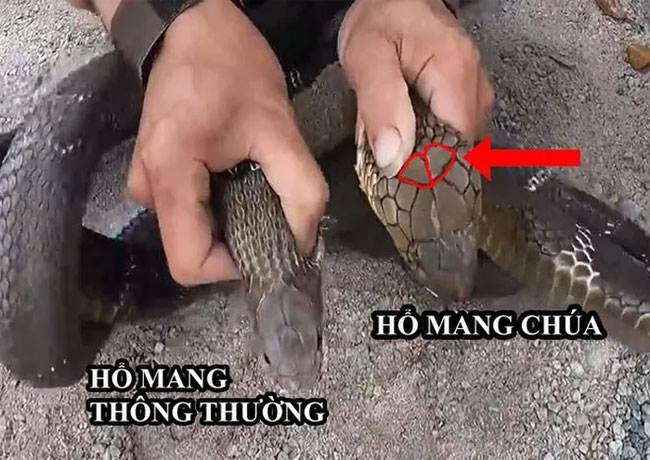
The king cobra's head scales are very different from those of common cobras. (Photo: Thành Luân).
The scales on top of the king cobra's head are also quite unlike those of common cobras. You can tell them apart quickly by looking for the scales marked in red (photo above) on the king cobra — common cobras lack these two large scales.
The king cobra's eyes are also distinctive, with a clearly visible round pupil (like a human eye) that gives it a fierce look, while in common cobras the pupil is hard to see and the eye looks uniformly black.
Telling the king cobra from the oriental rat snake (scientific name: Ptyas mucosa)

The oriental rat snake and the king cobra. (Illustrative photo: Thành Luân).
What confuses many people is that the pattern (pale bands) running along the bodies of the two species looks very similar at first glance. Both are also impressively long, so length alone is not a reliable clue.
Their heads, however, are very different, so look at the head to identify them. The oriental rat snake's head is slender and very small, while the king cobra has a very large head with big scales. When moving, the king cobra also often raises its head instead of crawling flat along the ground like the rat snake.
The highly venomous cobras that live in Vietnam
Four cobra species live in Vietnam, and all of them carry potentially lethal venom. Here is how to recognize them and what to do if you meet one.

The truth about Vietnam's strange "tie the girl to the post" bird
Beyond its unusual name, the Indian cuckoo, called "bắt cô trói cột" in Vietnam, has many curious traits.
Half frog, half snake, half worm: The bizarre caecilians of Vietnam
Vietnam's 'worm frogs' are legless amphibians so snake-like that many people are startled the first time they see one.
Southeast Asia's treasure: A rare animal found in only 9 countries, and good news from Vietnam
The critically endangered Sunda pangolin lives only in Southeast Asia, including Vietnam, and is among the world's most trafficked mammals.
The harmless snake often mistaken for a deadly venomous one in Vietnam
A small, harmless snake found across Vietnam is often needlessly killed because it is mistaken for a deadly venomous species.
Up close with the ultra-rare legless amphibian found in a Vĩnh Long garden
While gardening, a woman in Vietnam's Vĩnh Long province found a caecilian-like amphibian listed in Vietnam's Red Data Book.