Half frog, half snake, half worm: The bizarre caecilians of Vietnam
This strange 'worm frog' looks so much like a snake that many people are startled the first time they see one.
Mention frogs, and most people picture an amphibian with smooth, moist skin, long and powerful hind legs and an impressive ability to leap. But one so-called frog has an unusual appearance — more snake than frog — that frightens many people who come across it for the first time.
A 'frog' that looks like a snake
The animal in question is the ếch giun ("worm frog"), a caecilian of the family Ichthyophiidae. The group includes many different species, a number of which are threatened or close to extinction as their populations decline.
If 10 people came across one, seven would probably call it a worm and three would say it was a snake. In fact, this animal is an amphibian — a relative of... frogs.
These amphibians are found in many forested and mountainous areas of Vietnam, from Thái Nguyên province in the north all the way to Cà Mau province at the country's southern tip.
Caecilians are the only legless amphibians in Vietnam. They have long, limbless bodies with smooth, glossy skin ringed by many folds, giving them a strikingly snake-like look that frightens many people on first sight.
Caecilians also move like snakes, wriggling their bodies to push forward. Their body shape suits life underground and beneath piles of rotting leaves, letting them slip easily through cracks and tunnels in the soil.
Here are some photos of them:
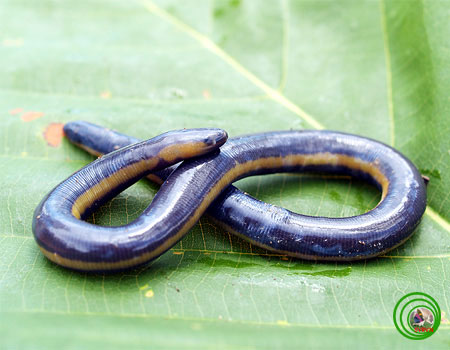
A caecilian's body is shaped like an earthworm's, only bigger. (Photo: Phùng Mỹ Trung).
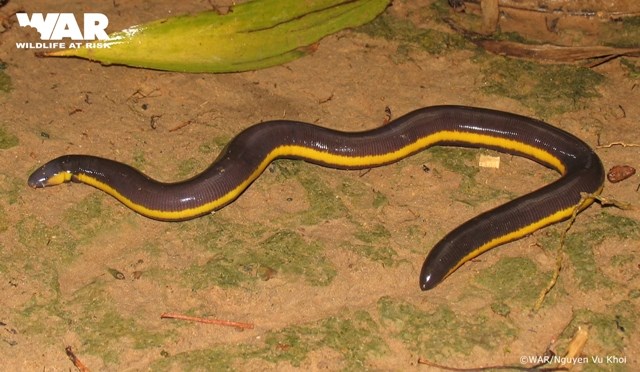
What's more, this caecilian's reptile-like body, with its glossy yellow-brown lengthwise stripes and wriggling flat head, makes people think of brightly coloured venomous snakes. (Photo: War/Nguyễn Vũ Khôi)
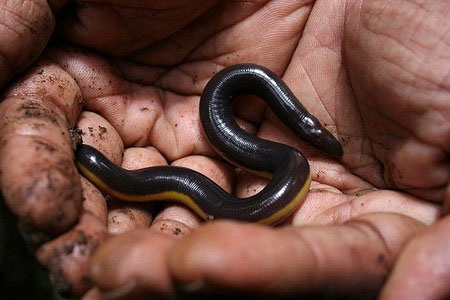
Caecilians can grow to several tens of centimeters long. (Photo: pskhun)
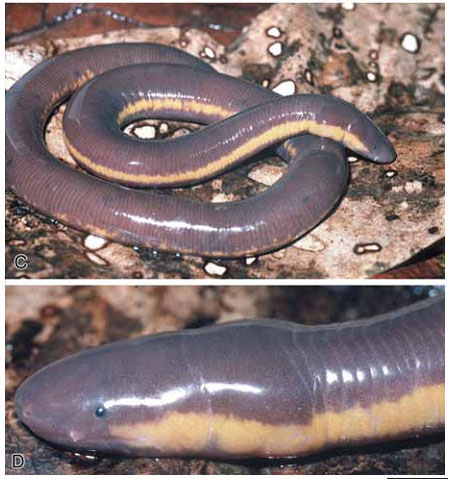
Unlike worms, they have eyes: two black dots on the head. (Photo: Maxim Ryzhov)
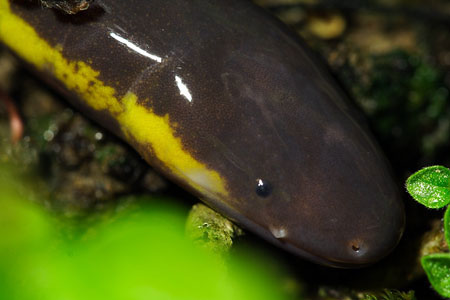
The head is small and slightly flattened, with a fairly pointed snout and distinct jaws. (Photo: biozcw)
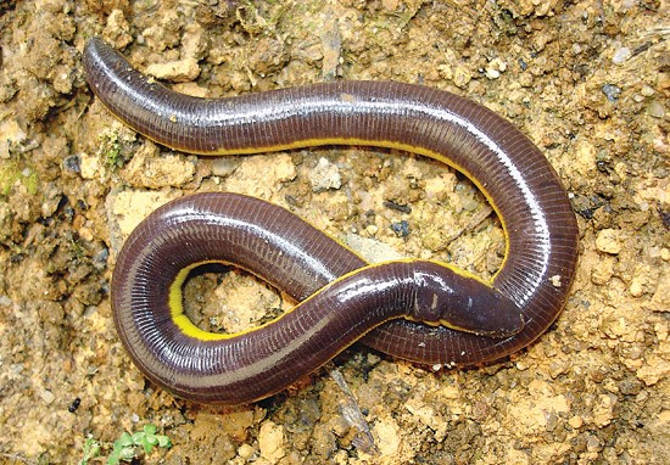
In the larval stage, caecilians have gills on both sides of the neck. As they mature, the gills disappear and the animals breathe in a different way.
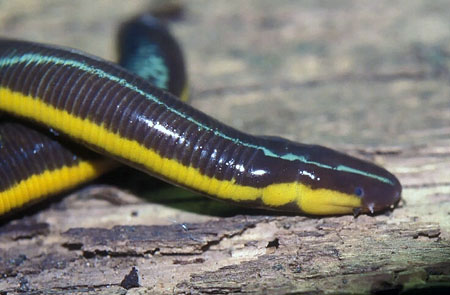
Caecilians often live at high elevations, such as in the Tam Đảo mountain range in northern Vietnam, but they have also been found in lowlands such as the U Minh forest in the Mekong Delta. (Photo: Maxim Ryzhov)
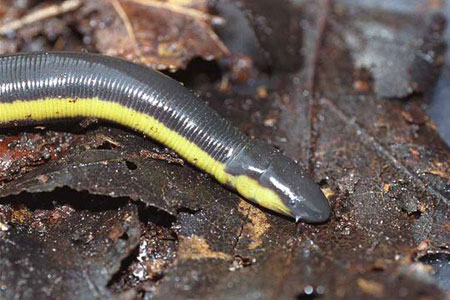
They burrow through the soil like worms; their burrows are usually found in loose soil about 20 - 30cm deep near ponds and lakes. (Photo: eol.org)
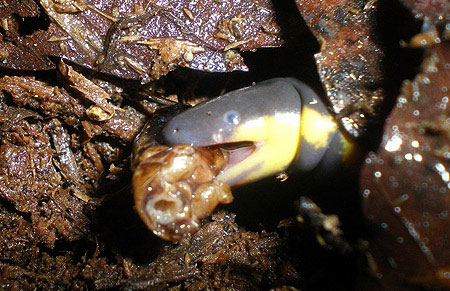
Caecilians feed on earthworms and some insects. (Photo: thetexanherper.com)
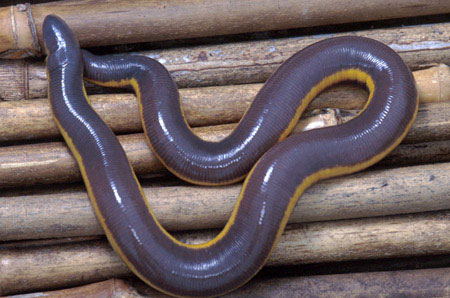
Caecilian numbers are now quite low because they have lost their habitat in many places. (Photo: Nikolai Orlov)
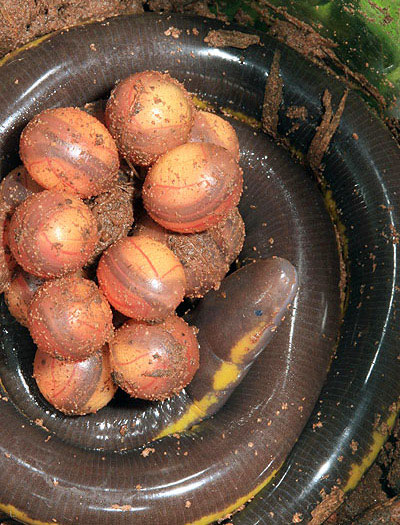
They lay their eggs near water. A clutch holds about 20 eggs linked together by mucus, and the female coils around them to keep them from drying out and to maintain a suitable temperature, giving the young the best chance to develop. (Photo: thetexanherper.com)
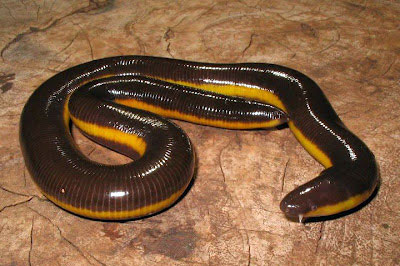
This unusual amphibian has been listed in the Vietnam Red Data Book and is protected by law. (Photo: Pskhun)
In caecilians, the head and body are not clearly separated. Their eyes and mouth are tiny and hard to see. At the front of the head, near the eyes, are 2 short tentacles that help them sense their surroundings and find food.
Caecilians eat earthworms, insect larvae, grubs, spiders and more. As a result, they play an important role in controlling insect numbers and maintaining the ecological balance of their habitats.
Caecilians: the devoted mothers of the amphibian world
While most other amphibians, such as frogs and toads, abandon their eggs right after laying them, caecilian mothers take careful care of theirs.
In the breeding season, the female looks for a humid spot near water to lay her eggs. Afterwards, she coils around the eggs to protect them and secretes mucus to keep them from drying out. The mother also regulates the eggs' temperature and humidity so that as many as possible will hatch.
Are caecilians venomous?
Caecilians have small mouths lined with two jaws of teeth that let them catch prey.
Scientists initially believed caecilians were not venomous. However, recent studies have shown that caecilians have venom glands in their mouths and may be able to release venom when they bite.
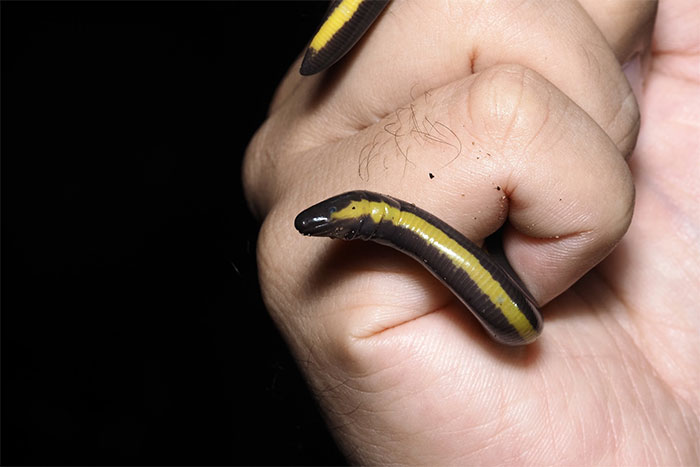
With such small mouths, caecilians can hardly bite or attack humans (Photo: Flickr).
Even so, scientists still do not fully understand how caecilian venom affects humans. And because their mouths are so small, it would be very difficult for them to bite a person and inject venom.
Caecilians: legally protected animals in Vietnam
Eleven caecilian species have been recorded in Southeast Asia, 4 of them in Vietnam, including 3 found nowhere else. The species found in Vietnam are:
Cát Lộc caecilian (scientific name: Ichthyophis catlocensis): This species was first found in 2015 in the Cát Lộc sector of Cát Tiên National Park in southern Vietnam (an area spanning the former Cát Tiên district and Bảo Lộc in Lâm Đồng province).
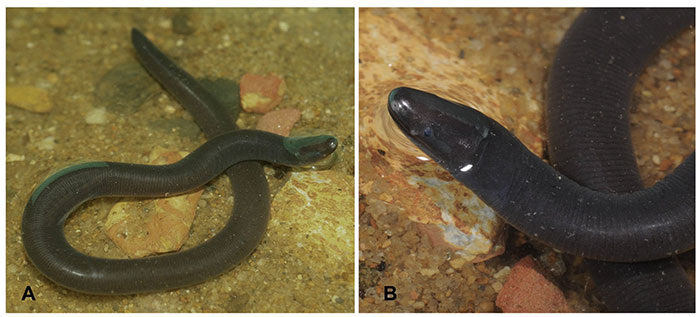
A close-up of a Cát Lộc caecilian, photographed in Cát Tiên National Park, Lâm Đồng province (Photo: E.A. Galoyan).
Unlike other caecilian species, the Cát Lộc caecilian lacks the yellow stripes running along the body. It is small, reaching only about 20cm long as an adult.
This caecilian is so rarely seen that scientists have yet to document its biology, such as its breeding behavior, habitat and diet.
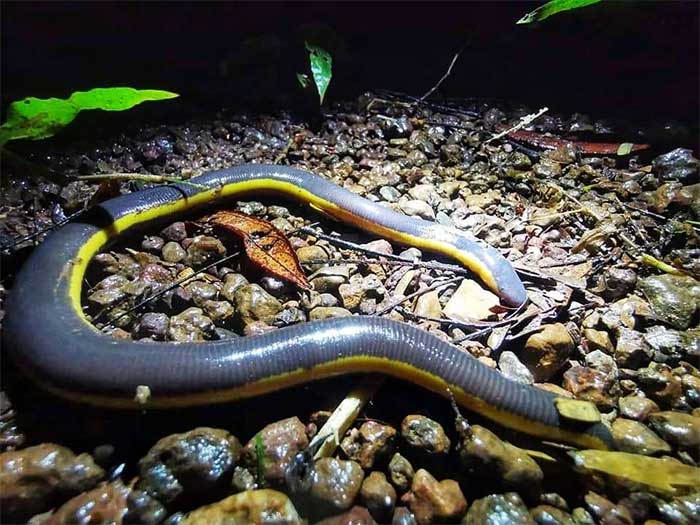
Cha Lo caecilian (scientific name: Ichthyophis chaloensis): This species is entirely bluish-black and also lacks the yellow stripes along the body seen in other caecilians. Adults are about 22cm long.
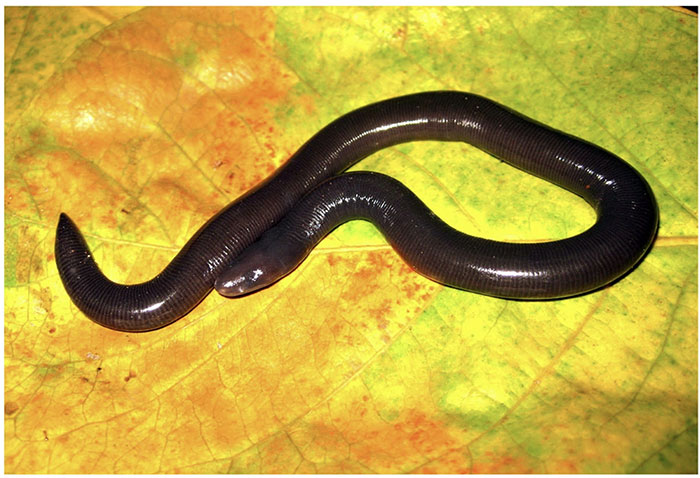
A close-up of a Cha Lo caecilian, photographed in Phong Nha - Kẻ Bàng National Park in the former Quảng Bình province (now part of Quảng Trị province), central Vietnam (Photo: Nguyễn Quảng Trường).
The Cha Lo caecilian was first discovered in 2015 in Phong Nha - Kẻ Bàng National Park, in the former Quảng Bình province. It is currently known only from Cha Lo village, in the former Hóa Sơn commune of the former Minh Hóa district, at elevations above 600m.
Like the Cát Lộc caecilian, the Cha Lo caecilian is very rarely seen, so its biology has not yet been fully documented.
Nguyen's caecilian (scientific name: Ichthyophis nguyenorum): This species was discovered in 2012 on the Kon Tum Plateau in central Vietnam. It was named in honor of 2 Vietnamese herpetologists, Nguyễn Quảng Trường and Nguyễn Thiên Tạo.
A close-up of a Nguyen's caecilian, with its 2 striking yellow stripes along the body (Photo: Chris Joldnall).
This caecilian is endemic to Vietnam and is found in the Central Highlands and the south, including Lâm Đồng, Gia Lai and Đồng Nai provinces and the former Kon Tum and Bình Phước provinces.
It has a purplish-black back, a paler belly and an unbroken yellow stripe on each side running from the middle of the upper jaw to near the tip of the tail. Adults can reach 30cm long.
Nguyen's caecilians are usually spotted during heavy rain. They typically live in damp areas under the forest canopy and in muddy streambanks, and are sometimes found on coffee farms, in rice paddies or in residential areas.
Koh Tao caecilian (scientific name: Ichthyophis kohtaoensis): This species has 2 even yellow stripes running from the eyes to the tip of the tail, a brown back and a light brown belly. Adults are about 40cm long.
It is named after the island of Koh Tao in Thailand, where it was first found in 1960. Beyond Thailand, it ranges widely across southern China, Vietnam, Laos and Cambodia.
In Vietnam, the Koh Tao caecilian has been found in provinces including Phú Thọ, the former Tiền Giang province, An Giang and Cà Mau, but only in very small numbers.
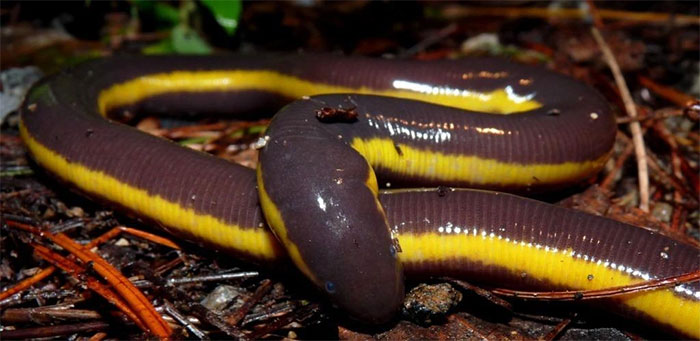
The Koh Tao caecilian looks quite similar to Nguyen's caecilian but is larger (Photo: iNaturalist).
The Koh Tao caecilian is found in damp areas under the forest canopy, on coffee farms, in rice paddies and in residential areas near forests. It is most active in the rainy season and is often found after heavy rain.
Vietnam's caecilians now face habitat loss and food shortages as forests shrink, soil erodes and prolonged flooding suffocates the animals in the ground. Caecilians have been listed in Vietnam's Red Data Book and need to be conserved, with hunting banned.
Hopefully this article will help readers tell caecilians apart from snakes, so they do not mistakenly kill these rare and declining animals.
Southeast Asia's treasure: A rare animal found in only 9 countries, and good news from Vietnam
The critically endangered Sunda pangolin lives only in Southeast Asia, including Vietnam, and is among the world's most trafficked mammals.
The harmless snake often mistaken for a deadly venomous one in Vietnam
A small, harmless snake found across Vietnam is often needlessly killed because it is mistaken for a deadly venomous species.
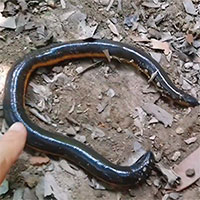
Up close with the ultra-rare legless amphibian found in a Vĩnh Long garden
While gardening, a woman in Vietnam's Vĩnh Long province found a caecilian-like amphibian listed in Vietnam's Red Data Book.
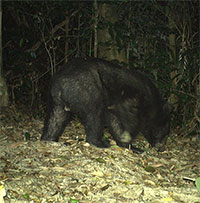
Rare and unusual animals caught on camera in Vietnam's Động Châu-Khe Nước Trong Nature Reserve
Camera traps have revealed many rare and endangered Red List animals, from Asian black bears to pangolins, in a nature reserve in central Vietnam.
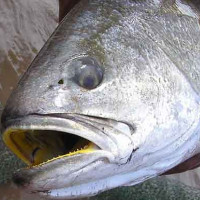
Why is the bronze croaker so expensive?
One bronze croaker can earn a fisherman hundreds of millions of VND, so sailors call it a "swimming lump of gold" or "Vietnam's gift from heaven".
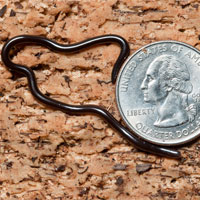
Vietnam's bizarre, super-tiny worm snake
Easily mistaken for earthworms, Vietnam's tiny worm snakes have scales, a forked tongue, and can reproduce without males.