Southeast Asia's treasure: A rare animal found in only 9 countries, and good news from Vietnam
This extremely rare animal lives only in Southeast Asia, including Vietnam.
In a world where unsustainable human consumption keeps pushing wildlife toward extinction, pangolins have emerged as a focal point of efforts to save species at risk of disappearing from the wild altogether.
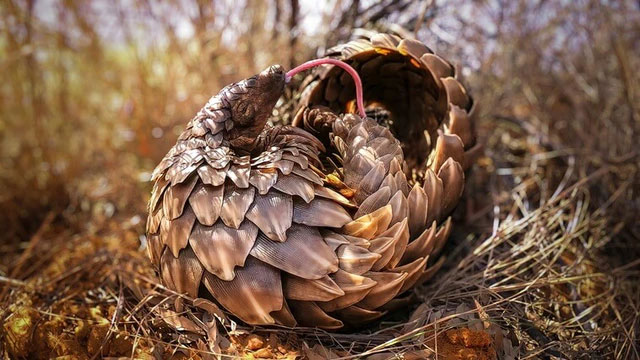
A pangolin yawning at Khamab Kalahari Reserve in South Africa. (Source: Workingwithwildlife).
According to the Wildlife Conservation Society (WCS), the illegal wildlife trade generates profits of up to 10 billion U.S. dollars a year worldwide; illegal logging is worth 7 billion dollars a year, while illegal fishing brings in a staggering nearly 9.5 billion dollars annually.
Taken together, illegal trade in wildlife, including fisheries and timber, is the fourth-largest illegal trade in the world, after drugs, human trafficking and counterfeit goods.
The root cause of the illegal wildlife trade is growing global demand for a wide range of products: bushmeat; ingredients for traditional Eastern medicine; exotic pets; jewelry, ornaments and accessories such as chess sets; and fur for uses ranging from coats to traditional costumes...
A sad fate for the pangolin!
These secretive, solitary, nocturnal animals have very few natural enemies, yet they are being ruthlessly killed by humans to make so-called cure-all remedies.
Pangolins are the only mammals completely covered in scales, which they use to defend themselves against predators in the wild. The overlapping scales are made of keratin, the same tough protein that makes up our fingernails. These scales act as a nearly impenetrable shield against predators such as lions, leopards and hyenas. When threatened, a pangolin curls into an extremely tight ball, forming a fortress of hard, sharp-edged scales.
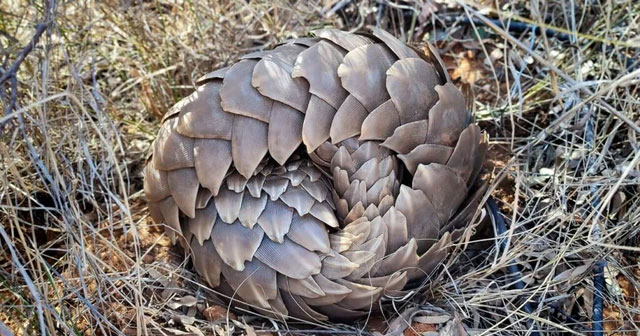
A pangolin curled up in a defensive posture. (Photo taken at Khamab Kalahari Reserve/Workingwithwildlife).
Few people may know that a single pangolin can eat enough termites to protect more than 40 acres of land from destruction, which is vital to ecosystem health. Ironically, the very armor that protects these small animals is what is driving them rapidly toward extinction. Pangolins have become the most trafficked wild mammals in the world, according to the U.S.-based conservation group WildAid.
There are eight species of pangolin in the world. All eight are on the Red List of the International Union for Conservation of Nature (IUCN), with statuses ranging from Critically Endangered (CR) to Endangered (EN) and Vulnerable (VU). All eight species are now protected under national and international law.
Despite this, poaching of pangolins for their meat and scales remains rampant. Whether in Asia or Africa, and whether Sunda pangolins, Chinese pangolins or giant ground pangolins, all are hunted and killed.
Worldwildlife reports that between 2011 and 2013, an estimated 116,990 to 233,980 pangolins were killed, and this figure is only the tip of the iceberg of the illegal trade. Experts believe that seizures represent only 10% of the pangolins actually smuggled by poachers worldwide.
So which pangolin species has been killed closest to the brink of extinction?
The Sunda pangolin: a treasure of Southeast Asia, including Vietnam
Of the world's eight pangolin species, the Sunda pangolin (scientific name: Manis javanica) was classified as Critically Endangered (CR) on the 2019 IUCN Red List because its population has fallen by 80% over the past 21 years.
[Two other pangolin species are also listed as CR on the IUCN Red List: the Philippine pangolin (scientific name: Manis culionensis) and the Chinese pangolin (scientific name: Manis pentadactyla). However, this article focuses only on the Sunda pangolin].
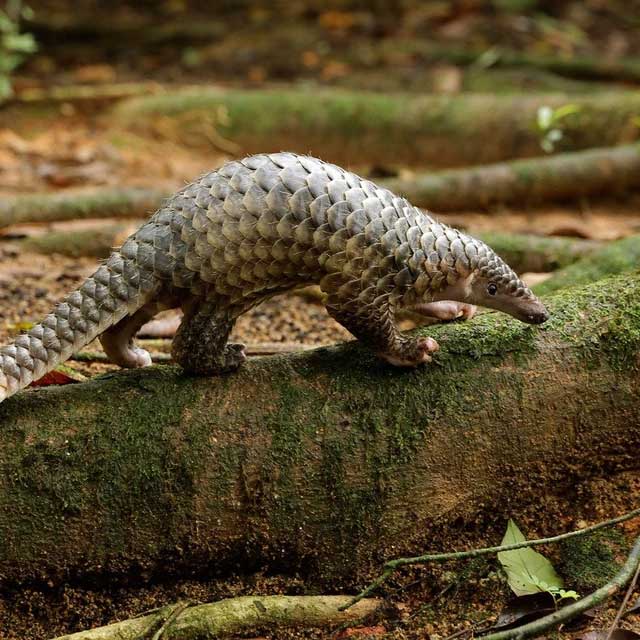
The Sunda pangolin lives only in Southeast Asia, including Vietnam.
The Sunda pangolin, also known as the Javan pangolin, is one of four species found in Asia (the other four live in Africa). The Sunda pangolin is found only in Southeast Asia, living mainly on the mainland and islands of nine Southeast Asian countries: Vietnam (central and southern regions), Myanmar (central), Thailand (southeast), Laos (lowlands), Cambodia, Malaysia, Singapore, Indonesia and Brunei.
An adult Sunda pangolin measures about 75 to 121 cm in total length from head to tail and weighs up to 10 kg. Males are larger than females.
According to the IUCN, the Sunda pangolin is listed as endangered in Vietnam. In three areas of Vietnam, namely Khe Nét Nature Reserve (former Quảng Bình province, now part of Quảng Trị), Kẻ Gỗ Nature Reserve (Hà Tĩnh province) and Sông Thanh Nature Reserve (former Quảng Nam province, now part of Đà Nẵng city), all in central Vietnam, Sunda pangolin populations have declined severely because of hunting pressure over the past few decades, especially since around 1990, when the trade in pangolins for their meat, blood, skin and scales began to escalate.
The species is found in primary and secondary forests, including lowland dipterocarp forests, and in cultivated areas, including oil palm and rubber plantations, as well as near human settlements.
Like most other pangolin species, the Sunda pangolin is mainly nocturnal and solitary (except when breeding), and it specializes in eating ants and termites. The species is thought to play a role in regulating insect populations. It also eats ant larvae, bee pupae, flies, worms, crickets and other insect larvae, as well as sand and grass.
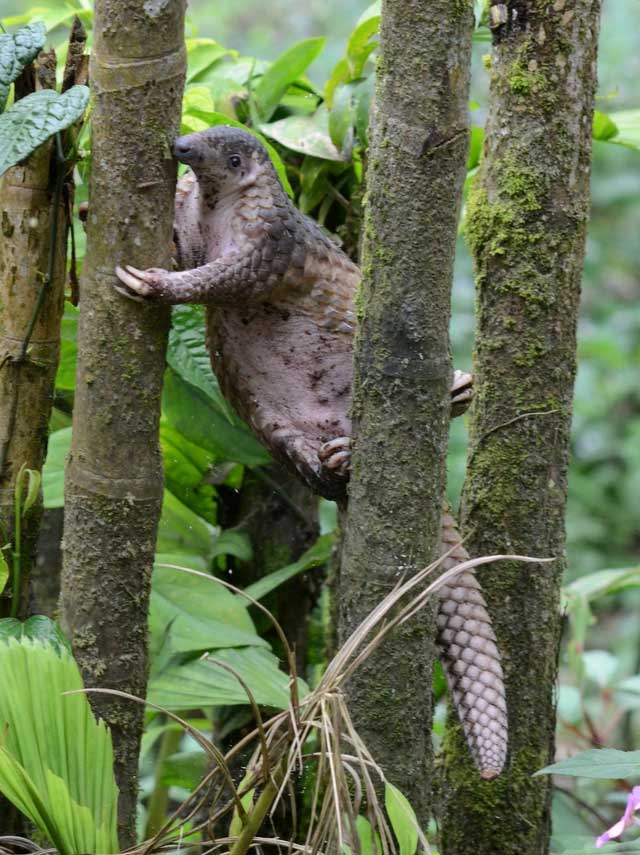
Sunda pangolins are skilled climbers and swimmers. (Photo: CC BY-SA 4.0).
The Sunda pangolin is known for being a fairly good climber and swimmer. It appears to be well adapted to wetland ecosystems, such as the U Minh wetlands in southern Vietnam.
With the aim of protecting the biodiversity of Southeast Asia in particular and the world in general, all countries where the Sunda pangolin lives protect it through government policy and law.
Beyond that, the Sunda pangolin, and pangolins in general, are protected internationally. In 2016, more than 180 governments party to an international treaty announced an agreement to end all legal trade in pangolins and protect them from extinction.
The World Wide Fund for Nature (WWF), together with TRAFFIC, the non-governmental organization that monitors the trade in wild animals and plants, continues to work to protect species from wildlife crime.
In Vietnam, the government issued Decree 06/2019/ND-CP in 2019 (effective March 10, 2019), which lists the Sunda pangolin in Group IB of the list of endangered, precious and rare forest animals. Hunting, trading or consuming pangolins and other protected species is illegal in Vietnam.
In addition to legal protection against poaching and smuggling, Sunda pangolins are also cared for by experts and then released back into the wild.
Good news: On November 5, 2024, the Ho Chi Minh City Forest Protection Sub-Department, together with Phước Bình National Park (in the former Ninh Thuận province, now part of Khánh Hòa province, south-central Vietnam), released 19 wild animals back into nature, including one rare Sunda pangolin. All of these tireless efforts aim to save the rare Sunda pangolin, a treasure of Vietnam, Southeast Asia and the world as a whole, from the brink of extinction! |
The harmless snake often mistaken for a deadly venomous one in Vietnam
A small, harmless snake found across Vietnam is often needlessly killed because it is mistaken for a deadly venomous species.
Up close with the ultra-rare legless amphibian found in a Vĩnh Long garden
While gardening, a woman in Vietnam's Vĩnh Long province found a caecilian-like amphibian listed in Vietnam's Red Data Book.
Rare and unusual animals caught on camera in Vietnam's Động Châu-Khe Nước Trong Nature Reserve
Camera traps have revealed many rare and endangered Red List animals, from Asian black bears to pangolins, in a nature reserve in central Vietnam.
Why is the bronze croaker so expensive?
One bronze croaker can earn a fisherman hundreds of millions of VND, so sailors call it a "swimming lump of gold" or "Vietnam's gift from heaven".
Vietnam's bizarre, super-tiny worm snake
Easily mistaken for earthworms, Vietnam's tiny worm snakes have scales, a forked tongue, and can reproduce without males.
55 bird species ranked from largest to smallest
From the towering ostrich to the tiny bee hummingbird, here are 55 of the world's bird species ranked by size.