Up close with the ultra-rare legless amphibian found in a Vĩnh Long garden
While working in her garden, Nguyễn Thị Ngọc of Vĩnh Long, a province in Vietnam's Mekong Delta, discovered a caecilian-like amphibian listed in Vietnam's Red Data Book. The animal is about 25 cm long and has no legs.
The caecilian-like amphibian she found moved very slowly and lived beneath a layer of rotting leaves in the garden.
Observations show that the amphibian has a purplish-black back, a paler belly and striking yellow stripes along both flanks.
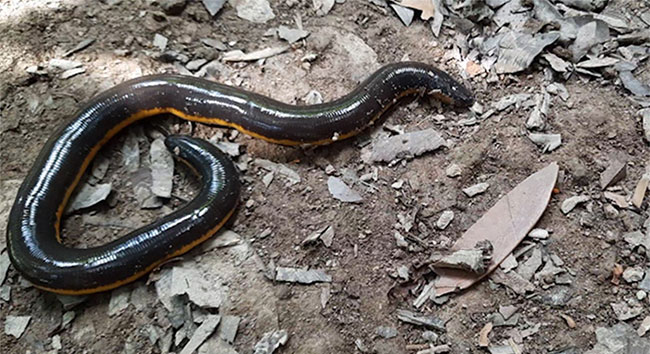
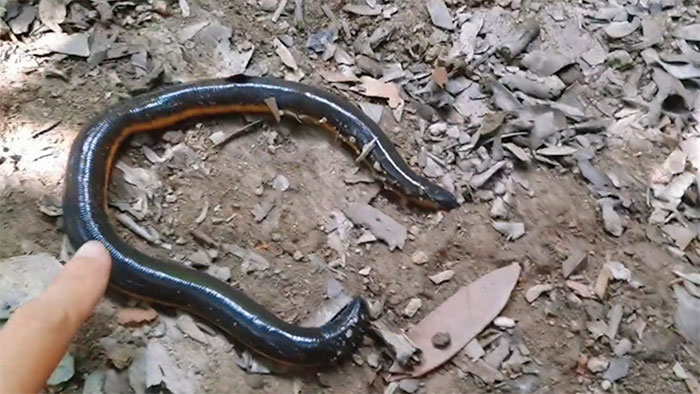
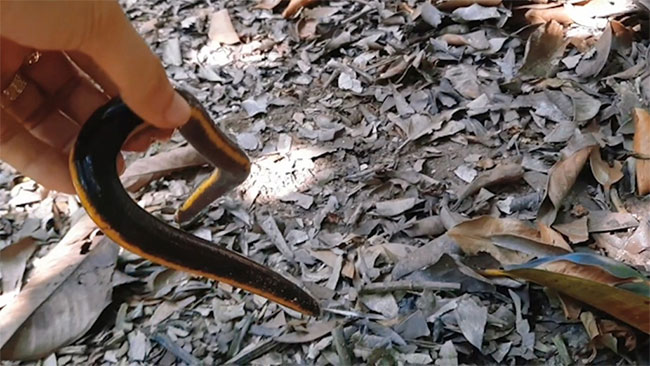
This caecilian moves very slowly and lives beneath a layer of rotting leaves in the garden.
After seeing photos of the creature, many people said it was very likely a rare caecilian found in Vietnam. Known scientifically as Ichthyophis bannanicus, it belongs to the caecilian family Ichthyophiidae and the legless order Gymnophiona. Caecilians look nothing like any other frog and have no legs.
The caecilian is listed in Vietnam's Red Data Book (2007) and on the IUCN Red List (2012).
This amphibian gets its Vietnamese name, "worm frog," because it looks exactly like a large earthworm. It has striking yellow stripes along both flanks and a body length of 10 to 30 cm.
With its reptile-like body, glossy yellowish-brown lengthwise stripes and wriggling flat head, the caecilian brings to mind brightly colored venomous snakes. In the larval stage, caecilians have gills on both sides of the neck. As adults, these gills disappear.
Caecilians typically live at elevations of around 900 to 1,000 m, burrowing in the soil. They dig into loose soil about 20 to 30 cm deep near ponds and lakes, or hide under large rocks beside streams.
Caecilians feed on earthworms and insects. After laying eggs near water in a highly humid spot, the female caecilian tends and guards the eggs and regulates their temperature so the young can hatch under the best conditions. Each clutch contains about 10 to 30 eggs. Egg-laying takes place between April and June each year.
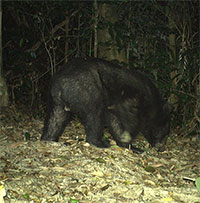
Rare and unusual animals caught on camera in Vietnam's Động Châu-Khe Nước Trong Nature Reserve
Camera traps have revealed many rare and endangered Red List animals, from Asian black bears to pangolins, in a nature reserve in central Vietnam.
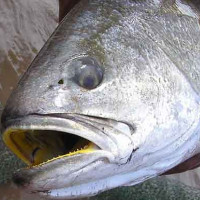
Why is the bronze croaker so expensive?
One bronze croaker can earn a fisherman hundreds of millions of VND, so sailors call it a "swimming lump of gold" or "Vietnam's gift from heaven".
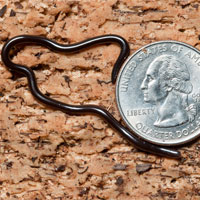
Vietnam's bizarre, super-tiny worm snake
Easily mistaken for earthworms, Vietnam's tiny worm snakes have scales, a forked tongue, and can reproduce without males.
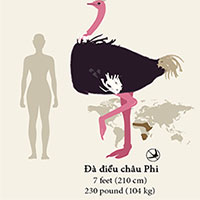
55 bird species ranked from largest to smallest
From the towering ostrich to the tiny bee hummingbird, here are 55 of the world's bird species ranked by size.
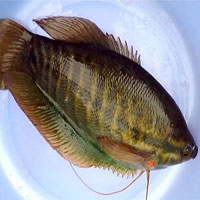
Common freshwater fish of Vietnam you should know
Freshwater fish live mainly in rivers and lakes with salinity below 0.05%. Here are the most common freshwater fish species in Vietnam.
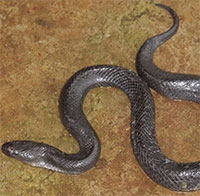
New snake species discovered in the former Đắk Nông province, Vietnam
Researchers have discovered a new mud snake species, Myrrophis dakkrongensis, in the former Đắk Nông province (now part of Lâm Đồng) in Vietnam.