Why is the bronze croaker so expensive?
Vietnam's waters are rich in both the quantity and variety of fish and seafood, and among them is an extremely rare fish that can fetch billions of VND: the bronze croaker, known locally as cá sủ vàng.
The bronze croaker (scientific name Otolithoides biauritus), also called cá sủ vây vàng, cá sủ vàng kép, cá thủ or cá đường in Vietnamese, is the largest member of the croaker and drum family (Sciaenidae). It is found in India, Indonesia, Sri Lanka, China and Vietnam.
In Vietnam, the bronze croaker is scattered along the coast from the north to the south. The fish also occurs off north-central provinces such as Thanh Hóa and Nghệ An, but it has become scarce there and is only seen occasionally. Even so, it has not been added to Vietnam's Red Data Book because it can still be caught.
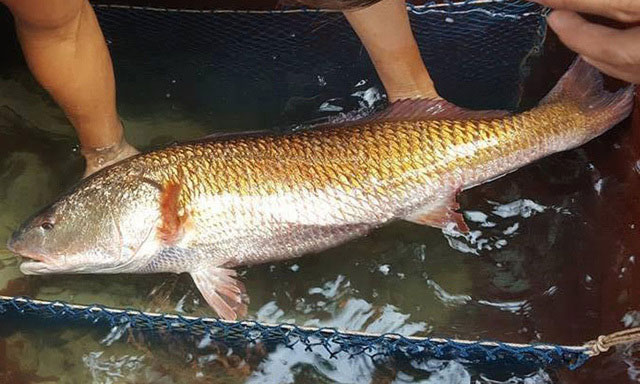
The bronze croaker is a rare fish of high economic value.
According to experts, the bronze croaker has a pointed snout, a wide mouth and a saffron-yellow color; its lower jaw extends to below the rear of the eye socket, and it has strong teeth and a long dorsal fin. The species lives in the sea, but during the spawning season (the 1st to 4th and 9th to 10th months of the lunar calendar) it swims into brackish estuaries to spawn.
The young fish move far inland into fresh water, where they live for 1 - 2 years before returning to the sea on their own. Adults can reach a maximum length of 160cm and weigh more than 120kg.
Depending on its environment, the fish's head and back may be gray or green. When a bronze croaker dies, its whole body gradually changes color from pale yellow to deep yellow.
The bronze croaker feeds mainly on invertebrates and small fish living near the bottom. It grows very poorly in artificial conditions, which makes keeping it as an ornamental fish or for conservation extremely difficult.
Explaining the value of the bronze croaker, Dr. Nguyễn Đức Cự of the Institute of Marine Environment and Resources (Vietnam Academy of Science and Technology), who once led a research project on the species, said that what makes the fish worth billions is not its flesh or scales but its swim bladder.
"The bronze croaker's swim bladder is a raw material for making medical sutures. These sutures dissolve on their own after being used to stitch up a patient," Cự said. A fish weighing 40 - 50kg yields a fresh swim bladder of about 1kg.
The mouth of the bronze croaker has a distinctive yellow color. (Photo: Đại Đoàn Kết newspaper).
In addition, dried swim bladder is also prized as a protein-rich food: 500g of dried swim bladder contains about 442g of protein. In traditional folk belief it is likened to ginseng and is traditionally used as a tonic, but these supposed health benefits have not been scientifically proven and it is not a proven treatment for any condition. Demand for the swim bladder in traditional Chinese cuisine and folk remedies has sent the value of this fish soaring.
In Vietnam, before 2005 the bronze croaker sold for 5 - 7 million VND/kg (300 - 400 USD/kg). In 2007 the price was around 15 – 20 million VND/kg, and today a fish that traders manage to find can sell for billions of VND, depending on its weight.
Moreover, according to long-standing Chinese tradition, dishes made from the bronze croaker have always been considered "a rare delicacy". They believe the fish brings good luck and prosperity in business. The bronze croaker used to cost about 15-20 million VND/kg and can now reach 30-40 million VND/kg.
Several distinctive dishes made from bronze croaker meat are among Hong Kong residents' top 10 favorite dishes and rank among the most expensive in the world. Chinese people also believe that eating the bronze croaker brings good fortune and success in business. In addition, the bronze croaker's scales are very hard, so they are used to make guitar picks for musicians and sold to Japan and Europe.
Professor Mai Đình Yên, a fish expert, added that the fish is mainly sold to advanced countries such as Japan, the United States and China, which have the technology to produce sutures from swim bladders. Because its scales are hard, they are also used to make picks for stringed instruments.
Vietnam's bizarre, super-tiny worm snake
Easily mistaken for earthworms, Vietnam's tiny worm snakes have scales, a forked tongue, and can reproduce without males.
55 bird species ranked from largest to smallest
From the towering ostrich to the tiny bee hummingbird, here are 55 of the world's bird species ranked by size.
Common freshwater fish of Vietnam you should know
Freshwater fish live mainly in rivers and lakes with salinity below 0.05%. Here are the most common freshwater fish species in Vietnam.
New snake species discovered in the former Đắk Nông province, Vietnam
Researchers have discovered a new mud snake species, Myrrophis dakkrongensis, in the former Đắk Nông province (now part of Lâm Đồng) in Vietnam.
Out hunting rat snakes, a man nearly grabbed a creature more dangerous than a king cobra
Hunting Indochinese rat snakes after rain, a snake catcher nearly grabbed the lookalike red-necked keelback, for which no specific antivenom is currently available in Vietnam.
The world's most venomous snakes
From Belcher's sea snake and the inland taipan to the black mamba and Russell's viper, meet some of the most venomous snakes on Earth.