Why is eucalyptus called the "gold-sucking tree"? The secret lies deep underground
According to the World Gold Council, more than 174,000 tonnes of gold have been mined from Earth since the dawn of civilization. In 2011, the U.S. Geological Survey estimated that 51,000 tonnes of gold still remain in reserves on our planet.
As one of the first metals humans discovered, gold has held a central place in human history. Today, it remains one of the forces shaping the global economy as well as the lives of individuals.
Gold mining draws growing attention as reserves of the precious metal steadily dwindle. However, in a study published nearly a decade ago, scientists found gold stored inside trees. The identity of those trees was even more surprising.
Gold found in leaves
Australian researchers discovered that tiny particles of gold from underground ore deposits are present in eucalyptus leaves. Most plants sink their roots deep into the ground to draw up the nutrients and minerals they need to survive. Many researchers therefore suspected that, along the way, the trees inadvertently "suck up" gold.
Eucalyptus trees can transport ultrafine gold particles from deep deposits thanks to their remarkably long roots. The roots of Eucalyptus marginata - a species in the genus Eucalyptus, in the myrtle family (Myrtaceae) - can reach as deep as 40 m into the ground in search of water in arid regions. In the process, the roots can pick up other things too, such as gold.
In 2019, the company Marmota found gold in South Australia using a method that relies on trees to detect minerals underground. Marmota discovered a 6 m-thick gold vein containing 3.4 grams of gold per tonne at a depth of about 44 m. It was a notable find because the deposit lies at least 450 m from other known gold deposits.
Testing the idea
To test whether eucalyptus trees really can "suck up" gold, the researchers examined the leaves, twigs and bark of eucalyptus trees up to 10 meters tall at two sites in Australia - one in the west and one in the south. Earlier exploratory drilling had shown that gold lay buried beneath these sites. The areas had not been disturbed by mining, which ruled out the possibility that gold dust had simply settled on the leaves.
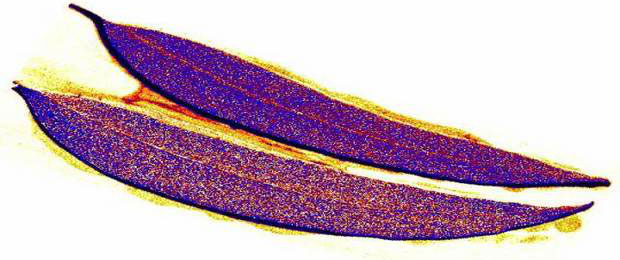
Scientists say tiny particles of gold from underground ore deposits are present in eucalyptus leaves.
They also grew eucalyptus trees in a greenhouse, in pots of soil laced with gold as well as in ordinary gold-free soil for comparison.
X-ray analysis revealed gold particles up to 8 microns wide in the trees' cells, or about 10 times thinner than the average human hair. The field samples and greenhouse experiments showed that these particles - present at concentrations that do not harm the trees - are absorbed by the roots and transported to other parts of the plant. The leaves held the highest concentrations of gold.
The average concentration of gold in the leaves was only about 46 parts per billion, equivalent to 0.000005% of each leaf's weight.
The study's lead author, Melvyn Lintern, a geochemist at Australia's Commonwealth Scientific and Industrial Research Organisation (CSIRO), said: "We were surprised to find that eucalyptus trees can bring up gold from a [depth] equivalent to a 10-story building."
The researchers are not proposing that these eucalyptus trees be harvested for gold, Lintern cautioned: "The amount of gold in the trees is extremely small. We estimate it would take 500 eucalyptus trees to contain enough gold to make a ring."
Even so, experts see considerable potential in the discovery. Rather than becoming a tool for extracting gold, eucalyptus trees could help prospectors pinpoint where gold deposits may lie deep underground, saving them time, money and resources otherwise spent searching for the precious metal across vast areas of land, Lintern said.
Little-known facts about eucalyptus
Beyond its role as a "gold-sucking tree," eucalyptus has many other unusual traits. Here are some intriguing facts about this familiar tree:
Eucalyptus flowers have no petals
From a distance, the flowers of most eucalyptus species look like clusters of dandelion heads about to go to seed. Up close, you will see that these flowers have no petals. The entire "flower" is actually a mass of hundreds of stamens sprouting from a cone-shaped bud in the center.
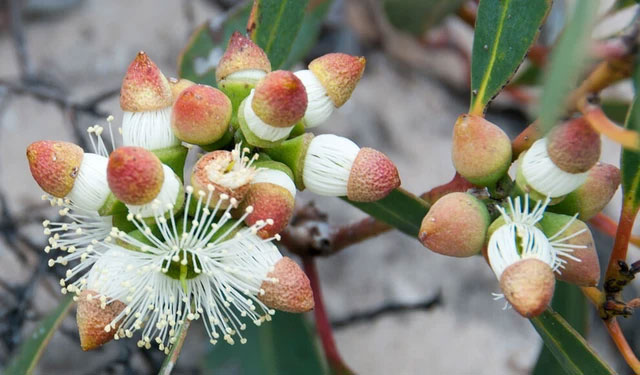
These flowers have no petals.
Eucalyptus trees need to make use of as much pollen as possible. They have few natural pollinators because of their high cineole content. Typically, the trees self-pollinate.
Cineole: The secret ingredient
Eucalyptus oil has been used in traditional medicine by Indigenous Australians as an antibacterial and antifungal agent for centuries. In traditional Indian medicine, it has commonly been used for respiratory ailments. In 19th-century England, eucalyptus oil was used to disinfect hospitals.
That is because the leaves and bark contain high levels of cineole. Cineole is a colorless liquid organic compound. It is sometimes called eucalyptol because it is so abundant in eucalyptus trees and shrubs. The characteristic scent of eucalyptus oil comes mainly from cineole.
Only koalas, ringtail possums and a few insects can eat eucalyptus leaves and bark. No other creature, humans included, can tolerate such high levels of cineole. That is why it makes an effective, natural insect repellent.
Laboratory and clinical studies have reported antibacterial, antiseptic and antifungal properties of cineole. Eucalyptus oil is traditionally used on minor wounds, in skin care and as a disinfectant, although it is not a proven treatment and should not replace medical care.
Eucalyptus trees and the fight against malaria
Because the leaves contain oils that are believed to repel insects, eucalyptus has been planted in areas with high rates of malaria.
Malaria is found on every continent. The malaria parasite lives in female mosquitoes that bite humans and is transmitted to people through those bites. In parts of the world with large populations of malaria-carrying mosquitoes, people have planted eucalyptus trees in the hope of helping to reduce the problem.
Eucalyptus trees may help manage wastewater problems
For years, scientists have studied the use of eucalyptus to mitigate wastewater problems. In some parts of the world, wastewater carrying heavy metals, bacteria and other toxins into groundwater is a concern for agriculture.
Environmental engineers and agroforestry specialists plant eucalyptus trees at contaminated sites. There is considerable evidence that eucalyptus trees absorb and filter many of the toxic elements present in water used for crops.
Although more research is needed to determine the right balance between these trees and farmland, experts say it is a promising and feasible solution.
The miracle fruit found in Vietnam that can turn any taste sweet
Vietnam is now home to a "miracle fruit" that can make every flavor in the world taste sweet after you eat it.
World's largest plant discovered, covering 200 square kilometers
A seagrass meadow in Western Australia is a single cloned plant that has spread from one seedling and survived environmental change for 4,500 years.
Vietnam's slipper orchid: The one-of-a-kind orchid found nowhere else on Earth that money can't buy
The Vietnamese slipper orchid, found only in Vietnam, is prized by collectors for its rare beauty and is now critically endangered.
Rare butterfly at risk of extinction in Vietnam
The Kaiser-i-Hind is a rare swallowtail butterfly found from Nepal and northern India to the high mountains of Vietnam.
The stunning flower found nowhere else on Earth but Vietnam is already threatened and needs protection
Vietnam is the only place in the world where this striking flower, Deinostigma serratum, is known to grow, and it is already rare.
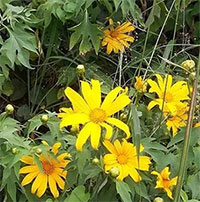
Fascinating facts about the flower painting Vietnam bright yellow
The Mexican sunflower (Tithonia diversifolia), or dã quỳ, is a wildflower famed for its brilliant yellow winter blooms. Here are some facts about it.