European mantis (Mantis religiosa)
| Latin name: Mantis religiosa Family: Mantidae (mantises) Order: Mantodea (mantises) Group: Insects |
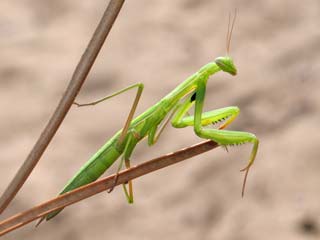
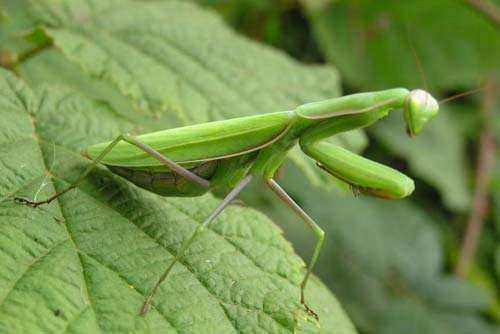
The European mantis is a large insect, 40–80 mm long, with two broad, well-developed forewings and two hindwings. The hindwings look like panes of glass, and the wings are pale green or pale brown. The prothorax (the first thoracic segment) is elongated and tube-like, and on the inner side of the coxae of the front legs there is a black spot, usually with a light-brown dot at its center.
The front legs are blade-shaped, with teeth along their inner edges, and are used to seize prey and fight off enemies. Females are generally larger than males (females 48–76 mm; males 40–61 mm). Body color varies with the surroundings (especially when the mantis is lying in wait for prey): it is usually green, the color of withered grass, or yellow to brown.
Biology:
 |
(Photo: curieux-de-nature) |
Females lay eggs shortly after mating. Each clutch contains about 100–300 eggs, neatly arranged inside an egg case. Eggs laid in summer or early autumn hatch after a short time (about a month). Eggs laid in late autumn usually overwinter and hatch in spring; the nymphs grow very quickly and reach adulthood after four molts.
Habitat and ecology:
Body color usually serves as protective camouflage matching the plants and surroundings where the insect lives; the species has the three basic color forms described above. It is more often found on large trees and shrubs than on herbaceous plants.
Distribution:
- Vietnam: found throughout the country; according to published records it has been found in Lạng Sơn province in northern Vietnam, Quảng Ninh province on the northeastern coast, Ninh Bình province in the Red River Delta, and Quảng Bình (now part of Quảng Trị province) in central Vietnam. It is the only species of the order Mantodea listed in the Vietnam Red Data Book (Sách Đỏ Việt Nam).
- Worldwide: the species is widespread in both temperate and tropical regions across Europe, Asia and Africa, and even in North America and Australia.
Uses:
This insect does more good than harm, because it kills many pest insects; in particular, it eats large numbers of plant-damaging aphids (Aphididae). It also adds to the beauty of nature. However, it sometimes also eats honeybees and other beneficial insects.
Status:
The population of this mantis is very small and it is rarely seen, owing to environmental factors, predators and cannibalism, and because in Vietnam children often catch them to play with. Many countries classify it as a rare insect.
(Photo: carnet)
Two new planthopper species discovered in central Vietnam offer a window on habitat change
Vietnamese scientists have described two new planthopper species of the genus Connelicita from Huế, central Vietnam.
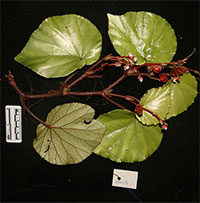
New begonia species discovered in Vietnam's Đakrông Nature Reserve
A new begonia, Begonia laxiflora, has been found in evergreen forest in the Đakrông Nature Reserve, Quảng Trị province, central Vietnam.
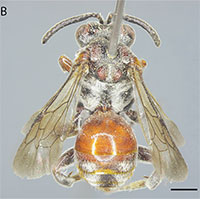
New cuckoo bee species discovered in Vietnam's Vũ Quang National Park
Scientists have described Pasites vuquang, a new cuckoo bee from Vũ Quang National Park and the first record of its tribe and genus in Vietnam.
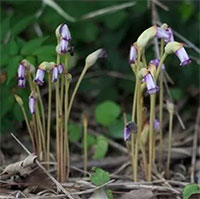
Rare tree species discovered in the forests of central Vietnam's Quảng Trị
Scientists found centuries-old podocarps, wild ancient tea trees and lệ dương plants in Quảng Trị forests above 1,000m in central Vietnam.
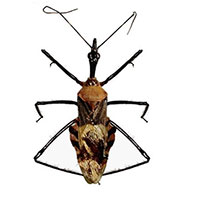
Two new assassin bug species discovered in Vietnam
Vietnamese scientists have described two assassin bug species new to science, Sycanus thuathienhuensis and S. taynguyenensis, using DNA and morphology.

Vietnam develops japonica rice with oil-rich bran
Vietnamese scientists have bred a new japonica rice line whose bran contains over 20% oil, suitable for producing cooking oil.