Vietnam develops japonica rice with oil-rich bran
Prof. Phạm Văn Cường and colleagues have developed a new rice line whose bran contains more than 20% oil, making it suitable for producing cooking oil.
Rice bran oil is easy to produce and inexpensive, and it is growing in popularity because it is rich in essential fatty acids and antioxidant compounds, especially gamma-oryzanol. Vietnam produces large quantities of rice and bran, yet rice bran oil remains uncommon in the country. Japan, by contrast, has successfully bred rice varieties for high-quality rice bran oil and is one of the world's leading producers and consumers of it.
To develop promising new rice lines for rice bran oil in Vietnam, in 2019 Vietnam's Ministry of Science and Technology launched a bilateral and multilateral program to exchange genetic resources and breed japonica rice varieties for rice bran oil processing. The project was led by the Vietnam National University of Agriculture (Học viện Nông nghiệp Việt Nam) in Hanoi, in cooperation with scientists from the Faculty of Agriculture at Kyushu University in Japan.
Prof. Phạm Văn Cường of the university's Vietnam-Japan Crop Research Center, the project's principal investigator, said the team's analysis showed that the oil content of the new japonica line's bran was about 7% higher than that of conventional Vietnamese rice varieties (Khang Dân 18). Its bran ratio is also about 6% higher, so its oil yield will be much greater than that of conventional varieties. Its gamma-oryzanol content is also about 50% higher, which means the oil is of good quality. The japonica rice is also cold-tolerant, tolerates heavy fertilization, resists lodging and is less susceptible to certain pests and diseases.
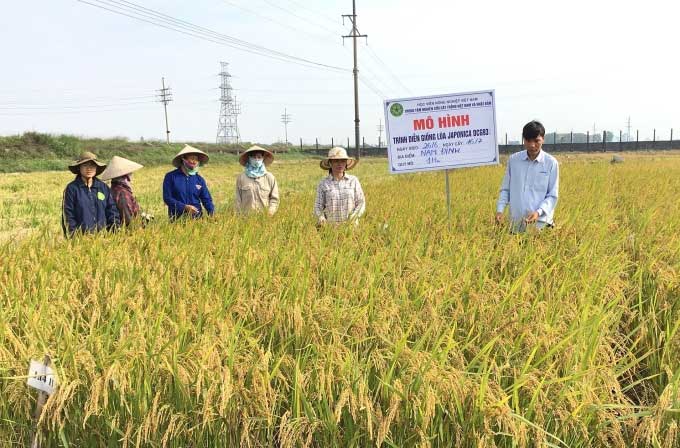
A trial plot of the DCG93 rice variety in Nam Định (now part of Ninh Bình province). (Photo: courtesy of the interviewee)
Using molecular and genetic selection methods, the team produced a japonica line carrying elite genes suited to conditions in Vietnam. The first seeds were multiplied over three crops a year: the spring and summer-autumn (main) seasons in Hanoi, and a winter-spring crop in Sóc Trăng in the Mekong Delta (now part of Cần Thơ city). "The new japonica variety DCG93 is suited to oil production and gives high yields in areas with strong sunlight, such as the northern mountainous provinces, in the spring season", Cường said, describing the results after more than a year of work on the project.
Grown in trial plots, the DCG93 rice variety has a growing period of 135-140 days in the spring season and 120-125 days in the main season in the northern provinces. The plants have sturdy stems, resist lodging well and are rarely affected by pests and diseases, with average yields of 6.9 tonnes/ha in the spring season and 5.7 tonnes/ha in the main season. DCG93 rice has high ratios (15.2-15.6% bran), (23.3-24.1% oil content in the bran) and (2.21-2.23% gamma-oryzanol content). By comparison, J02, a japonica variety widely grown in northern Vietnam, has a bran ratio of 9.5-9.8%, an oil content of only 18.1-18.4% and a gamma-oryzanol content of 1.37-1.41%.
According to Cường, the project's success lies in its use of plant material and selection methods from Japan. Building on these, the team developed a japonica cultivation process suited to the ecological conditions of growing regions in Vietnam. The team also developed a technology for extracting crude rice bran oil, with encouraging initial results at laboratory scale and good-quality oil.
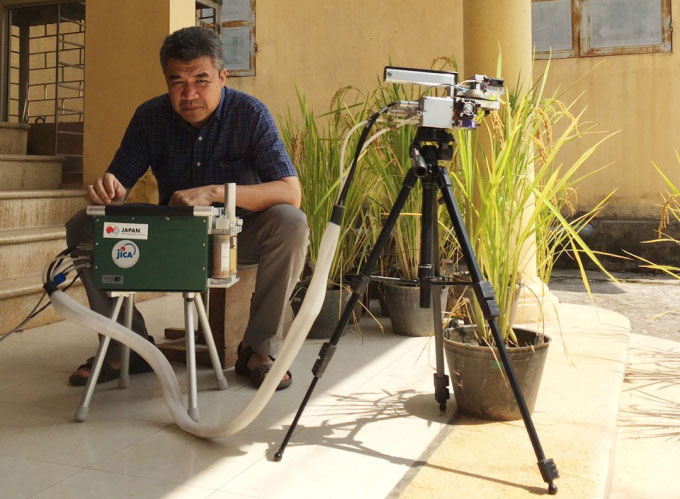
Prof. Phạm Văn Cường uses a photosynthesis meter in his rice breeding research. (Photo: courtesy of the interviewee)
For large-scale rice bran oil production, Cường said, it must be tied to dedicated raw-material growing areas, and bran from milling conventional rice varieties could also be used. Besides expanding production of oil-oriented japonica rice, research is needed on processing and using the japonica rice left after milling to remove the bran, in order to improve the economic efficiency of rice farming.
Cường added that the team will continue to develop the japonica line DCG93 and other promising lines, while improving the processes for extracting and refining rice bran oil. "We hope to continue receiving support from the Ministry of Science and Technology, local authorities and businesses so that DCG93 can be officially recognized and its production expanded on a large scale, increasing economic value for farmers," Cường said.
Three rare plant species being conserved and expanded in Vietnam's Pù Luông Nature Reserve
Surveys in Pù Luông Nature Reserve found 130 Garcinia fagraeoides, 25 Cephalotaxus mannii and 120 Camellia pleurocarpa, prompting a conservation plan.
New critically endangered plant genus and species discovered in Vietnam's Quảng Trị limestone mountains
Scientists have described a new endemic plant genus and two critically endangered species from limestone mountains in Quảng Trị, central Vietnam.
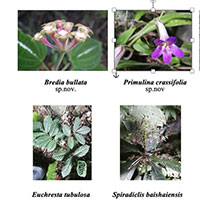
Three new plant species and six new records found in caves of northern Vietnam
Scientists have compiled the first checklist of cave plants in northern Vietnam: 337 species from 142 genera and 63 families.
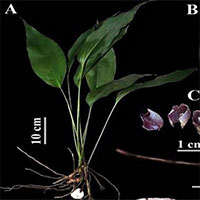
New rock aspidistra species discovered in Phong Điền Nature Reserve, Huế
Aspidistra phongdiensis, a new plant species in the asparagus family, has been found only in the Phong Điền Nature Reserve in central Vietnam.

Strange new bee species with a dog-like face discovered in Australia
A new native bee with a snout-like face, Leioproctus zephyr, has been discovered in bushland around Perth, Western Australia.
Stunning discovery reveals the evolutionary path that turned plants into carnivores
Scientists are uncovering how ordinary plants evolved into carnivores, by repurposing ancient genes and enzymes rather than stealing them.