Strange new bee species with a dog-like face discovered in Australia
A new native bee with a dog-like face has been discovered in bushland in Perth, Western Australia.
The bee was identified through research led by Curtin University, shedding new light on some of our most important pollinators.
Dr. Kit Prendergast of the Curtin School of Molecular and Life Sciences named the new species after her dog, Zephyr, after noticing that a prominent part of the insect's face resembles a dog's snout. Prendergast is the author of the paper describing the discovery, published on 31 October in the Journal of Hymenoptera Research.
“When I first examined the specimens collected during my PhD surveys of native bee biodiversity in urbanized areas of the Southwest Western Australia biodiversity hotspot, I was immediately struck by this bee's very unusual face,” Prendergast said.

Specimen of the new bee species Leioproctus zephyr (Photo: Curtin University)
“When I went to identify it, I found it did not match any described species. I was sure that if it were a known species it would be fairly easy to identify, since this bee looks quite unusual. You can only confirm a particular species after looking at it under a microscope and going through the long process of comparing its features with those of other identified species, and then checking museum collections.
When I looked through the Western Australian Museum's entomology collection, I found that some specimens of Leioproctus zephyr had first been collected back in 1979, but it had never been scientifically described,” Prendergast added.
Prendergast said she was delighted to play a part in bringing the species to light and giving it an official name.
Prendergast said: “Insects in general are incredibly diverse and important, yet we lack scientific descriptions or names for so many of them. Leioproctus zephyr has a very restricted distribution, found at only seven sites across southwest Western Australia so far. It was completely absent from residential gardens and was present in only five of the urban bushland remnants I surveyed, where it foraged on plants of the genus Jacksonia.”
“Not only is this species a picky forager, it also has a clypeus that looks like a snout. So I named it after my dog, Zephyr. She has been vital to my mental health and well-being throughout the challenging time of doing my PhD and beyond.”
Using DNA barcoding, Prendergast also confirmed that the new species is most closely related to other, as-yet unidentified Leioproctus species.
Stunning discovery reveals the evolutionary path that turned plants into carnivores
Scientists are uncovering how ordinary plants evolved into carnivores, by repurposing ancient genes and enzymes rather than stealing them.
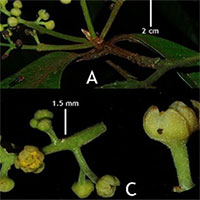
New, critically endangered plant species of value discovered in Vietnam's Vũ Quang National Park
A new plant species, Beilschmiedia danhkyii of the laurel family, has been described from Vũ Quang National Park and assessed as critically endangered.
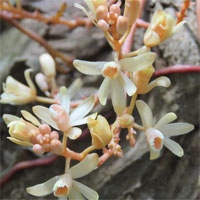
Rare leafless orchid discovered in Vietnam's Quảng Trị province
A rare leafless orchid, Erythrorchis ochobiensis, has been found in the Rú Lịnh forest of Quảng Trị province in central Vietnam.

Tissue culture technology helps conserve Hanoi's West Lake lotus
Vietnamese scientists have developed a tissue culture protocol to propagate the prized Bách Diệp lotus of Hanoi's West Lake and preserve its genes.
Three new plant species with stunning flowers discovered in Vietnam
The three new species, small herbs with beautiful flowers and leaves, have high ornamental value and were described in the journal Phytotaxa.
Rare 'praying-hands' tree Chunia bucklandioides found to be native to Vietnam
A tree once known only from China's Hainan Island has been found in Vietnam, adding a native timber species to the country's flora.