Seaweed: The strange but remarkably useful "treasure" that could help secure humanity's future
Found in almost every sea on the planet, seaweed is not only familiar to many coastal communities but could also play an enormous role in the fight against climate change.
A treasure slowly revealed
Like many coastal communities around the world, people who make their living from the sea in the United Kingdom have harvested and eaten seaweed for decades. In Wales, a local specialty, laverbread, is made from a seaweed called laver. The dish is so revered that it has protected designation of origin status.
The uses of seaweed go well beyond the dinner table. Today it turns up in everything from cosmetics and animal feed to gardening products and packaging.
As concerns about the environment, food security and climate change mount, seaweed — a succulent treasure that comes in every color and shape and, crucially, is entirely edible — is set to play an important role in a sustainable future for the planet. The U.K. has recognized its importance and wants to act.
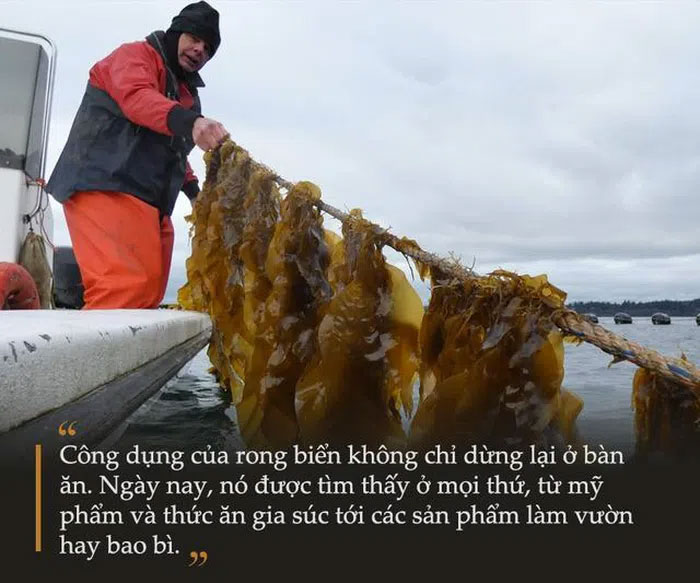
In April, a project billed as "the U.K.'s first dedicated seaweed industry facility" was officially launched. Experts hope it will kick-start the commercialization of a sector that is widespread around the world but has long been underinvested.
The Seaweed Academy received nearly $500,000 in funding from the U.K. government to begin research aimed at stimulating "the growth of seaweed aquaculture in the U.K." Initially, the project will focus on "high-value markets" and use its research to boost the global competitiveness of British seaweed products.
Contrary to what many might imagine, however, the seaweed industry will look "very different" from other forms of industrialized agriculture. There will be no giant machines diving into the sea to harvest the seaweed or assist with cultivation. From the outside, all you see are buoys floating on the surface, with long ropes beneath them carrying huge clumps of seaweed. Harvesting will also be very much "by hand."
Even so, a host of other challenges, from obtaining licenses to set up farms to natural disasters and storms, threaten seaweed farming. It will take several years of research to find the optimal model for scaling seaweed production up to an industrial level.
Searching for the perfect model for the... seaweed industry
The U.K.'s interest in farming and harvesting seaweed has not yet affected traditional practices. In picturesque Cornwall, at the southwestern tip of England, the Cornish Seaweed Company continues the work it has been doing since 2012, while offering a glimpse of how the industry might develop in the years ahead.
Tim van Berkel, the company's co-founder and CEO, said they harvest wild seaweed from the shoreline for food. In 2017, the business also began growing seaweed from spores at a mussel farm off Porthallow, a fishing village in Cornwall.
"They grow along ropes suspended in the water. Growing seaweed this way is similar to farming mussels. The business currently grows two types of seaweed at this site. In addition, we harvest six types of wild seaweed year-round from waters around the country," van Berkel said.

Many other businesses are also looking to make their mark in this field along the U.K.'s coastlines. They are also focusing on cultivating seaweed species native to those waters in order to boost yields.
In 2020, a report from the Food and Agriculture Organization of the United Nations described seaweed farming as "dominated by countries in East and Southeast Asia." It is big business, generating $14.7 billion in 2019 from the value of seaweed alone.
Huge seaweed farms in China and Indonesia show how large the industry has grown. But it is not just Asia: in the U.S., large farms have also sprung up in many regions, from New England to Alaska and the Pacific Northwest.
Economic value is not everything, however. Scientists at the National Oceanic and Atmospheric Administration (NOAA) stress that "seaweed absorbs CO2 and uses it to grow. It also absorbs nitrogen and phosphorus."
Worldwide, the industry has grown rapidly over the past two decades. Global seaweed production rose from 10.6 million tonnes in 2000 to 32.4 million tonnes in 2018. There are problems, though, such as farmed seaweed growing too vigorously and invading the surrounding environment, or seaweed farms having other environmental impacts.
Even so, weighed against the benefits it brings, countries are still investing heavily in its development and are working out how to plan for maximum efficiency in order to build a sustainable industry.
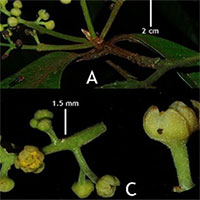
New, critically endangered plant species of value discovered in Vietnam's Vũ Quang National Park
A new plant species, Beilschmiedia danhkyii of the laurel family, has been described from Vũ Quang National Park and assessed as critically endangered.
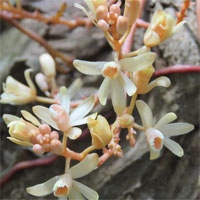
Rare leafless orchid discovered in Vietnam's Quảng Trị province
A rare leafless orchid, Erythrorchis ochobiensis, has been found in the Rú Lịnh forest of Quảng Trị province in central Vietnam.
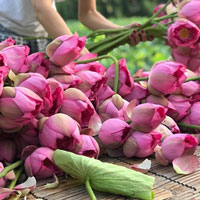
Tissue culture technology helps conserve Hanoi's West Lake lotus
Vietnamese scientists have developed a tissue culture protocol to propagate the prized Bách Diệp lotus of Hanoi's West Lake and preserve its genes.
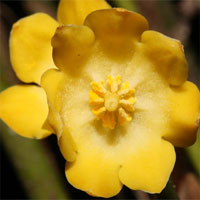
Three new plant species with stunning flowers discovered in Vietnam
The three new species, small herbs with beautiful flowers and leaves, have high ornamental value and were described in the journal Phytotaxa.
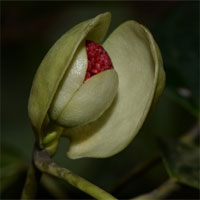
Rare 'praying-hands' tree Chunia bucklandioides found to be native to Vietnam
A tree once known only from China's Hainan Island has been found in Vietnam, adding a native timber species to the country's flora.
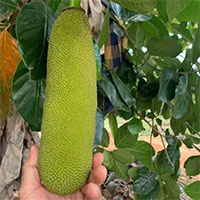
Rare "exotic" jackfruit with meter-long fruit that looks like a mutation
This Malaysian jackfruit variety, with fruit over 1m long and weighing up to 40kg, is still unfamiliar to many Vietnamese people.