The creepy secret inside one of Vietnam's strangest and rarest plants
Its outside looks bizarre enough, but what lies inside is truly creepy...
The ant plant, also known in Vietnamese as "bí kỳ nam" or "kỳ nam kiến" (scientific name Hydnophytum formicarum), is an unusual plant found in the forests of the Central Highlands (Tây Nguyên) of Vietnam. This epiphyte lives attached to large trees and has a swollen, tuber-like stem with a rough, knobbly surface; at first glance it looks like a deformed tumor growing on the trunk of its host tree.
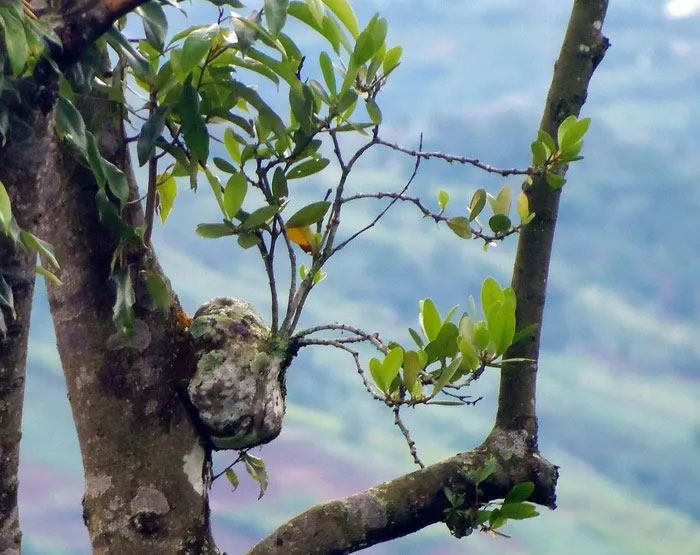
At first glance, it looks like a deformed tumor growing on the trunk of its host tree.
As strange as the plant looks from the outside, its interior is truly the stuff of nightmares. Slice the "tumor" open lengthwise, and anyone squeamish about insects would likely recoil at the sight of tens of thousands of ants and ant larvae swarming through a dense maze of winding tunnels. Look closely at the surface of the "tumor" and you can spot small openings — the entrances to the ants' nest.
The ant plant is, quite literally, an ant nest. It is a rare form of symbiosis between a plant and insects that helps both survive in the wild.
In this relationship, the plant provides the ants with a sheltering "fortress" and water, while the ants carry in organic debris and deposit their waste to nourish the plant, as well as defend it against unwanted intruders.
Even as a seedling, the ant plant already has a swollen stem. At this stage, however, it has not yet "teamed up" with the ants and relies solely on nutrients from its host tree. As it grows and those nutrients become increasingly scarce, cavities gradually form inside the stem, and the plant releases substances that lure ants to move in. That is when the symbiosis between ants and plant begins.
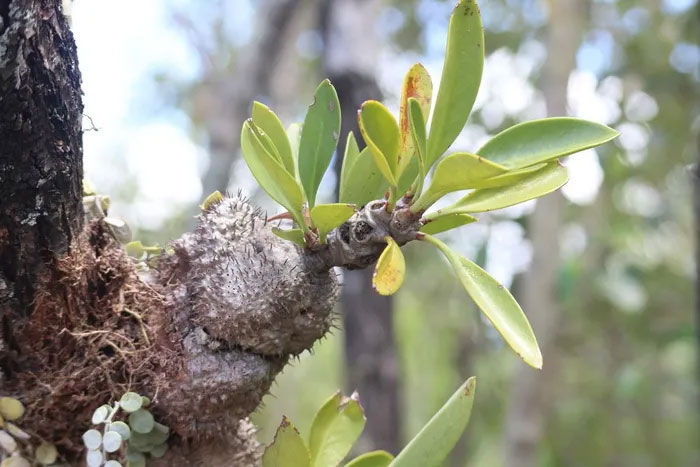
Ethnic communities in the Central Highlands have long used the ant plant as a medicinal herb.
The special partnership between the ant plant and its ants is the result of a long evolutionary process and a testament to the wonders of nature.
For hundreds of years, ethnic communities in the Central Highlands have used the ant plant as a remedy for a variety of ailments. Internationally, it is also prized by ornamental plant collectors for its bizarre appearance.
In Vietnam, wild populations of the ant plant are steadily declining due to deforestation and overharvesting, compounded by the species' slow growth rate. It has been listed as endangered in the Vietnam Red Data Book (Sách Đỏ Việt Nam).