World's largest plant discovered, covering 200 square kilometers
A seagrass meadow in Western Australia is actually a single cloned plant that has spread from one seedling and persisted through environmental changes for 4,500 years.
Researchers at the University of Western Australia and Flinders University have found that a meadow of Poseidon's ribbon weed (Posidonia australis) off Western Australia covers an area of 200km2. The entire meadow grew from just one seedling, spreading by cloning itself. That likely makes it the largest plant in the world. The study was published on 1 June in the journal Proceedings of the Royal Society B.
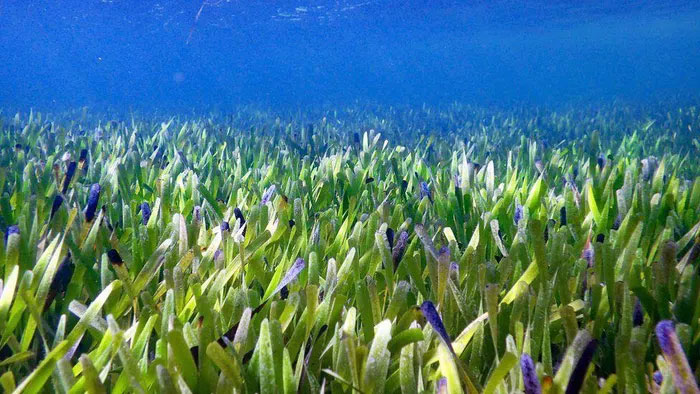
Part of the seagrass meadow that is now the largest plant in the world. (Photo: University of Western Australia)
The team originally set out to study the genetic diversity of seagrass meadows in Shark Bay. They sampled shoots from across the area, spanning a range of different environments, and then examined 18,000 genetic markers to build a genetic profile of the plants.
"The answer blew us away — there was only one! That's it, just one plant has expanded over 180km in Shark Bay, making it the largest known plant on Earth. The existing 200km2 of ribbon weed meadows appear to have expanded from a single, colonizing seedling," said Jane Edgeloe, the study's lead author.
Poseidon's ribbon weed convincingly sets a new record, at least in terms of area. The previous record for the world's largest plant belonged to Pando, a quaking aspen in Utah, USA. That tree has cloned itself into a colony of stems connected by a single root system. Pando spreads over an area of 0.4km2, meaning the seagrass meadow is more than 400 times larger. However, Pando may still be bigger in terms of biomass.
The team estimates that the Poseidon's ribbon weed in Australia is at least 4,500 years old. They also worked out how it has managed to cope with environmental changes despite its lack of genetic diversity. It is a polyploid plant, meaning it carries two full sets of genes from its parent plants instead of inheriting just half from each.
"Polyploid plants often reside in places with extreme environmental conditions, are often sterile, but can continue to grow if left undisturbed, and this giant seagrass has done just that. Even without successful flowering and seed production, it appears to be really resilient, experiencing a wide range of temperatures and salinities plus extreme high light conditions, which together would typically be highly stressful for most plants," explained Dr. Elizabeth Sinclair, the study's senior author.
The researchers plan to continue studying Poseidon's ribbon weed in more depth to uncover more secrets about how it grows.
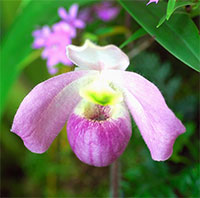
Vietnam's slipper orchid: The one-of-a-kind orchid found nowhere else on Earth that money can't buy
The Vietnamese slipper orchid, found only in Vietnam, is prized by collectors for its rare beauty and is now critically endangered.
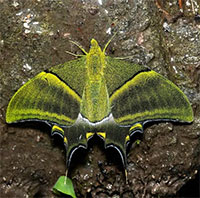
Rare butterfly at risk of extinction in Vietnam
The Kaiser-i-Hind is a rare swallowtail butterfly found from Nepal and northern India to the high mountains of Vietnam.
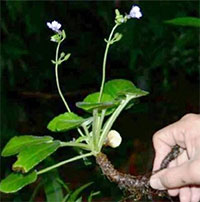
The stunning flower found nowhere else on Earth but Vietnam is already threatened and needs protection
Vietnam is the only place in the world where this striking flower, Deinostigma serratum, is known to grow, and it is already rare.
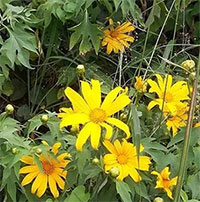
Fascinating facts about the flower painting Vietnam bright yellow
The Mexican sunflower (Tithonia diversifolia), or dã quỳ, is a wildflower famed for its brilliant yellow winter blooms. Here are some facts about it.
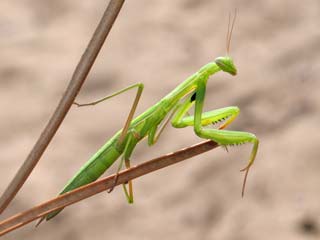
European mantis (Mantis religiosa)
A large insect 40–80 mm long, the European mantis uses blade-like front legs to catch prey, and females may eat males during mating.
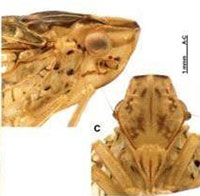
Two new planthopper species discovered in central Vietnam offer a window on habitat change
Vietnamese scientists have described two new planthopper species of the genus Connelicita from Huế, central Vietnam.