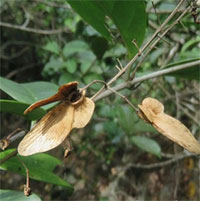
Two new planthopper species discovered in central Vietnam offer a window on habitat change
Scientists at the Institute of Scientific Research for Central Vietnam (Viện Nghiên cứu Khoa học miền Trung) — part of the Vietnam National Museum of Nature (Bảo tàng Thiên nhiên Việt Nam) under the Vietnam Academy of Science and Technology (Viện Hàn lâm Khoa học và Công nghệ Việt Nam) — have discovered and described two new insect species. They are 2 planthopper species of the genus Connelicita, in the family Tropiduchidae (tropiduchid planthoppers), order Hemiptera (true bugs).
The discovery adds to the biodiversity of Vietnam's ecosystems and provides important information for conservation research and for monitoring environmental change.
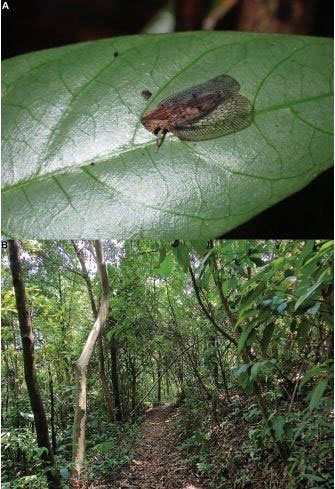
Connelicita bachmaensis was discovered in Bạch Mã National Park in central Vietnam (in the former Thừa Thiên - Huế province, now Huế city). (Photo: VNA).
The specimens of the 2 species were collected at two sites: Bạch Mã National Park (former Thừa Thiên - Huế province, now Huế city), and the Vietnam Center for Natural Resource Conservation and Wildlife Rescue (Vietnam National Museum of Nature) in the former Phong Điền district, now part of Huế city. The two species have been named Connelicita bachmaensis and Connelicita phongdienensis.
According to Associate Professor Phạm Hồng Thái, PhD, director of the institute, the addition of two new Connelicita species to Vietnam's fauna brings the number of species of this genus known in the country to 4 and extends its known range southward. However, a gap of more than 500 km still separates these areas, and there are no new records of Connelicita in the northern half of central Vietnam, which opens up the possibility of more new species being found there in the future.
Thái added that discovering and describing the two new species improves understanding of the tropical fauna of Southeast Asia and makes an important contribution to ecological conservation research. Detailed information on their morphology and habitat will also help scientists develop effective conservation strategies, especially as their habitat is threatened by exploitation and climate change. The diversity of the family Tropiduchidae (tropiduchid planthoppers) in Vietnam could also provide useful information for tracking changes in natural habitats.
Describing the two species in more detail, Thái said Connelicita bachmaensis is medium-sized, with a body length of about 12.56 mm in males and 13.60 mm in females. Its head is narrower than its thorax, and the vertex is longer than the eyes, giving the insect a distinctive elongated shape. The vertex is brown with a pale yellow median line, and its lateral margins are gently curved. The eyes are globular, bulge slightly to the sides and are covered with brown spots, giving the insect a sharp, striking look. The forewings are transparent with a brown spot in the middle, which helps the species camouflage itself on leaves. The hindwings are semi-transparent, with dark veins and slightly rounded tips, well suited to flying through dense forest.
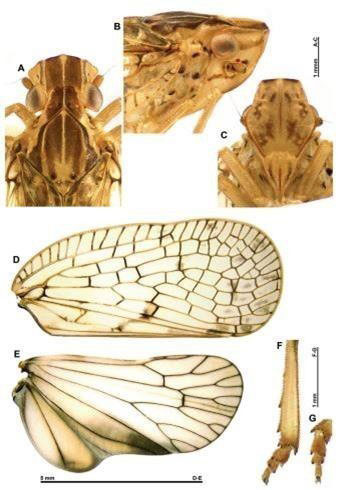
Connelicita phongdienensis was discovered at the Vietnam Center for Natural Resource Conservation and Wildlife Rescue (Vietnam National Museum of Nature) in the former Phong Điền district, now part of Huế city. (Photo: VNA).
Connelicita phongdienensis has distinctive morphological features compared with other species in the genus and can be distinguished by the characteristic structure of the male genitalia. Its head and body are light brown with small black spots, with darker coloration in certain prominent areas such as the vertex and the spots beside the eyes. The forewings have a complex venation pattern, with veins running in parallel and branching at defined points, creating a pattern that is easy to see under light.
“Although the new species can easily be told apart by their genitalia, their external appearance is very similar. Therefore, identification should not rely on photographs alone, and we recommend avoiding species-level identification of these insects unless good-quality photos of the specimen's genitalia are available,” Thái said.
New begonia species discovered in Vietnam's Đakrông Nature Reserve
A new begonia, Begonia laxiflora, has been found in evergreen forest in the Đakrông Nature Reserve, Quảng Trị province, central Vietnam.
New cuckoo bee species discovered in Vietnam's Vũ Quang National Park
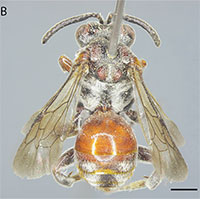
Scientists have described Pasites vuquang, a new cuckoo bee from Vũ Quang National Park and the first record of its tribe and genus in Vietnam.
Rare tree species discovered in the forests of central Vietnam's Quảng Trị
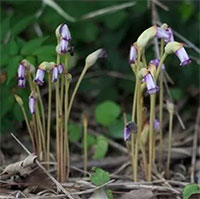
Scientists found centuries-old podocarps, wild ancient tea trees and lệ dương plants in Quảng Trị forests above 1,000m in central Vietnam.
Two new assassin bug species discovered in Vietnam
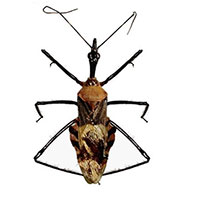
Vietnamese scientists have described two assassin bug species new to science, Sycanus thuathienhuensis and S. taynguyenensis, using DNA and morphology.
Vietnam develops japonica rice with oil-rich bran
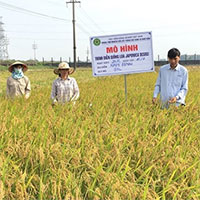
Vietnamese scientists have bred a new japonica rice line whose bran contains over 20% oil, suitable for producing cooking oil.
Three rare plant species being conserved and expanded in Vietnam's Pù Luông Nature Reserve
Surveys in Pù Luông Nature Reserve found 130 Garcinia fagraeoides, 25 Cephalotaxus mannii and 120 Camellia pleurocarpa, prompting a conservation plan.