Where does the Mid-Autumn Festival come from?
The Mid-Autumn Festival, known in Vietnam as Tết Trung thu, goes by several other names, including the Children's Festival, the Moon-Watching Festival and the Lantern Festival. It is held on the 15th day of the eighth lunar month. Because it is the biggest holiday of the year for children, kids grow increasingly excited as the day approaches, looking forward to going out and buying the festival's signature items for the moon feast, such as star lanterns, masks and spinning shadow lanterns (đèn kéo quân).
People in ancient times believed that human life was linked to the moon: the full moon and the waning moon mirrored joy and sorrow, reunion and separation. That is why the full moon became a symbol of togetherness, and the Mid-Autumn Festival is also called the Reunion Festival, the Children's Festival and the Moon-Watching Festival.
- Children's Festival: On this occasion, adults give children toys, cakes and sweets. Children parade with lanterns, share the Mid-Autumn feast, sing songs and enjoy festive activities such as unicorn and dragon dances and all kinds of games. With so many activities for children, and with the figures of Chú Cuội (the boy in the moon) and Chị Hằng (the moon lady) at its heart, the festival is truly dedicated to the young. Hence its name, the Children's Festival.
- Moon-Watching Festival: On this day, families traditionally prepare a Mid-Autumn feast tray, which is never complete without mooncakes. Families gather together to admire the moon, share the feast and talk, which is why the festival is also called the Moon-Watching Festival.
Origins of the Mid-Autumn Festival
No mention of the Mid-Autumn Festival would be complete without its signature baked mooncakes (bánh nướng) and soft sticky-rice mooncakes (bánh dẻo). Traditionally, the cakes are filled with mixed nuts and cured meats, or with mung bean and salted egg yolk. Over time, however, bakers have created new flavors such as matcha green tea, red bean and black sesame.
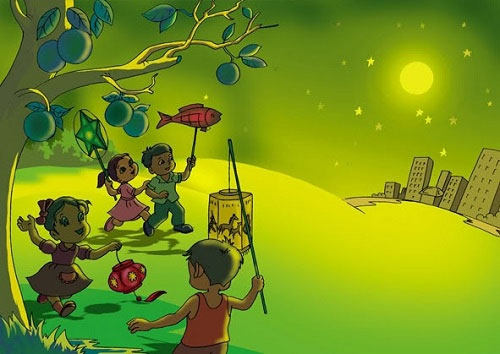
When the moon rises high, children sing and dance while admiring the moon and sharing the feast.
On this festival day, people lay out feasts and watch the moon. When the moon rises high, children sing and dance while admiring the moon and sharing the feast. The feast tray holds puffed rice, sweets and cakes. Many places hold unicorn, lion and dragon dances for children to enjoy. In China and in Chinatowns around the world, fireworks are also set off on this day.
The history of the Mid-Autumn Festival has not been clearly established; it is unclear whether it originated in Vietnam's wet-rice civilization or was adopted from Chinese culture. There are, however, three best-known legends associated with the festival: Chang'e and Hou Yi (Hằng Nga and Hậu Nghệ in Vietnamese), Emperor Xuanzong of Tang (Đường Minh Hoàng) visiting the moon palace, and Vietnam's own tale of Chú Cuội.
According to archaeologists, scenes of the Mid-Autumn Festival are depicted on the face of the Ngọc Lũ bronze drum, a Đông Sơn-culture artifact from northern Vietnam. The ancient Chinese believed that the festival dated back to the Spring and Autumn period. The Mid-Autumn Festival may have begun in the wet-rice civilization of the plains of southern China and the Red River Delta (đồng bằng sông Hồng) of Vietnam, as a harvest celebration when farmers could rest and enjoy themselves after the growing season.
Phan Kế Bính wrote in his book Việt Nam phong tục (Vietnamese Customs): "In the 19th century, our people prepared offerings for their ancestors during the day and, in the evening, laid out a feast to admire the moon. The centerpiece of the feast was the moon cake, along with many kinds of cakes and fruits dyed in bright colors of green, red, white and yellow. Girls in town competed in skill, carving papayas into all sorts of flowers and molding dough into shrimp and whales...".
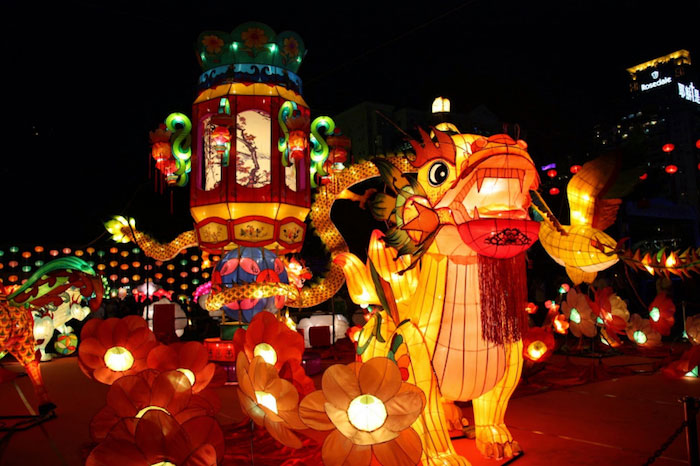
During the festival, the Chinese typically perform dragon dances, while the Vietnamese perform lion or unicorn dances.
Mid-Autumn Festival activities
Children's toys for the Mid-Autumn Festival are papier-mâché figures such as butterflies, praying mantises, elephants, horses, unicorns, lions, dragons, deer, shrimp and fish. On the evening of the festival, children gather in groups to play tug-of-war and sing call-and-response work chants (hò khoan), and parade with lanterns and lions to the sound of drums and gongs.
At this time of year, people also buy mooncakes, tea and wine to offer to their ancestors on the evening of the full moon. It is also an occasion for people to show their affection for grandparents, parents, teachers and friends by giving mooncakes, fruit, tea or wine.
Families prepare a feast tray as an offering for the middle of the month. A traditional tray features a dog made from pomelo segments, with two black beans for eyes. Around it are mooncakes, fruit, incense and candles. When the moon is directly overhead, it is time to "break the feast," and everyone shares in the flavors of the Mid-Autumn Festival.
The Chinese typically perform dragon dances during the Mid-Autumn Festival, while the Vietnamese perform lion or unicorn dances. The unicorn symbolizes luck and prosperity and is a good omen for every household. In the past, Vietnamese people also sang Trống Quân songs and hung spinning lanterns during the festival.
In the past, Vietnamese people also sang Trống Quân songs during the Mid-Autumn Festival. Trống Quân singing follows a three-beat rhythm: "thình, thùng, thình."
In the old days, young men and women sang Trống Quân songs on full-moon nights, especially on the full moon of the eighth lunar month.
Children's toys for the Mid-Autumn Festival.
Young men and women sang to each other in a call-and-response style, both for fun and to find a lifelong partner. The songs used poems written in the lục bát (six-eight) verse form or its variations.
At first, the Mid-Autumn Festival was a festival for adults, who admired the beauty of nature, ate cakes and drank tea under the full moon in the middle of autumn. Gradually it became a children's festival, though adults still take part.
Children get to parade with lanterns, sing, and share the feast laid out by their parents and older siblings, and above all, they can eat as many sweets as they like without fear of being scolded.
The meaning of the Mid-Autumn Festival
The Mid-Autumn Festival is a deeply meaningful custom. It is about caring, filial piety, gratitude, friendship, reunion and love.
During the festival, children hear the Vietnamese legend of Chú Cuội and the banyan tree. They also play and join in many full-moon activities, such as lantern parades, unicorn dances and receiving gifts and cakes. Yet the Mid-Autumn Festival is also an occasion for families to gather, share their love and enjoy happy moments together. That is why a popular saying goes, "The Mid-Autumn Festival is the Festival of Reunion." If you are studying or working far from home, take some time to visit your family and parents for the Mid-Autumn Festival.
Besides being a time of fun for children and adults, the Mid-Autumn Festival was also an occasion when people watched the moon to predict the harvest and the fate of the nation. According to folk belief, if the autumn moon was yellow, there would be a good silk harvest that year; if it was blue or green, natural disasters would strike; and if it was a clear, bright orange, the country would prosper.

The 8 longest rivers in Vietnam
Vietnam's heavy rainfall has created a vast network of waterways, with around 2,360 rivers and canals, large and small.

Expert explains the funnel-shaped vapor trail in the sky over Thanh Hóa
A strange vapor streak seen near the horizon over the former Hậu Lộc district in Thanh Hóa, Vietnam, was caused by jet engine exhaust, experts say.
How do the lunar and solar calendars differ?
The lunar calendar is a key part of East Asian tradition. Here is how it differs from the solar calendar and why it matters in Vietnam.
Could humans live underground to escape climate change?
Is living underground a viable solution to an approaching climate crisis? Scientists weigh the benefits and the risks.
Where women paint their nails, wear traditional robes and take spears to the sea to hunt squid
Oman's Bedouin women fishers hunt cuttlefish, rays and octopus with simple handmade spears, but their tradition may be dying out.
Fascinating fact: The University of Oxford is older than the Aztec civilization
Did you know that the University of Oxford is more than 200 years older than the mysterious ancient Aztec civilization?