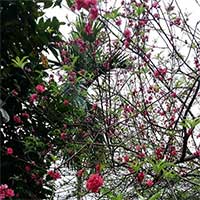
Tissue culture technology helps conserve Hanoi's West Lake lotus
Scientists at the Plant Resources Center (Trung tâm Tài nguyên Thực vật) in Vietnam have successfully developed a protocol for propagating the West Lake lotus using plant tissue culture.
The Bách Diệp lotus (the lotus of Hồ Tây, or West Lake, in Hanoi) is a prized variety, but it has been gradually degenerating. The area planted with lotus on West Lake is also shrinking. The question facing the research team was how to secure a reliable source of planting stock. Propagating the plant only by dividing its shoots gives a low multiplication rate and leads easily to degeneration, creating a real risk that this lotus will gradually lose its distinctive traits.
Associate Professor Đồng Văn Giới of the Plant Resources Center and his colleagues collected original genetic material from growing areas around West Lake and preserved the original stock at the Center for Conservation, Exploitation and Development of Lotus Genetic Resources at the Vietnam National University of Agriculture (Học viện Nông nghiệp Việt Nam) in Hanoi. From this original stock, he used tissue culture to produce reliable planting material. The method keeps the lotus's characteristics intact, and the seedlings are free of pests and disease. The in vitro research proved successful, and more than 500 plantlets have just been moved to a nursery for evaluation.

The Bách Diệp lotus grown on West Lake is a highly valuable genetic resource. Photo: Ngọc Yến
According to Associate Professor Giới, the Bách Diệp lotus has been cultivated around West Lake in Hanoi for a very long time. Its name, Bách Diệp ("hundred petals"), comes from the fact that each flower has as many as 100 petals. Its easily recognizable features are double, pink petals, a long-lasting fragrance, and large, plump lotus stamens. The variety is most valued for its long-lasting, rich fragrance, which makes it the only lotus used to scent tea.
Associate Professor Đặng Văn Đông, deputy director of the Fruits and Vegetables Research Institute (Viện Nghiên cứu Rau quả), who has studied lotus for many years, said that many of Vietnam's valuable lotus species and varieties are in fact degenerating, so conserving, preserving, restoring and developing these lotus genetic resources is essential.
Normally, growers can select the best plants with valuable traits from a population and grow them separately, then propagate them from seed (for pure-bred varieties) or from rhizomes/tubers in a disease-free environment, producing good planting stock that retains the traits of the original variety. However, Đông believes that for conservation and restoration to be highly effective and to produce high-quality plantlets, tissue culture is the best method. Tissue culture makes it possible to produce large numbers of plantlets in a short time, while the propagated plants retain the original traits of the mother plant, thereby conserving the lotus's genetic resources.
The West Lake lotus is classified as a specialty, rare genetic resource that needs to be conserved. In 2017, scientists at the Plant Resources Center and the Vietnam National University of Agriculture studied the plant and identified a number of characteristic morphological features for recognizing the West Lake lotus variety.
Based on this research, the Bách Diệp lotus is identified as follows: the leaves are dark green, while the leaf stalks and flower stalks are pale green. Each leaf has 20-22 veins, and the leaf blade is rough. The flower bud is long and oval, with a blunt, pale-pink tip. The double flowers are pink, the seed head is flat-topped, and the seeds are long and oval. Each West Lake lotus flower has about 100 petals on average. The seeds are arranged in 3 concentric rings on the seed head: the first ring has 1-5 seeds, the second 5-12 seeds and the third 10-17 seeds.
Giới hopes the plantlets moved to the nursery will perform well. They will become a source of high-quality Bách Diệp lotus planting stock for local growers to cultivate and boost their incomes.
Three new plant species with stunning flowers discovered in Vietnam
The three new species, small herbs with beautiful flowers and leaves, have high ornamental value and were described in the journal Phytotaxa.
Rare 'praying-hands' tree Chunia bucklandioides found to be native to Vietnam
A tree once known only from China's Hainan Island has been found in Vietnam, adding a native timber species to the country's flora.
Vietnamese scientist discovers an extremely rare new begonia
A begonia new to science, Begonia tadungensis, has been found in Vietnam's Tà Đùng National Park and is already considered Critically Endangered.
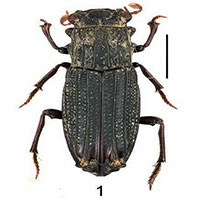
New insect species discovered in Vietnam
Scientists have described a new beetle, Rhyparus vietnamicus, and two new Sogana planthoppers from Vietnam.
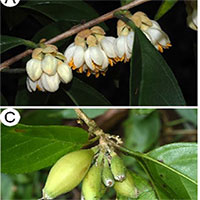
New tree species discovered in Vietnam's Trường Sơn mountains
Vietnamese and international scientists have discovered a new large timber tree in the Trường Sơn range of central Vietnam, named Rehderodendron truongsonense.
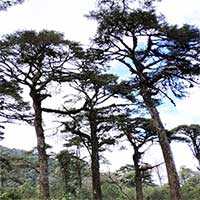
Rare hemlock population discovered in Vietnam's Lào Cai province
A population of more than 100 rare hemlock trees has been found at 1,800-2,000 m in Bát Xát Nature Reserve, Lào Cai province, northern Vietnam.