Where women paint their nails, wear traditional robes and take spears to the sea to hunt squid
Bedouin women fishers living along the coast of Oman still head out to sea every day to fish. However, they may be the last generation to do so, as no one wants to carry on this traditional work.
Barefoot, Khaleedah al-Hokmani strides steadily through murky water, a rusty iron spear in her hand. She walks in silence until she plunges the spear into the water with a resounding sound, like a balloon deflating. Seconds later, a silvery cuttlefish surfaces, spraying black ink all over her clothes. Without hesitation, she tears the cuttlefish apart.
She explains that this one is a female carrying eggs; she separates the eggs and eats them on the spot. A blue ink sac is still stuck between her fingers after she sucks it dry. Hokmani breaks into a smile, revealing blackened teeth.
"This is how we keep ourselves healthy," she says.
This is how some 400 Bedouin women fishers catch invertebrates, a method they inherited from their mothers. The practice is so deeply rooted in Oman that the women hold a "monopoly" on this kind of fishing.
Locals call them by a special name: rahas. Armed with nothing but spears, they hunt cuttlefish, rays and octopus, and also comb the shores for oysters and clams to sell at local markets.
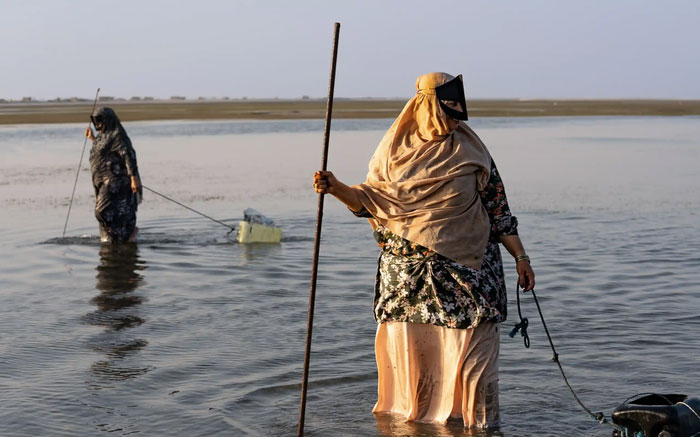
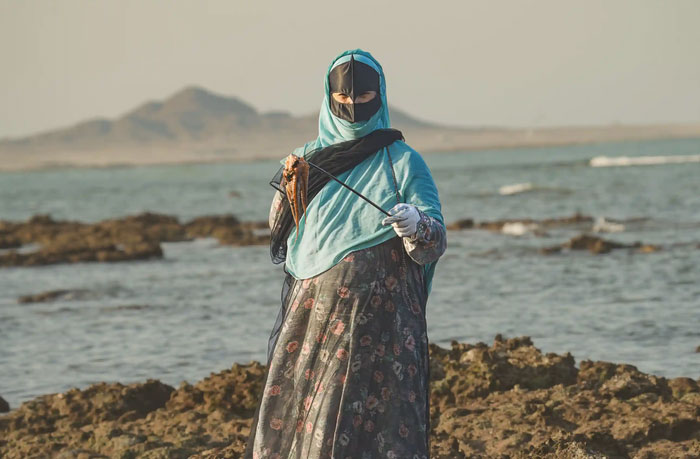
The women inherited their fishing methods from their mothers.
A traditional craft in decline
However, as the fishing industry, dominated by men, is increasingly commercialized, the women's fishing is being pushed into decline and could even disappear.
Most of the women fishers live and work in Mahout, a remote coastal town of 17,000 Bedouin families. Mahout is in Al Wusta governorate, the most productive fishing region in Oman.
Although more than 95% of the country's catch comes from small-scale fishing, Oman is investing heavily in offshore fishing projects. One example is a 24 million Omani rial (1,438 billion VND) seafood cannery planned in Al Wusta, which was scheduled to open in 2024, along with a tender to buy three large fishing vessels.
Farha al-Kindi, founder of the seafood company Sea Delights, says that while the expansion of the fishing industry aims to create opportunities for local fishers and foreign workers, these projects have had little impact on the women fishers on the island.
For Hokmani, who was taught the art of spearfishing, fishing now feels more precarious than ever. Divorced and raising eight children, she works mornings as a bus driver to supplement her main income from fishing.
Hokmani and other fisherwomen work as a group. To fish, they drive 50 km from home to their fishing grounds, carrying their gear, including iron spears and plastic fuel cans with ropes for hauling the catch, along with tea and snacks.
As a seasoned member, she leads her group out. After two hours, her haul is 20 cuttlefish, 2 rays and nearly 30 shells.
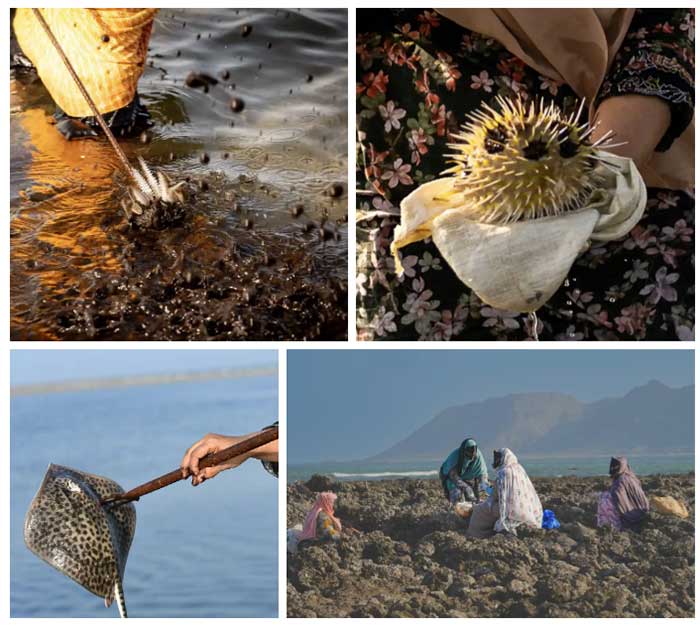
The women show off their catch
The same is happening on Masirah, Oman's largest island, where Bedouin women have long gathered sea snails. There, 58-year-old Shefya al-Farsi has been fishing for 40 years. Her daughters, however, did not learn the trade; instead, they went to university and hope to work in the city.
"I wish my children would continue my work. We want this work to be carried on by the next generation. But now it seems very few women want to do it," Farsi says.
In the distance, two male fishers in a small boat are casting nets into deeper water. Subsidized by the Omani government, their equipment is modern, in stark contrast to the simple, handmade tools of the women fishers.
"We don't want this work to disappear. We still want to use traditional fishing methods, but we also want the government to support us and create a better environment for passing the craft on to girls," Kindi says.

Fascinating fact: The University of Oxford is older than the Aztec civilization
Did you know that the University of Oxford is more than 200 years older than the mysterious ancient Aztec civilization?

Vietnamese scientists resolve a microalgae mix-up that lasted more than a century
Vietnamese researchers have re-described the dinoflagellate Ostreopsis siamensis, ending more than 100 years of taxonomic confusion.

3 breathtaking, treacherous mountain roads in Hà Giang that rival Mã Pí Lèng
The winding roads of Hà Giang in Vietnam's far north, graceful as silk ribbons yet full of danger, hold a strange allure for travelers.

The beauty of Longquan celadon, one of the most traded treasures on the Silk Road
You don't need to be an expert to judge the value of a piece of Longquan porcelain: its glaze tells you much of what you need to know.

Why is bánh chưng eaten with pickled onions? A fun explanation
The harmonious pairing of tangy pickles and rich, fatty flavors is what makes bánh chưng, Vietnam's Tết sticky rice cake, so appealing.

13 bizarre creatures from Vietnam that amazed the internet
From leaf insects and mouse deer to mossy frogs and mudskippers, Vietnam is home to a surprising array of bizarre creatures.