What is the "full moon effect"? Does the full moon really drive sharks to attack?
You may not know it, but when the full moon rises, a lot of strange things happen on Earth: corals spawn, plankton dive deeper, seabirds roost closer to shore, and lions hunt less... Many of these behaviors are tied to moonlight, while others are driven by the tides, but there is still no clear explanation.
Notably, an analysis of shark attack data spanning more than 50 years found that sharks attack people more often as the moon gets fuller. Ecologist Steve Midway of Louisiana State University explained: "At night, sharks can see more light. Most shark attacks happen during the day. The relationship may be mere coincidence, or it may be the result of a phenomenon known as the 'full moon effect'."
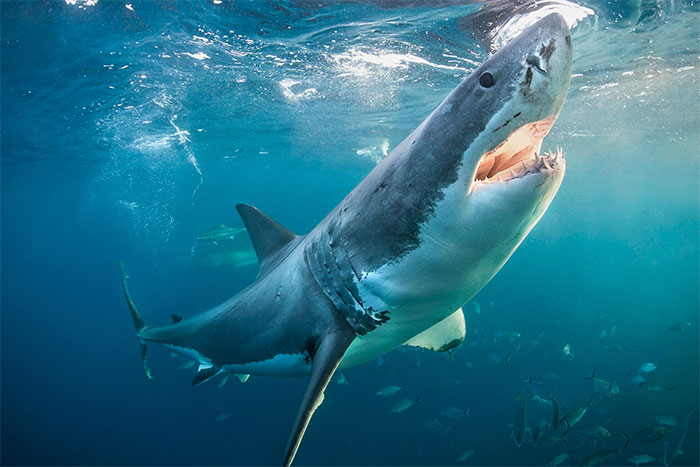
Sharks attack people more often as the moon gets fuller
Specifically, the "full moon effect" is an unproven correlation between the phases of the moon and the activity of plants and animals here on Earth. It may sound mystical at first, but there is a good reason to think that an invisible thread from Earth's "neighbor" is stirring up life on our planet.
A recent meta-analysis found compelling evidence that tides generated by the moon's gravity can change the way animals and plants sleep, move and grow. However, the exact mechanisms behind these phenomena remain a mystery.
Most marine life is influenced by the moon, and sharks are no exception. Their movements and feeding have previously been linked to lunar rhythms. But sharks are not the only large animals that change their behavior under the moon's influence. Surfers — the group most affected by shark attacks — have also noticed that the best surfing conditions come around the full moon.
That could also imply that human activity around the full moon leads to more shark attacks. If so, it would be better for us to know what is actually driving shark aggression.
"While this is not yet conclusive evidence that shark attacks tend to occur around the full moon, these results are the first large-scale assessment of shark attacks in relation to the lunar cycle, and they open up new avenues of investigation."
It is also worth noting that, frightening as they are, shark attacks are relatively rare. Sharks play an important role in ocean ecosystems as apex predators. Many species are declining in number or facing major changes in their habitats that force them to move into areas more crowded with marine life.
According to investigations, while shark attacks have been increasing as people spend more and more time in the sea, humans have also swum alongside sharks with few incidents. Sharks do not target humans as prey, and attacks are thought to be cases of mistaken identity. More research is needed to find out what is really going on, because any measures to reduce harmful interactions need to be well founded. Swimming in groups, or avoiding the sea at dawn and dusk, may reduce the risk of encountering these aggressive "visitors."
Vietnamese scientists resolve a microalgae mix-up that lasted more than a century
Vietnamese researchers have re-described the dinoflagellate Ostreopsis siamensis, ending more than 100 years of taxonomic confusion.

3 breathtaking, treacherous mountain roads in Hà Giang that rival Mã Pí Lèng
The winding roads of Hà Giang in Vietnam's far north, graceful as silk ribbons yet full of danger, hold a strange allure for travelers.

The beauty of Longquan celadon, one of the most traded treasures on the Silk Road
You don't need to be an expert to judge the value of a piece of Longquan porcelain: its glaze tells you much of what you need to know.

Does smiling make you more trustworthy?
Genuine smiles that engage the eye and cheek muscles are seen as more trustworthy than polite social smiles. Here is why.

Why is bánh chưng eaten with pickled onions? A fun explanation
The harmonious pairing of tangy pickles and rich, fatty flavors is what makes bánh chưng, Vietnam's Tết sticky rice cake, so appealing.
13 bizarre creatures from Vietnam that amazed the internet
From leaf insects and mouse deer to mossy frogs and mudskippers, Vietnam is home to a surprising array of bizarre creatures.