Fierce but non-venomous: the snake that helps Vietnam's farmers
A snake species widespread in Vietnam has a fierce temperament despite having no venom at all. It is an excellent rat catcher, which is why it is considered beneficial to agriculture.
The radiated ratsnake: a widespread and commonly seen snake in Vietnam
The snake in question is the radiated ratsnake, known in Vietnamese as rắn hổ ngựa, rắn sọc dưa or rắn rồng, scientific name Coelognathus radiatus. It belongs to the colubrid family (Colubridae), and its range stretches from India and Bangladesh into Southeast Asia, including Vietnam.
In Vietnam, the snake is found throughout the country, most often in the lowlands and midlands. It turns up in areas with plenty of trees and thickets, or in abandoned rat burrows. Radiated ratsnakes are skilled climbers, so they can also be spotted in shrubs and occasionally on rooftops.
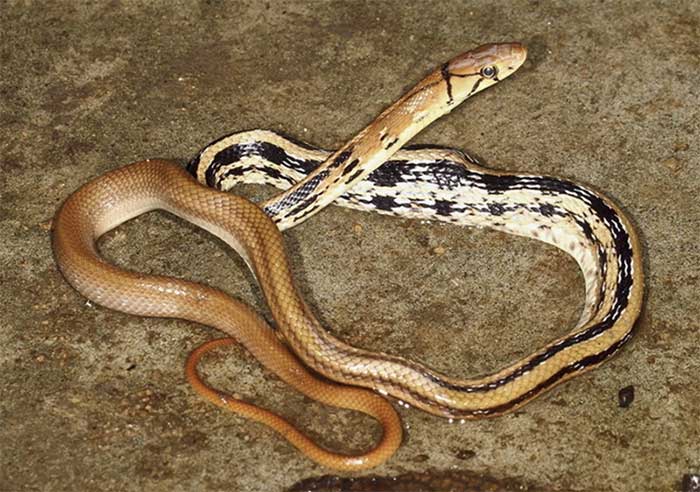
The radiated ratsnake is easy to identify thanks to the distinctive markings on its face and body (Photo: Dan Rosenberg).
Adult radiated ratsnakes can reach 2 m in length. The species is easy to recognize by its body markings. Three thin black lines radiate from each eye: two run diagonally down to the upper lip, and one crosses the temple. The body bears four black stripes running from the nape to beyond the midbody; the two central stripes are broad and continuous, while the two outer ones are thinner and broken.
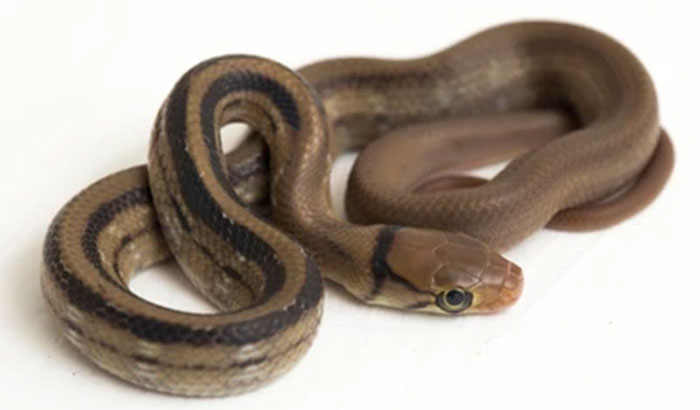
The characteristic markings on the head and body of a juvenile radiated ratsnake (Photo: Shutterstock).
Because it is widespread and lives in many different habitats, the radiated ratsnake is often encountered around human settlements, especially where rats, its favorite prey, are abundant. Thanks to its easily recognizable features, however, people can quickly identify it and respond appropriately.
A fierce but harmless snake
Despite its Vietnamese name "hổ ngựa" (which evokes the cobra, "rắn hổ"), this snake is a colubrid and has no venom; it is not a member of the cobra family (Elapidae), as many people mistakenly believe.
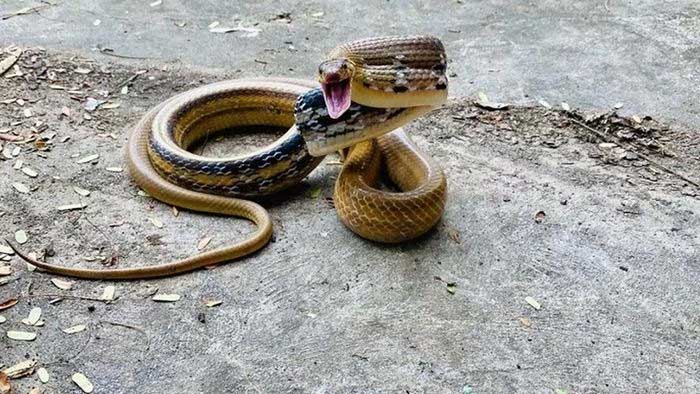
When in a defensive posture, the radiated ratsnake rears its head high and opens its mouth wide in a threatening display (Photo: Rừng hoang dã).
Although it lacks venom, the radiated ratsnake is an aggressive snake, ready to strike first when it feels threatened. When in danger, it raises the front third of its body off the ground, gapes widely and tries to flatten and spread the skin of its neck, all while poised to strike.
The snake often holds this pose, head raised and mouth agape, as it threatens enemies and moves about, leading many people to mistake it for a deadly cobra. In reality, however, it is non-venomous and harmless to humans.
A bite from a radiated ratsnake can draw blood. If bitten, clean and disinfect the wound thoroughly to prevent infection. If you are not completely sure the snake was a radiated ratsnake, seek medical attention promptly, as several venomous snakes in Vietnam can look similar.
An aggressive yet timid snake that plays dead to escape its enemies
Despite its aggressive nature and habit of actively threatening enemies, the radiated ratsnake is in fact a rather... timid snake.
If its threat display fails to deter an enemy, the radiated ratsnake puts on a clever "act" of playing dead. It rolls onto its back and lies motionless as if dead. No matter what is done to it, the snake stays still and shows no reaction whatsoever.
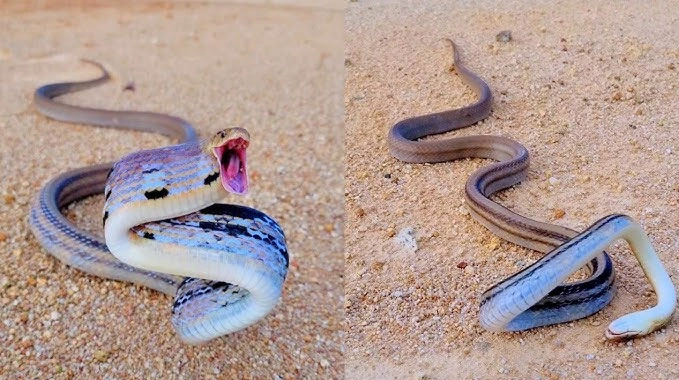
When its threat display fails, the radiated ratsnake "plays dead" to fool its enemy (Photo: YouTube).
Many predators tend not to eat animals that are already dead, so the radiated ratsnake's death-feigning act can help it escape dangerous predators, and even humans.
After lying motionless for a while, once it senses the threat has passed, the snake rolls back over and quickly flees. If it is still pursued, however, it will repeat its death-feigning act until it fools its enemy and successfully escapes.
A snake that helps farmers
Because it is so widespread, the radiated ratsnake frequently crosses paths with people. Owing to its aggressive temperament, it often tries to intimidate people before fleeing, and as a result it is frequently killed when it has the misfortune of meeting humans.
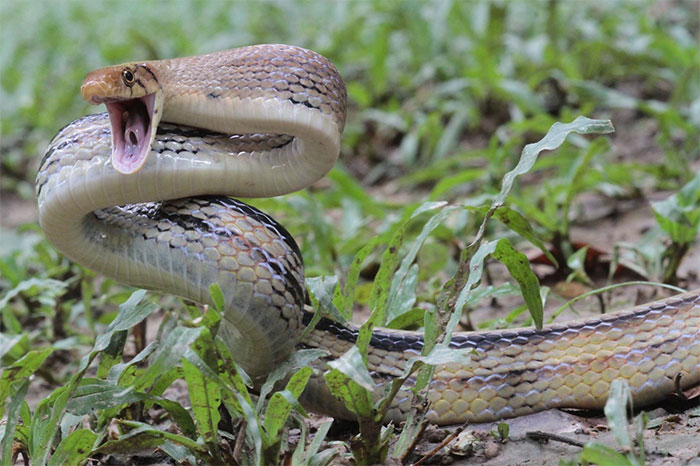
This snake is a highly skilled rat hunter.
The radiated ratsnake feeds on lizards and frogs, and sometimes even fish and nestling birds. Its favorite food, however, is rats. Its speed makes it an extremely effective rat hunter, which is why the radiated ratsnake is considered beneficial to agriculture.
Because the radiated ratsnake is harmless, easy to identify and useful to agriculture, if you come across one, you can try to drive it away rather than kill it.
Meet the highly venomous sea snakes of Vietnam
Sea snakes are small to medium-sized ocean-dwelling snakes with paddle-like tails and venom potent enough to kill a human. Here are species found in Vietnam.
"Sea dragon" said to predict earthquakes washes up in Vietnam
Many believe an oarfish washing ashore is an omen of disasters and earthquakes. So what is the truth?
Vietnam's "four great national dogs": Which rare breeds make the list?
Vietnam's four native "national dogs" are the Bắc Hà dog, the Lài dog, the Hmong Bobtail and the Phú Quốc Ridgeback.
10 of Vietnam's rarest and most unusual birds
Vietnam's rich, diverse ecosystems are home to many rare birds, some with unusual names and distinctive calls.
Found only in Vietnam: the bizarrely evolved fish with a truly unique way of mating
The Mekong priapiumfish, endemic to Vietnam, was named one of the world's 10 strangest discoveries by National Geographic in 2012.
Rare animals rescued in Vietnam
Leopards, yellow-cheeked gibbons, grey-shanked doucs, silvered langurs and Asian black bears are among rare animals rescued by Wildlife At Risk in Vietnam.