Found only in Vietnam: the bizarrely evolved fish with a truly unique way of mating
In 2012, National Geographic included this animal in its list of the 10 strangest discoveries in the world.
Discovering a new species
In July 2009, Koichi Shibukawa, a scientist at the Nagao Natural Environment Foundation in Tokyo, Japan, discovered a new species while surveying a small canal of the Hậu River - part of the Mekong (Cửu Long) river system - in Cù Lao Dung, a former district of the former Sóc Trăng province (now part of Cần Thơ city) in southern Vietnam.
Working with colleagues from Cần Thơ University in the Mekong Delta, including Dr. Trần Đắc Định and Trần Xuân Lợi, MSc, he realized it was a species previously unknown to science. The study describing the new fish was published in the scientific journal Zootaxa, issue 3363, in July 2012.
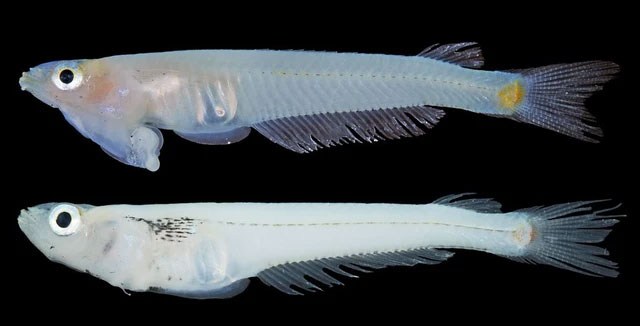
The study describing the new species was published in the journal Zootaxa in 2012. (Photo: VietnamNewFish)
The Mekong priapiumfish (scientific name: Phallostethus cuulong) is a ray-finned fish of the priapiumfish family Phallostethidae, order Atheriniformes; it was found in Vietnam in 2009 and described as a new species in 2012. It is considered a fairly rare surface-dwelling fish of the Mekong River region in Southeast Asia.
The meaning of its scientific name can be explained as follows: The names of the genus and family come from Greek, meaning "penis" (phallos) on the "chest" (stēthos): phallos + stēth + the suffix -us = Phallostethus. The English name of the group, priapiumfish, comes from Priapus, the ancient Greek god of fertility, while the species name (cuulong) refers to the river where it was first found.
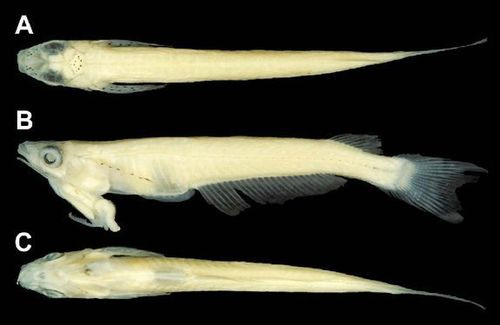
The fish reaches a standard length of about 25 mm. (Photo: Huffpost).
Three species of the genus Phallostethus are currently known. Besides P. cuulong, there are P. dunckeri (C. T. Regan, 1913) from the Malay Peninsula and P. lehi (Lynne R. Parenti, 1996) from northwestern Borneo. Phallostethus cuulong is the 22nd species of the family Phallostethidae to be discovered. And the Mekong priapiumfish is endemic to Vietnam, found nowhere else in the world.
A fish with a unique way of mating
This fish is distinctive in that its sex organ sits right under its chin, behind the mouth. Males have a priapium, an organ that resembles an inverted penis and is derived from the pelvic fins. This organ helps ensure a high rate of egg fertilization, allowing the female's oviduct to hold a large amount of sperm. The female's genital opening, meanwhile, is located under its throat.
The fish mates in a peculiar way, with the male positioning its head close to the female at an angle of about 45 degrees. Although their mating has never been documented in detail, scientists, based on their body structure and comparisons with similar species, suggest that they use saw-like and whip-like structures to attract females during the breeding season. Males develop a penis-like organ projecting from the head like a serrated hook to clasp onto females during mating.
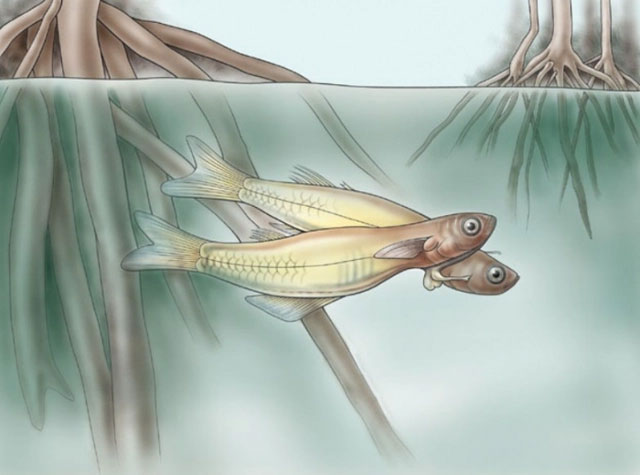
This fish has a unique mating mechanism. (Photo: Zootaxa).
This makes it one of the most bizarrely evolved fish in the world, as one of the few fish species in which eggs are fertilized inside the female's body.
Lynne Parenti, a researcher at the Smithsonian Institution in Washington, D.C., said scientists still do not know why priapiumfish evolved such unusual genitalia. They belong to a group of fishes called Atherinomorpha – in which, in this lineage, the fins have evolved to serve a "sperm transfer" function, Parenti added.
Eight specimens of P. cuulong were studied, five males and three females, measuring 20 to 24.5 mm. Body measurements were expressed as percentages of standard length: head length 22.1% to 24.1%, snout length 7.5% to 8.5%, eye diameter 6.7% to 7.3%, interorbital width 3.3% to 5.2%, jaw length 8.0% to 9.4%, predorsal length 78.0% to 82.6%, preanal length 46.4% to 48.7%, and greatest body depth 15% to 18.7%.
Rare animals rescued in Vietnam
Leopards, yellow-cheeked gibbons, grey-shanked doucs, silvered langurs and Asian black bears are among rare animals rescued by Wildlife At Risk in Vietnam.
"Gan lì cóc tía": The strange animal behind a famous Vietnamese idiom
The fire-bellied toad lives on in the Vietnamese idiom "gan lì cóc tía," yet today almost no one ever gets to see one in the wild.
What to know about Vietnam's rare crocodile newt
Like the Tam Đảo newt, the Vietnamese crocodile newt (Tylototriton vietnamensis) is an exceptionally rare animal found only in Vietnam.
Close-up of a new snake species found only in Vietnam
A new rat snake species, Ptyas bachmaensis, has been recognized as endemic to Vietnam and has so far been recorded only in the country.

The animals with the weirdest hair in the world
The Victoria crowned pigeon, bearded pig and alpaca are among the animals whose striking head tufts look like bizarre hairstyles.
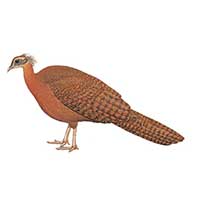
Treasure of the Trường Sơn Range: An extremely rare bird found in only two countries, flagged by the IUCN for urgent protection
The IUCN Red List urges urgent protection for the Vietnamese crested argus, a Critically Endangered pheasant at risk of vanishing from the wild.