Venomous snakes of Vietnam
The animal kingdom, and the world of snakes in particular, is full of fascinating surprises. Vietnam's venomous snakes include the king cobra, the banded krait, the white-lipped pit viper and many others. Several species carry venom that can kill a person in a matter of moments.
How to recognize venomous snakes in Vietnam
Biology and behavior
"Snake" is the common name for a group of carnivorous, legless reptiles with long, cylindrical bodies. Like other squamates, snakes are vertebrates, and they have no eyelids and no external ears.
Their highly flexible jaws allow them to swallow prey much larger than their own heads.
Snakes hunt in two ways: venomous species paralyze their prey with venom, while non-venomous species constrict it. Most snakes, however, are not venomous; they generally avoid people and bite only when provoked.
Lacking legs, snakes move mainly by crawling and slithering, using a wide variety of techniques such as lateral undulation, sidewinding and swimming. Besides helping them hunt, venom also serves as a defensive weapon.
Snakes are found on every continent except Antarctica and in almost every type of terrain, from the open ocean to altitudes as high as 4,900 meters.
Classification
More than 20 families and 500 genera, comprising 3,400-3,550 species worldwide, testify to the remarkable adaptability and success of these animals.
Given this diversity, we will focus only on the venomous and non-venomous species commonly encountered in Vietnam.
Identification relies mainly on external features such as coloration, the shape of the head and body, and the structure of the teeth. By these criteria, Vietnam has two families of highly venomous snakes: the cobras and their relatives (Elapidae) and the vipers (Viperidae).
Vietnam is home to nearly 200 snake species, 53 of which are venomous, belonging mainly to these two families.
Horned pit viper
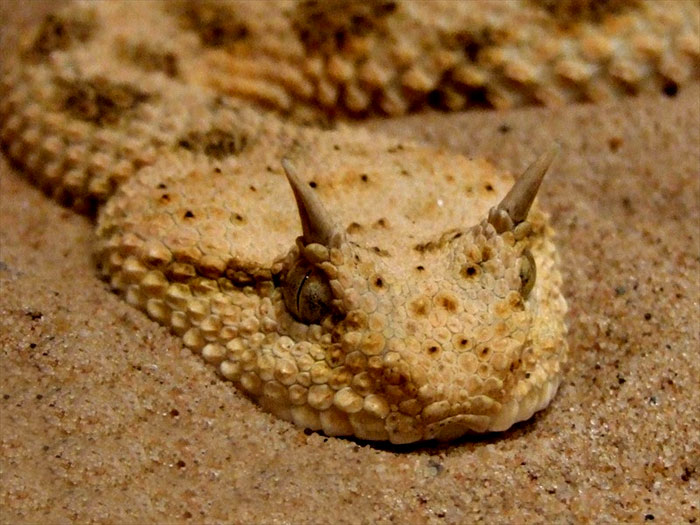
Known scientifically as Protobothrops cornutus (formerly Trimeresurus cornutus), the horned pit viper (rắn lục sừng) is found in Vietnam. Its triangular head is clearly distinct from the neck and covered on top with small scales, while the scales above its eyes have developed into hornlike projections, earning it the nickname "devil snake." It grows to about 50cm. Its venom ranks it among the most venomous snakes in Vietnam.
Red-tailed pit viper
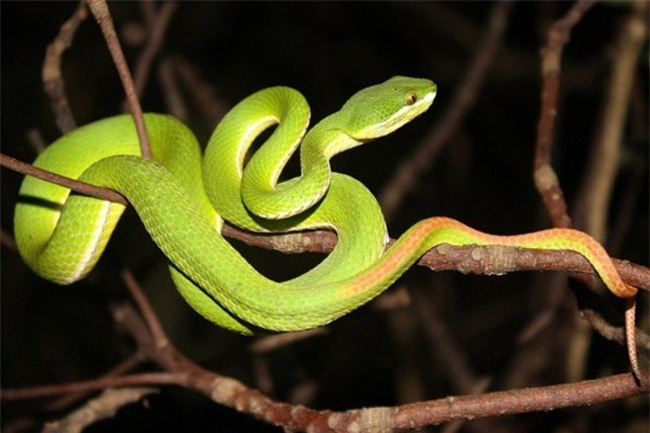
Known scientifically as Trimeresurus albolabris (the white-lipped pit viper), this is one of the most venomous of the pit vipers, with a green body and a reddish-brown tail. It lives mainly in high mountains and deep forests of the Trường Sơn (Annamite) range and the mountains of northwestern Vietnam; it is now also found, though rarely, in Cần Thơ in the Mekong Delta. It has recently appeared in Quảng Ngãi province and in the Nam Đàn area of Nghệ An province, and last year it was recorded as far as the city of Đà Nẵng.
Malayan pit viper
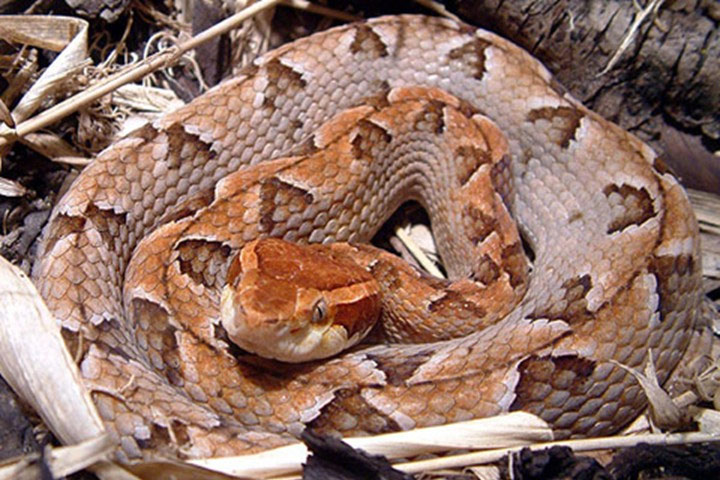
The Malayan pit viper, known in Vietnam as rắn chàm quạp or rắn khô mộc ("dry-wood snake"), has the scientific name Calloselasma rhodostoma. It owes its name to skin colors that blend in with dry leaves and dead wood, making it extremely hard to spot. It is common in the vast rubber plantations of southeastern Vietnam, and according to Professor Nguyễn Lân Dũng, it is second only to sea snakes in how dangerous it is.
Vogel's pit viper
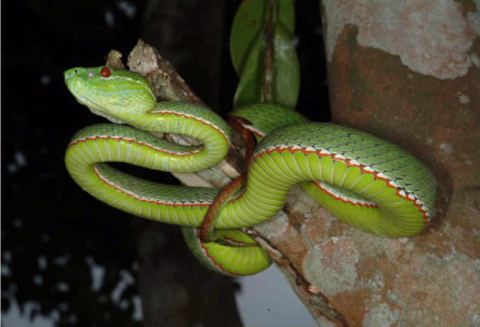
Its scientific name is Trimeresurus vogeli (formerly Viridovipera vogeli). The top of its head and its body are green, with a paler belly. Scientists still know little about this species' diet. It is active at night and lives in thickets and low shrubs in hilly and mountainous terrain at elevations of 900 m to 1,500 m. In Vietnam it is found in Gia Lai, Đồng Nai and Lâm Đồng provinces.
Fea's viper
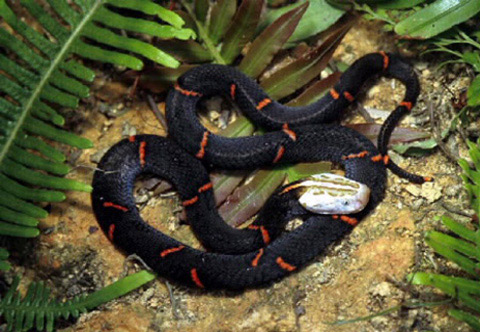
According to Wikipedia, Fea's viper, known in Vietnam as the white-headed viper (rắn lục đầu bạc), has the scientific name Azemiops feae and is considered one of the most primitive venomous snakes. It is medium-sized, with a slightly flattened head that is clearly distinct from the neck, and grows to about 80 cm long. It lives in mountainous areas at elevations of up to 1,000 m. In Vietnam, the white-headed viper is found in Cao Bằng, the former Vĩnh Phú province and Lạng Sơn. Very few remain in the wild.
Trùng Khánh pit viper
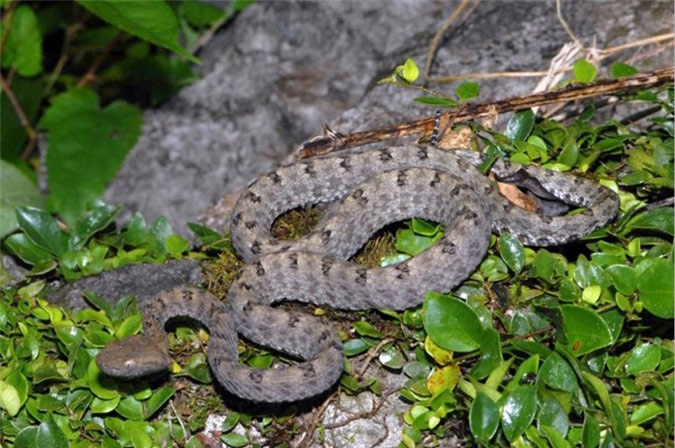
Its scientific name is Protobothrops trungkhanhensis. So far, scientists have found this species only in the Trùng Khánh Nature Reserve in Cao Bằng province, northern Vietnam. The Trùng Khánh pit viper is about 70 cm long, fairly small compared with other members of the genus Protobothrops. It lives at elevations of 500 – 700 m in evergreen forests and tropical limestone rainforests.
Indochinese spitting cobra
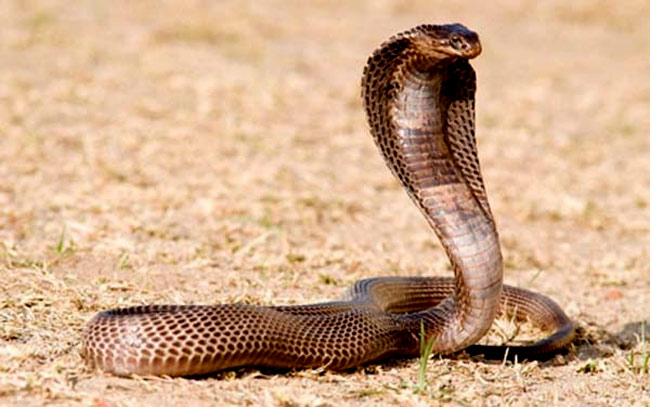
The Indochinese spitting cobra, or Siamese cobra (rắn hổ mang xiêm), also called rắn hổ mang bành in Vietnamese, has the scientific name Naja siamensis. Its venom can be lethal to humans. Cobras usually strike when provoked or threatened. A person bitten by this snake can die in as little as about 30 minutes, as the venom depresses breathing, paralyzes the diaphragm and leads to asphyxiation. Cobras typically feed on rats, birds and frogs. In Vietnam, the species is found mainly in the south-central region and the south.
King cobra
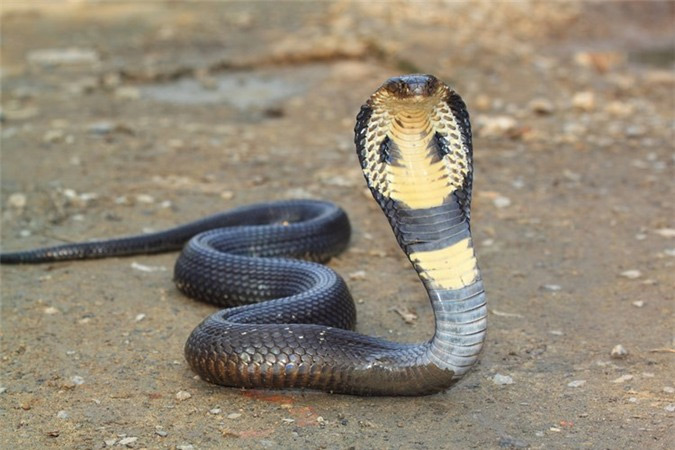
The king cobra's scientific name is Ophiophagus hannah. Although it does not actively attack people, it is still considered a dangerous and fearsome animal within its range. Not only can it inject venom, it can also control how much venom it delivers when biting its prey. Its venom contains neurotoxins that paralyze the nervous system, causing victims to fall into a coma and die.
Monocled cobra
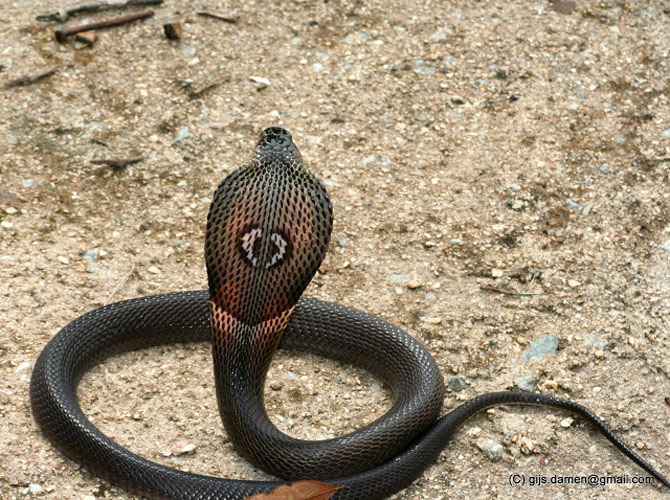
The monocled cobra, known in Vietnam as rắn hổ đất, hổ mang một mắt kính ("one-spectacled cobra") or hổ phì, has the scientific name Naja kaouthia. When disturbed, it spreads its neck into an intimidating hood. Even a small amount of its venom can kill prey suddenly.
Sea snakes
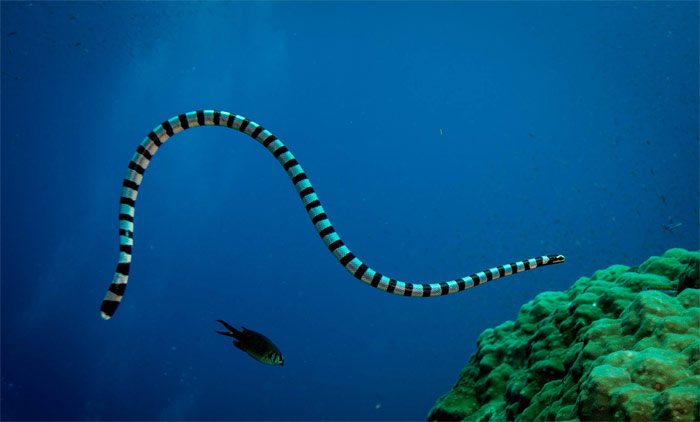
Sea snakes belong to the subfamily Hydrophiinae. They are venomous snakes that live in the ocean, although they evolved from land-dwelling ancestors. Sea snakes typically have laterally flattened, eel-like bodies. Unlike fish, they have no gills and must regularly surface to breathe. Most sea snakes have potent venom. In Vietnam, they go by several other names, such as rắn đẻn or rắn đẻn biển, and they occur in many of the country's coastal waters.
Banded krait
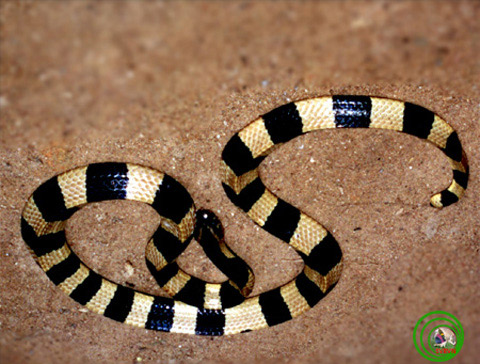
The banded krait (Bungarus fasciatus), known in Vietnam as rắn cạp nong, rắn cạp nia or rắn mai gầm, belongs to the cobra family (Elapidae). It is one of the most venomous snakes; although it rarely attacks people, if someone is unlucky enough to be bitten, the venom can kill within minutes without prompt treatment. It is common in Vietnam's lowlands, midlands and mountains. It hunts at night, preying on other snakes and occasionally lizards.
Spotted "dry-leaf" snake
The spotted "dry-leaf" snake (rắn lá khô đốm) has variable coloration: its head is blackish to light brown, and its body is deep orange or light reddish-brown. The body pattern may consist of large, widely separated spots along the flanks, large irregular round spots, a black twisting pattern or black stripe along the back, or no pattern at all. There is a black ring on the body and at the tip of the tail. The belly is pink, and the underside of the tail has irregular black and white patches. It grows to about 47cm.
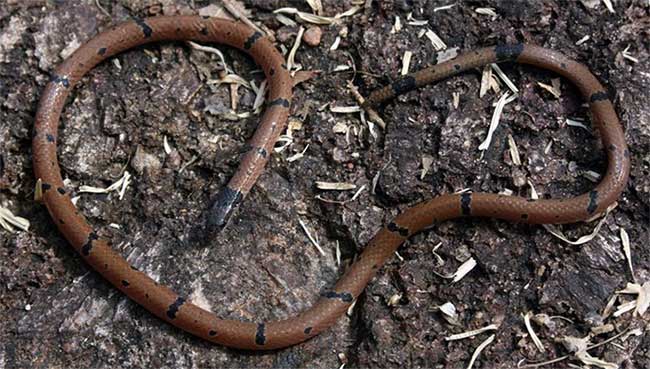
The body pattern may consist of large, widely separated spots along the flanks.
Females lay once a year, with 2 eggs per clutch. The snake feeds mainly on small snakes, especially blind snakes of the genus Typhlops sp., and on lizards. It is venomous and dangerous. When agitated, it typically flips up the black-and-white underside of its tail and coils up to intimidate enemies.
When cornered, it plays dead and releases a foul odor to deceive predators. This nocturnal snake is usually found under debris, woodpiles and similar spots in dense forest at elevations of up to 1,000m.
"Cat cobra"
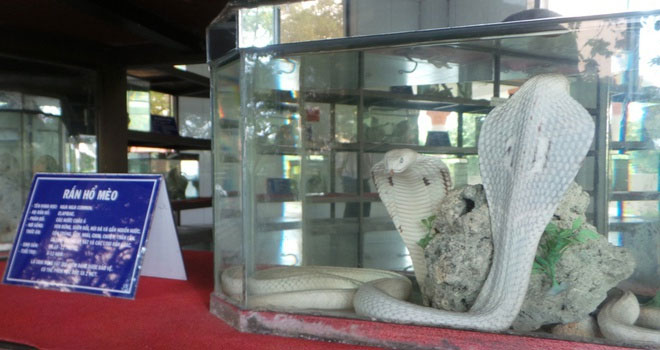
Photo: Trường Nguyên.
The rắn hổ mèo ("cat cobra") is also known as the Indochinese cobra. It is famous for its ability to spit venom 1.4-1.6 m. According to Dr. Tình, the cat cobra usually has a V-shaped or cat-face-like marking on its head. It is common in southern Vietnam. When angered, it puffs up its neck front to back rather than spreading it sideways like other cobras.
How to tell dugongs and manatees apart: Two rare look-alike sea mammals
Dugongs and manatees look remarkably alike, but a glance at the tail gives them away. Only the dugong lives in Vietnam's waters.
Hepu mitten crab identified in Vietnam
In Vietnam, the Hepu mitten crab goes by many local names, such as cà ra, cua lông and cua da, depending on the province.
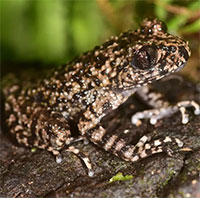
New toad species discovered, found only in Vietnam
A new toothed toad of the genus Oreolalax, discovered on Pờ Ma Lung mountain, has been recognized as endemic to Vietnam.
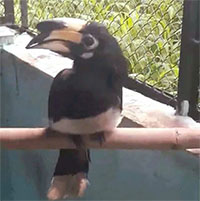
Man drinking coffee in Thủ Đức spots a rare stray oriental pied hornbill
A man in Ho Chi Minh City spotted a big-billed bird on a branch; it flew toward him instead of away, so he caught it and handed it to forest rangers.
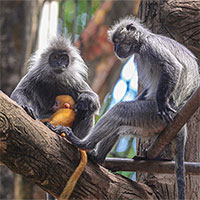
Silvered langur family's orange baby causes a stir at Saigon Zoo
A baby silvered langur with bright orange fur at Ho Chi Minh City's Saigon Zoo has gone viral, sparking jokes that it is a hybrid. The zoo says it is normal.
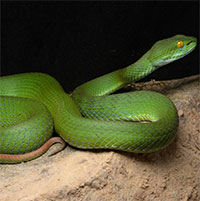
Up close with the new venomous pit viper discovered in Vietnam
An international team has discovered a new venomous pit viper with yellow eyes and blue lips in the coastal forests of central Vietnam.