How to tell dugongs and manatees apart: Two rare look-alike sea mammals
One of the two species is also found in Vietnam's waters.
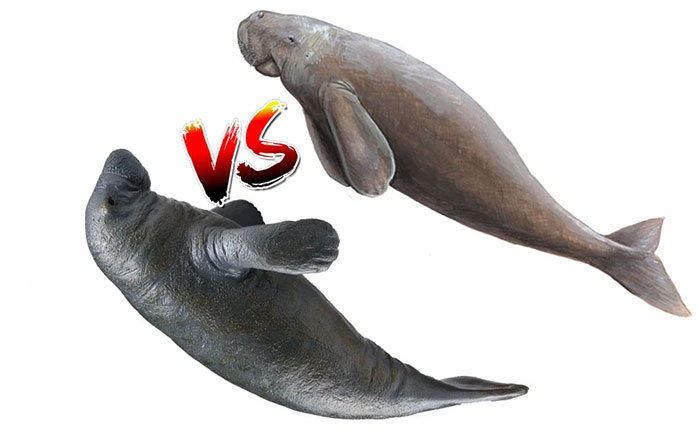
Can you tell which is the dugong and which is the manatee? (Illustrative photo: Thành Luân)
Dugongs (scientific name: Dugong dugon) and manatees (scientific name: Trichechus) look so alike that they are easy to confuse at first glance. Both belong to the order Sirenia, which is why they share a similar body shape (see the photo below).
The dugong is a marine animal with a spindle-shaped body. It is sometimes called the "mermaid fish" or "sea mermaid" because its tail resembles a mermaid's. Its paddle-like front flippers are used for steering while swimming, and its skin is very thick and covered with sparse hairs.
The head is relatively large for its body. Dugongs have poor eyesight but make up for it with an extremely keen sense of smell. Their thick, flattened lips are covered with bristly whiskers, an adaptation for grazing on seagrass and algae on the seabed.
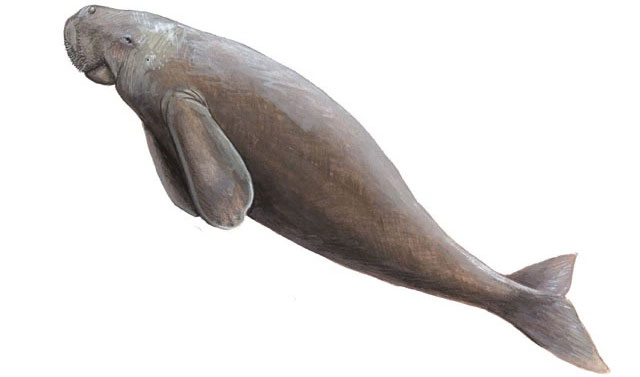
A dugong. (Photo: Wiki)
Males also have tusks, similar to an elephant's, which are highly prized and make them a target for many hunters. Hunting, trading or consuming dugongs and their products is illegal and can lead to criminal prosecution. The dugong is currently listed as Critically Endangered (CR) in the Vietnam Red Data Book and as Vulnerable on the IUCN Red List.
Dugongs usually live and travel in pairs. They swim very slowly and pose no danger to humans; they rest during the day and forage at night. Every so often, a dugong rises to the surface to breathe. They can typically hold their breath for about 15 minutes.
A dugong can eat 10 to 30 kg of seagrass a day, and the animals are long-lived (more than 70 years). Very few dugongs remain today, mostly in the Indo-West Pacific region, including Indonesia, Malaysia, Thailand, Myanmar, Papua New Guinea and Vietnam.
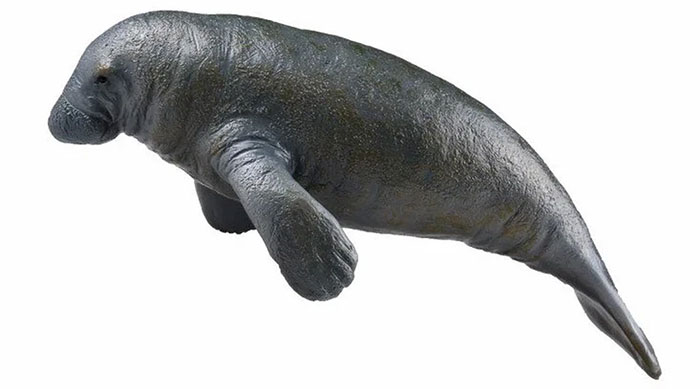
A manatee. (Photo: Wiki)
The manatee is also a fully aquatic, plant-eating marine mammal, but it is usually larger than the dugong. Its snout is shorter than a dugong's, and its upper lip is bigger than the lower one and highly flexible, able to grasp objects. Manatees use it to gather food and to communicate and interact socially.
Manatees lack the tusks that dugongs have; they do not even have incisors, only a set of cheek teeth that can be replaced throughout their lives. Their tail is rounded and paddle-shaped, unlike the whale-like fluked tail of the dugong.
A manatee's stomach is also much simpler than a dugong's (dugongs have a very long digestive tract to extract as many nutrients as possible). Manatees tend to be more solitary rather than living in pairs like dugongs, and during the breeding season males pursue females. Manatees feed during the day.
Manatees also have to surface to breathe (roughly every 20 minutes). When threatened, they can move fairly fast (30 km/h), and they can live up to 60 years.
A manatee can eat up to 50 kg of food a day (typically water hyacinth, buttercups, grasses, water celery, seaweed and so on), equivalent to about 10%–15% of its body weight. Manatees are highly intelligent, similar to dolphins and seals.
A simple way to tell dugongs and manatees apart
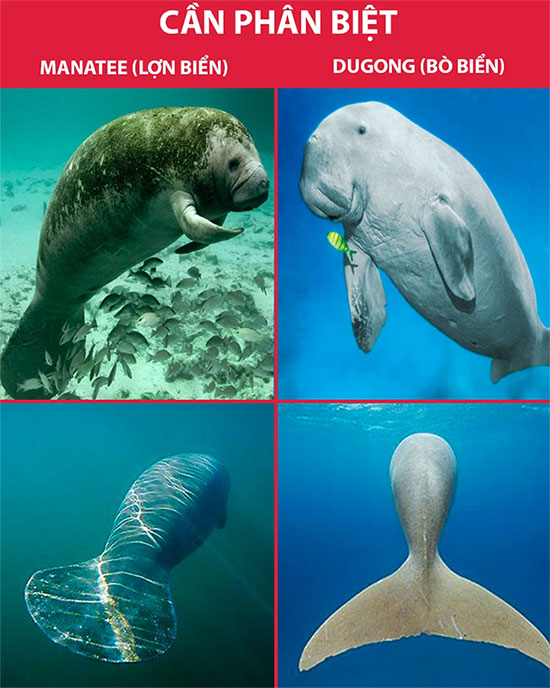
The difference between the tails of the dugong and the manatee. (Photo: Khám phá Thế giới động vật)
There are many differences between the dugong and the manatee, but the quickest way to tell them apart is the tail. A dugong's tail is crescent-shaped (like a mermaid's tail), while a manatee's tail is rounded, like a paddle.
Several other features can also help us distinguish these two marine animals, including the shape of the mouth, the skin, the size and the body weight (see the image below).
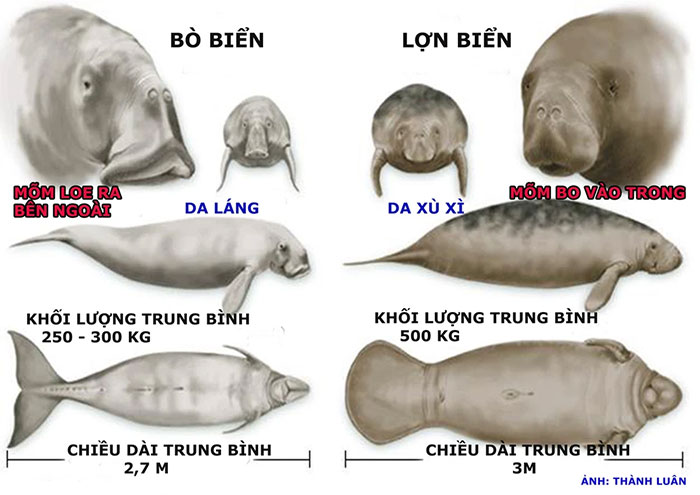
Telling dugongs and manatees apart. (Vietnamese-labeled image: Thành Luân)
Those are some quick ways to tell these two unique and rare marine animals apart by their appearance. Of the two, only the dugong lives in Vietnam's waters, around Côn Đảo (formerly part of Bà Rịa–Vũng Tàu province, now Ho Chi Minh City) and the island of Phú Quốc (formerly Kiên Giang province, now An Giang) in southern Vietnam.
Why can't humans domesticate wolves?
Dogs and wolves share very similar genes, yet wolves stay wild. A study points to differences in their earliest sensory experiences.
Meet the new snake species found only in Vietnam
Scientists have described a new snake species, Colubroelaps adleri, known only from Hòn Tre, a small island in Khánh Hòa province, Vietnam.
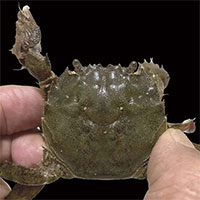
Hepu mitten crab identified in Vietnam
In Vietnam, the Hepu mitten crab goes by many local names, such as cà ra, cua lông and cua da, depending on the province.
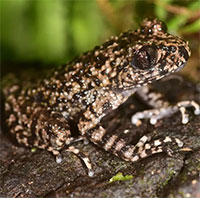
New toad species discovered, found only in Vietnam
A new toothed toad of the genus Oreolalax, discovered on Pờ Ma Lung mountain, has been recognized as endemic to Vietnam.
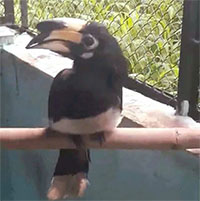
Man drinking coffee in Thủ Đức spots a rare stray oriental pied hornbill
A man in Ho Chi Minh City spotted a big-billed bird on a branch; it flew toward him instead of away, so he caught it and handed it to forest rangers.
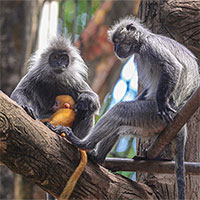
Silvered langur family's orange baby causes a stir at Saigon Zoo
A baby silvered langur with bright orange fur at Ho Chi Minh City's Saigon Zoo has gone viral, sparking jokes that it is a hybrid. The zoo says it is normal.