Silvered langur family's orange baby causes a stir at Saigon Zoo
In recent days, crowds of visitors have flocked to Thảo Cầm Viên, the Saigon Zoo and Botanical Gardens in Ho Chi Minh City, to see for themselves a family of silvered langurs whose newborn has bright orange fur, a sight that has taken social media by storm.
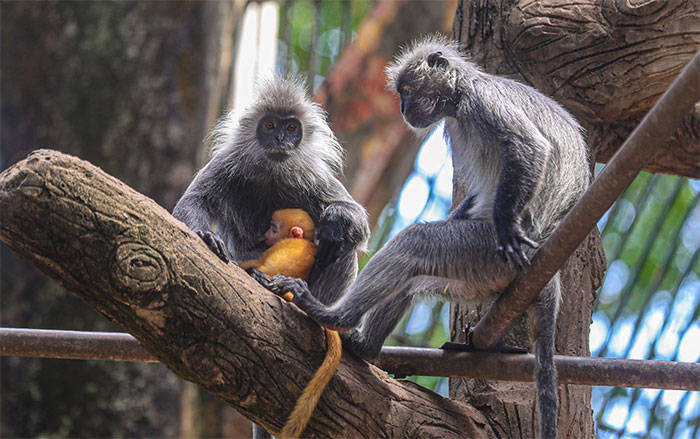
Social media has been buzzing over images of a langur family at the Saigon Zoo whose baby has an orange coat, strikingly different from the silvery-gray fur of its parents.
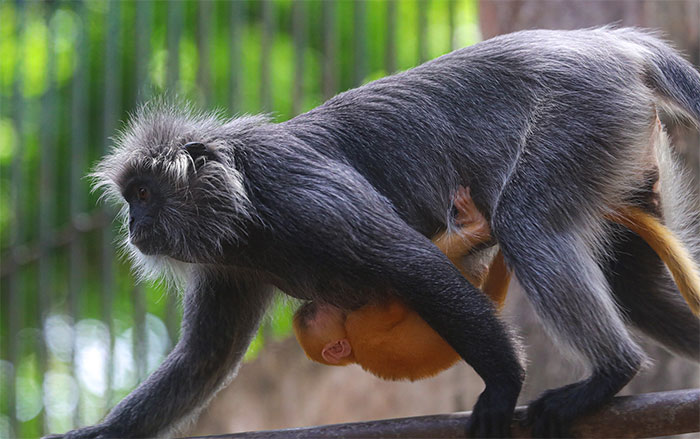
Images circulating online show a newborn langur with orange fur being cared for by its silvery-gray parents. Right next door is the enclosure of a pair of yellow-cheeked gibbons, one of which has yellowish fur similar to the baby's.
This led many visitors and netizens to joke that it was a "love scandal" between the silvered langur and the yellow-cheeked gibbon, and that the orange baby was a "hybrid" of the two different species.
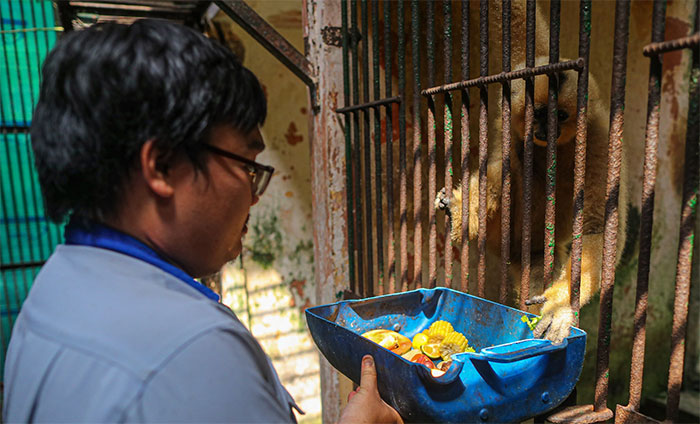
The neighboring enclosure houses a yellow-furred yellow-cheeked gibbon. Online, it was cast as the "other man" and suspected of being related to the orange baby simply because the two share the same fur color.
In adult yellow-cheeked gibbons, males have black fur, while females are yellowish.
After the photos and story of the zoo's langur family spread on social media, many visitors headed to the Saigon Zoo to see the stars of the story in person.
Thiên Ân, a visitor from the former Phú Nhuận district of Ho Chi Minh City, said that after seeing the photos and the rather amusing story of the langur family over the past few days, Ân invited a friend to come and see them.
"I'm not sure what the truth is behind the langurs' love story, but when I got here I found the baby really cute, with beautiful orange fur, and the whole family looked very happy cuddling together," Thiên Ân said.
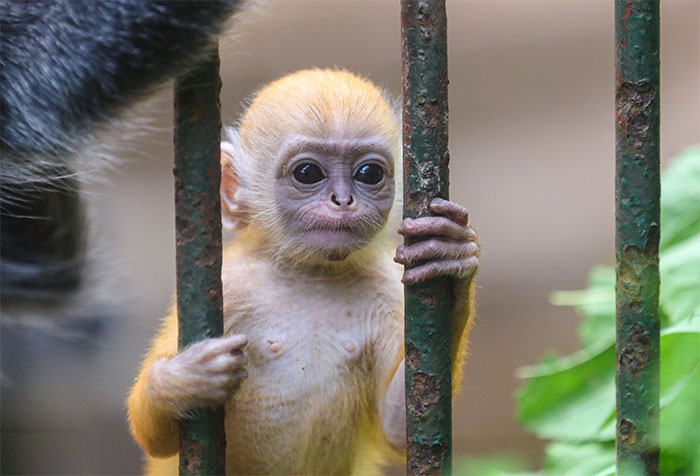
The baby silvered langur with orange fur has drawn a great deal of attention from visitors and netizens at the Saigon Zoo in recent days.

Many visitors have come to the langur enclosure to see the silvered langur family that went viral on social media.
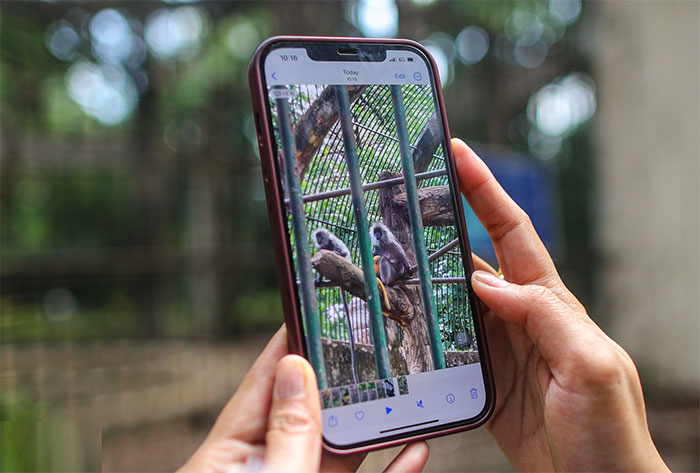
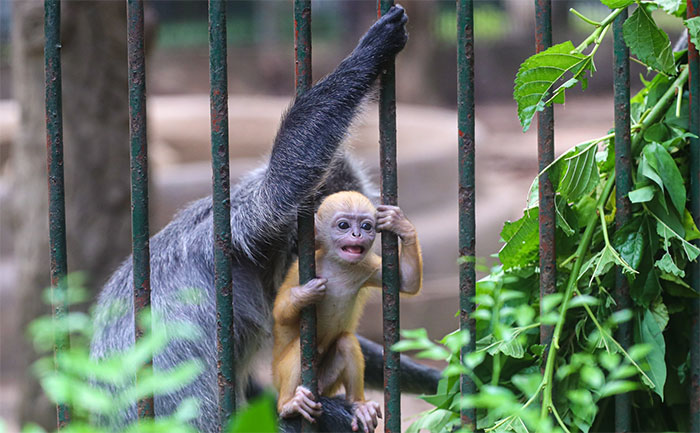
Visitors use their phones to film the silvered langur family and its orange baby.
Speaking to reporters, Mai Khắc Trung Trực, director of the animal division at Saigon Zoo and Botanical Gardens Co., Ltd., said that claims shared online that the orange baby was a hybrid of two different species were simply a misunderstanding.
According to Trực, adult silvered langurs have silvery-gray fur and jet-black skin. Newborns, however, have orange fur and slightly paler skin than their parents.
"A baby langur's color changes with age. At about 6 months after birth, it starts to change color, gradually turning from orange to silvery gray. This usually begins with the fur on the arms, legs and the top of the head, then spreads toward the body. By 1 year of age, the baby's fur looks exactly like its parents'," Trực said.
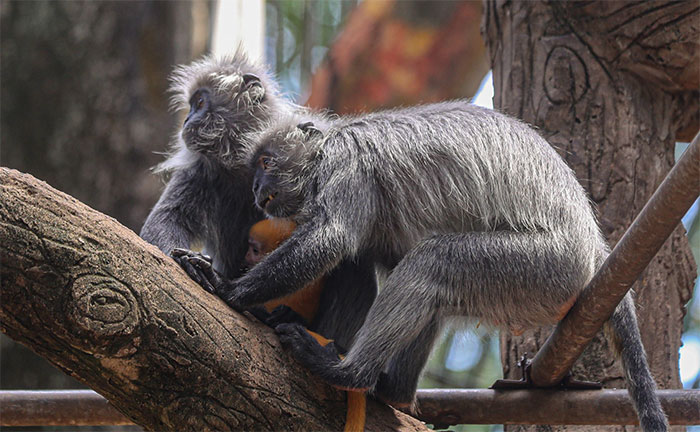
Days after the "love scandal," the silvered langur family remains inseparable. The father keeps showing affection and caring for the baby.
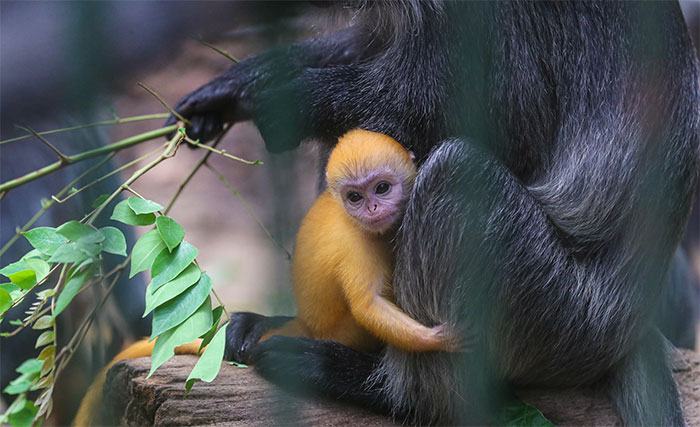
The baby is just over 1 month old, rather shy, rarely interacts with visitors and always stays close to its mother.

According to the director of the zoo's animal division, the zoo now has 30 silvered langurs, including 2 newborns.
The langurs are kept in enclosures, but some individuals are free to roam outside to play and mingle with nature in the gardens.
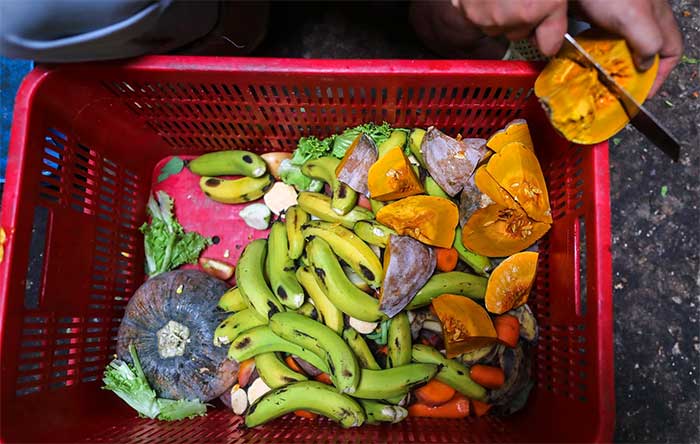
A keeper in charge of the langur enclosure said the langurs' diet consists mainly of vegetables, fruit and leaves, fed once a day. The ration is 1kg per animal, enough to last them the whole day.
Caring for the baby is not complicated, since the mother spends most of her time holding and nursing it. As long as the mother is well fed, she will take care of her baby herself.
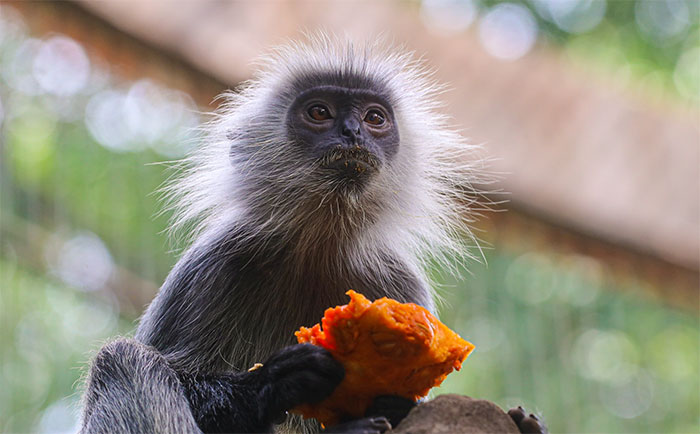
Silvered langurs are said to live about 20-30 years in the wild on average and breed once a year. In Vietnam, the species is found mainly in the former Kiên Giang province (now part of An Giang) and in several national forests.
According to some scientific studies, the orange color helps camouflage baby langurs from predators that hunt them, such as wild cats and leopards, which are red-orange color-blind. The orange color also draws the parents' attention, helping them spot their offspring easily and making it easier to care for them. |
Up close with the new venomous pit viper discovered in Vietnam
An international team has discovered a new venomous pit viper with yellow eyes and blue lips in the coastal forests of central Vietnam.
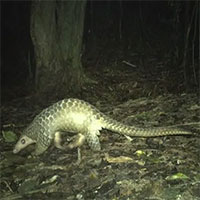
Close-up of rare animals in Vietnam's Sao La Nature Reserve
Camera traps in Vietnam's Sao La Nature Reserve have recorded 39 animal species since 2023, many of them rare and critically endangered.
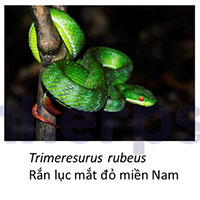
They look like the same red-tailed green pit viper, but there are actually 7 different species
What look like red-tailed green pit vipers are actually seven different species in Vietnam. Here is how to tell them apart.
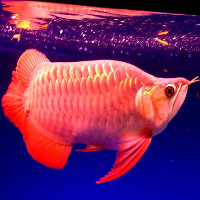
Things you may not know about the Asian arowana, the 'dragon fish'
The Asian arowana, or dragon fish, is a rare freshwater fish listed in Vietnam's Red Data Book that can grow up to 90 cm, exceptionally 120 cm, long.
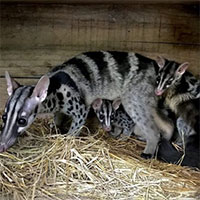
Rare Owston's civets successfully bred in captivity in Vietnam
Ten rare Owston's civets have been born naturally at a wildlife conservation center in Cúc Phương National Park, northern Vietnam.
Rare southern Vietnamese box turtle recorded in Vietnam's former Phú Yên province
The Critically Endangered southern Vietnamese box turtle can seal itself inside its shell completely, thanks to a hinged plastron.