Up close with the new venomous pit viper discovered in Vietnam
Scientists and biologists from several countries have surveyed the coastal region of central Vietnam and discovered a new species of pit viper.
According to a study published in the journal Zootaxa, the international team carried out fieldwork in 2023 in several coastal forests of south-central Vietnam to survey the region's wildlife.
During the expedition, the researchers found dozens of pit vipers with striking yellow eyes.
Notably, one individual measuring about 63cm was found in a forest in Ninh Thuận province (now part of Khánh Hòa province), Vietnam. It stood out for its yellow eyes and blue lips. The scientists spotted the snake while it was hiding in a tree.

A close-up of the newly discovered blue-lipped pit viper in Vietnam (Photo: Nick Poyarkov et al.).
At first, the scientists assumed the snakes belonged to an already known species. However, a closer look at the captured specimens revealed distinctive features showing that they belonged to an entirely new species.
The researchers named the new species the blue-lipped pit viper, with the scientific name Trimeresurus cyanolabris. The name "cyanolabris" comes from the Latin "cyaneus", meaning "dark blue", and "labrum", meaning "lip", a reference to the distinctive blue patches on the snake's lips.
According to the study, the new species differs from known pit vipers in its scale counts, coloration and eyes. DNA analysis also showed that it is at least 6% genetically distinct from other known pit vipers.
The blue-lipped pit viper is a small species, reaching only about 60cm in length. It has a long, slender body and a triangular head that is clearly distinct from the neck. Its face is dominated by large, bright yellow eyes.
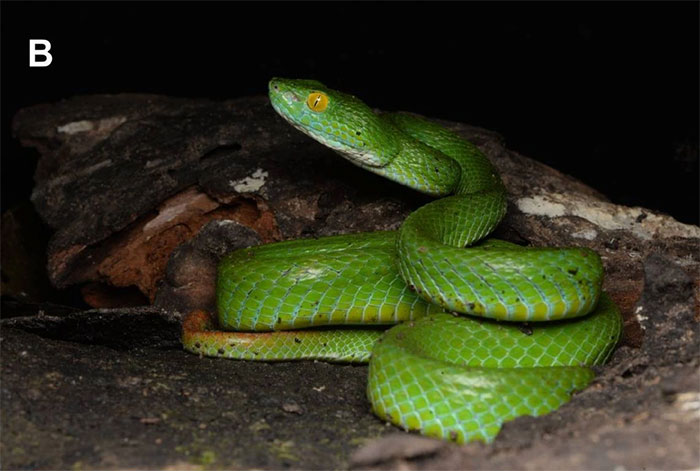
The newly found pit viper stands out for its large, bright yellow eyes (Photo: Nick Poyarkov et al.).
The snake has a green body that turns yellowish-green on the flanks and belly, and the end of its tail bears a dark red stripe. True to its name, it has a sky-blue stripe running along its lips, jaw and throat.
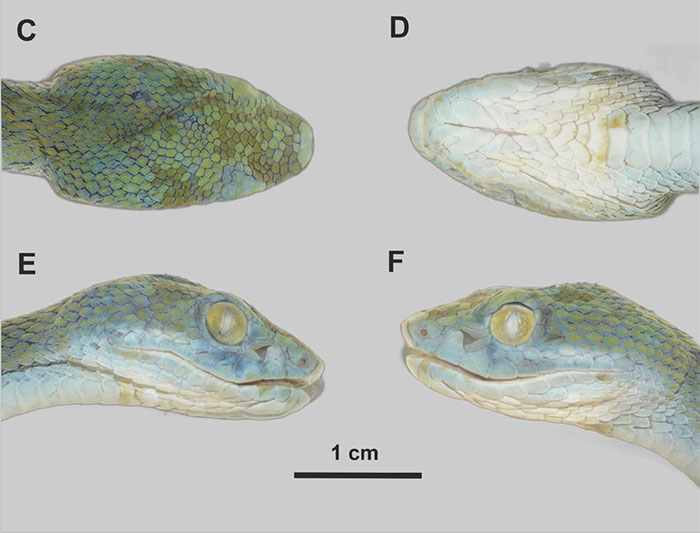
A close-up of the head of a blue-lipped pit viper specimen collected by the scientists (Photo: ResearchGate).
The blue-lipped pit viper lives in coastal forests along Vietnam's central coast and is most active at dusk and after dark. During the day, it usually hides on low branches or in tree hollows.
The researchers also found blue-lipped pit vipers on rocks near rivers and in thickets on the ground.
The study found that the snake feeds on frogs and small lizards.
Like other pit vipers, the blue-lipped pit viper has venom that is dangerous to humans, although scientists have yet to study its venom in detail.
So far, the blue-lipped pit viper has been recorded in several southern lowland areas, from the former Phú Yên province (now part of Đắk Lắk) to the former Ninh Thuận province. The researchers expect the species may turn out to be more widely distributed.
The team that discovered the new pit viper included two Vietnamese biologists, Nguyễn Văn Tân and Lê Đắc Xuân, along with scientists from several other countries: Sabira Idiiatullina, Andrey Bragin and Nikolay Poyarkov (all from Russia), Parinya Pawangkhanant (Thailand), Gernot Vogel (Germany) and Patrick David (France).
Close-up of rare animals in Vietnam's Sao La Nature Reserve
Camera traps in Vietnam's Sao La Nature Reserve have recorded 39 animal species since 2023, many of them rare and critically endangered.
They look like the same red-tailed green pit viper, but there are actually 7 different species
What look like red-tailed green pit vipers are actually seven different species in Vietnam. Here is how to tell them apart.

Things you may not know about the Asian arowana, the 'dragon fish'
The Asian arowana, or dragon fish, is a rare freshwater fish listed in Vietnam's Red Data Book that can grow up to 90 cm, exceptionally 120 cm, long.
Rare Owston's civets successfully bred in captivity in Vietnam
Ten rare Owston's civets have been born naturally at a wildlife conservation center in Cúc Phương National Park, northern Vietnam.

Rare southern Vietnamese box turtle recorded in Vietnam's former Phú Yên province
The Critically Endangered southern Vietnamese box turtle can seal itself inside its shell completely, thanks to a hinged plastron.
Rescued pangolins give birth in Vietnam
Two Sunda pangolins rescued from traffickers and cared for at a wildlife rescue center near Hội An, Vietnam, have given birth.