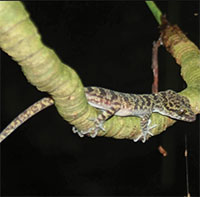
They look like the same red-tailed green pit viper, but there are actually 7 different species
Green pit vipers are widespread in Vietnam and pose a hidden danger to people because they blend so well into their surroundings. Yet few people know that as many as seven different green pit viper species live in the country.
Telling them apart when you come across one is far from easy, so the guide below should help readers quickly identify the different species. It was shared by the Amphibians and Reptiles of Vietnam (Lưỡng cư và Bò sát Việt Nam) page.

Key features for telling green pit vipers apart.
The viper family in Vietnam includes about 22 to 24 recorded species in the family Viperidae, spread across seven genera. Snakes in this group are mostly green or brown. This article covers seven species that share a distinctive green color and are very easily confused because they look so alike.
People unfamiliar with snakes call all of them "red-tailed green pit vipers," but there are actually seven different species:
- 1. Trimeresurus albolabris: white-lipped pit viper (the most common)
- 2. Trimeresurus vogeli: Vogel's pit viper
- 3. Trimeresurus stejnegeri: Stejneger's green pit viper
- 4. Trimeresurus rubeus: southern ruby-eyed pit viper
- 5. Trimeresurus cardamomensis: Cardamom Mountains green pit viper
- 6. Trimeresurus guoi: Guo's pit viper
- 7. Trimeresurus gumprechti: Gumprecht's green pit viper
To distinguish these species, we need to look at eye color, geographic location and the color of the snake's cheeks (pinkish or pale white), and finally the color of the tail. Let's look at each species in more detail below.
We will divide the snakes into three main groups based on eye color, distribution and the white stripe below the eye. See the image below:
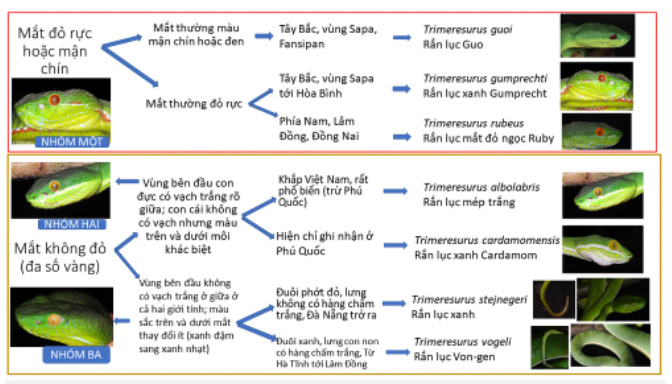
A quick way to tell green pit vipers apart. (Photo: Amphibians and Reptiles of Vietnam).
Group 1: red or plum-colored eyes (3 species)
- If the eyes are black or plum-colored, with a yellow or white stripe along the flank, and the snake is found only in the northwest, it is Guo's pit viper, Trimeresurus guoi.
- If the eyes are red and the flank stripe is red, in the northwest from the former Hòa Bình province (now part of Phú Thọ) to Lào Cai, it is Gumprecht's pit viper, Trimeresurus gumprechti.
- If the eyes are red and the snake is in the south, in Lâm Đồng or Đồng Nai and nearby areas, it is the red-eyed or ruby-eyed pit viper, Trimeresurus rubeus.
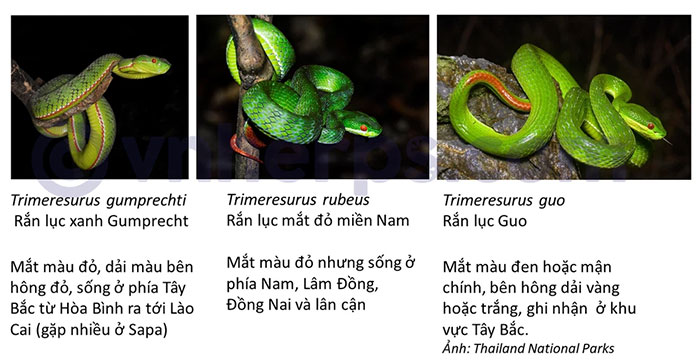
For Group 1, the red-eyed group, the following extra information is needed for identification. (Photo: Thailand National Parks).
Group 2 (two species): eyes not red
If the eyes are not red but brown, pale yellow, or possibly copper, look at the cheeks: males have a distinct white stripe, while females have two-toned cheeks that are fairly sharply divided (green on the upper part and yellow along the lower lip).
These two species are very similar, so the location where they are found is needed to identify them: the Cardamom green pit viper has been recorded only on Phú Quốc Island, off southern Vietnam (formerly part of Kiên Giang province, now An Giang province), while the white-lipped pit viper is found across almost all of Vietnam.
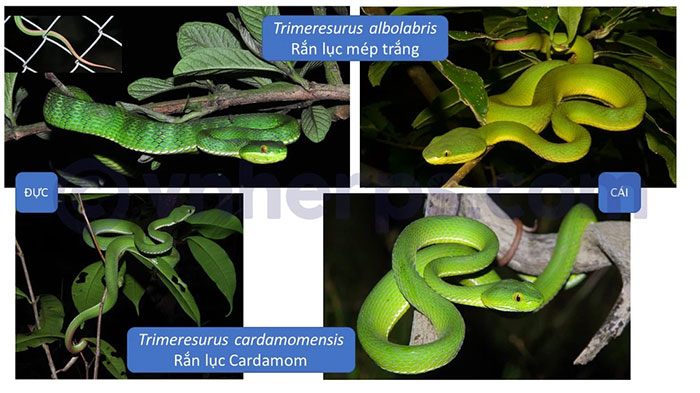
Telling apart the two species in Group 2. (Photo: Amphibians and Reptiles of Vietnam).
Group 3 (2 species): no white stripe on the cheeks
Both have copper or brown eyes like Group 2, but their cheeks lack a white stripe; they are usually uniformly green or shade from dark green above to a paler color toward the mouth.
These are the two hardest species to tell apart, even for professional taxonomists. They can be distinguished as follows:
- Juveniles often have white spots on the back, the tail is entirely green, and the species lives from Hà Tĩnh south to Lâm Đồng: Vogel's pit viper, Trimeresurus vogeli.
- The tail tip is reddish brown, there are no white spots on the back at all, and the species lives from Đà Nẵng northward: Stejneger's green pit viper, Trimeresurus stejnegeri.
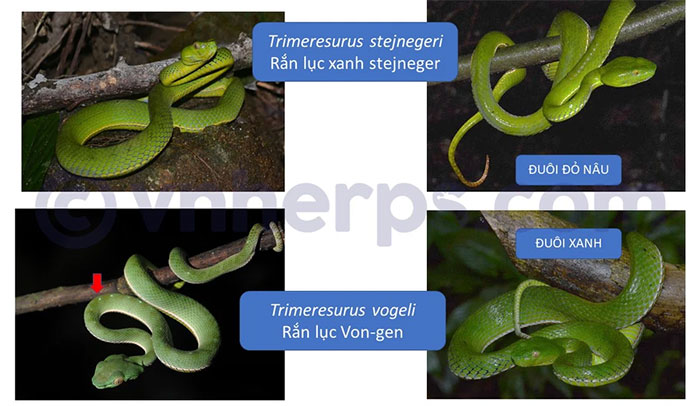
Group 3 includes two very similar species. (Photo: Amphibians and Reptiles of Vietnam)
These are quick identification tips that most people can use, even those who are not specialists in snake taxonomy. All seven species are venomous, with hemotoxic venom that causes tissue necrosis, but bites are not fatal if treated promptly.
If you are bitten by a red-tailed green pit viper, never apply a tourniquet, cut the wound or suck out the blood, and do not apply remedies of unknown origin. Instead, give first aid (apply a light bandage and splint, as you would for a broken arm or leg) and take the victim to the nearest medical facility for help.
Rare Owston's civets successfully bred in captivity in Vietnam
Ten rare Owston's civets have been born naturally at a wildlife conservation center in Cúc Phương National Park, northern Vietnam.

Rare southern Vietnamese box turtle recorded in Vietnam's former Phú Yên province
The Critically Endangered southern Vietnamese box turtle can seal itself inside its shell completely, thanks to a hinged plastron.
Rescued pangolins give birth in Vietnam
Two Sunda pangolins rescued from traffickers and cared for at a wildlife rescue center near Hội An, Vietnam, have given birth.
Rare glossy ibis recorded in central Vietnam for the first time
Fourteen glossy ibises, a rare bird usually seen in southern Vietnam, have been recorded in central Vietnam for the first time.
Ho Chi Minh City resident catches rare hornbill on rooftop garden trellis
A family in Ho Chi Minh City found a rare wreathed hornbill perched on a gourd trellis and handed it over to forest rangers.
Nearly 100-kg green turtle travels from Malaysia to Côn Đảo to lay eggs
A green turtle weighing nearly 100 kg and wearing a Malaysian tag came ashore on Hòn Bảy Cạnh, Côn Đảo, and laid 108 eggs.