"Sea dragon" said to predict earthquakes washes up in Vietnam
Many people believe that when this fish suddenly washes ashore, it is an omen of impending natural disasters and earthquakes. So what is the truth?
Meet the "sea dragon" said to predict earthquakes that drifted into Vietnamese waters
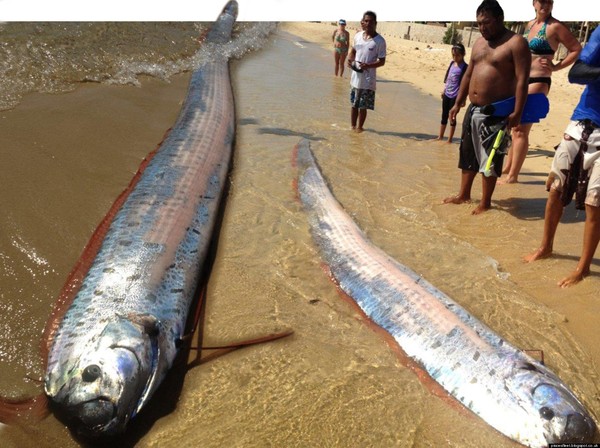
According to some reports, on the morning of May 12, residents of the Trung Trạch coast in the former Bố Trạch district, in the former Quảng Bình province in central Vietnam, spotted a fish more than 4 m long that had washed ashore.
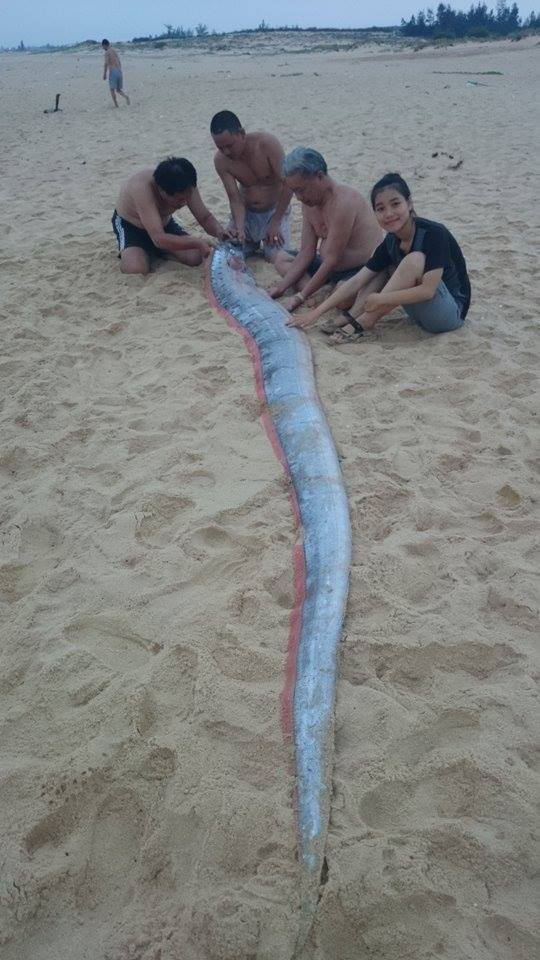
The giant fish that washed ashore in Quảng Bình on May 12 (Photo: Otofun)
Last year, a fisherman from Đà Nẵng, a city in central Vietnam, also reported catching a “monster” fish measuring 4.2 m long and weighing 29.6 kg in the Chân Mây Bay area of the former Thừa Thiên Huế province.
Based on an initial assessment, the fish was identified as an oarfish, scientific name Regalecus glesne, one of the longest bony fish in the world.
Rumors have spread that the oarfish can forecast natural disasters, so its appearance is taken as a sign of an earthquake. The phenomenon has attracted a great deal of attention from scientists and curious members of the public alike. Read on to learn more about this giant fish and the truth behind its supposed mysterious powers.
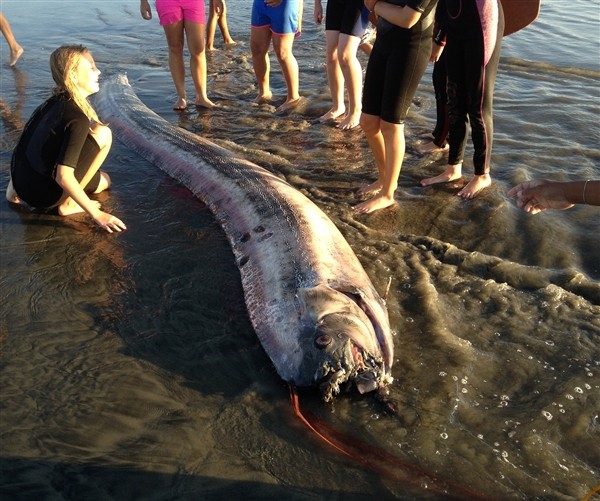
The giant oarfish (also known as the king of herrings, scientific name Regalecus glesne) was first described in 1772, but it is rarely seen because it lives deep in the ocean, at depths of up to 1,000 m below the surface.

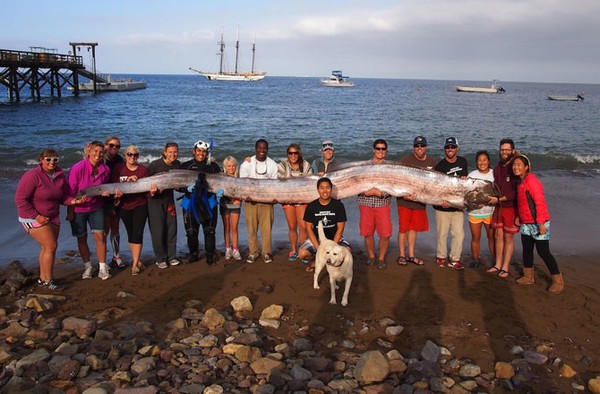
The giant oarfish is the longest species known among bony fish, with reported lengths of up to 17 m and weighing as much as 270 kg.
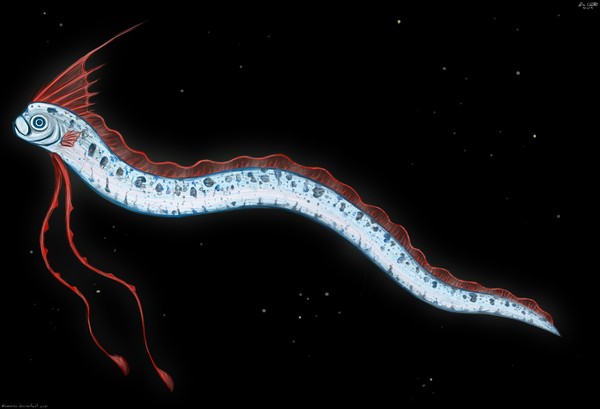
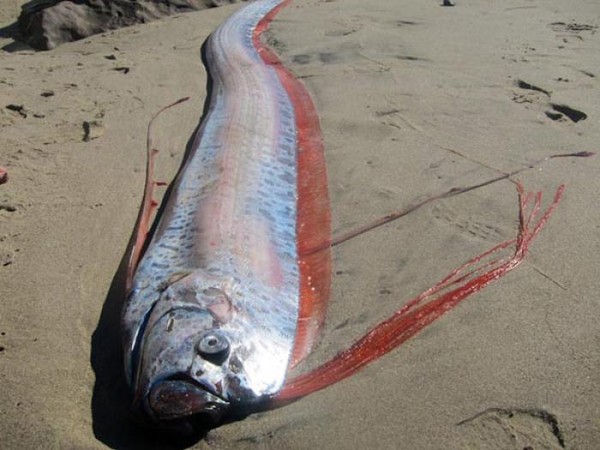
The oarfish has a ribbon-like appearance, with a fairly thin, flattened body and a dorsal fin that runs along its entire length. Because of its "monster" length and distinctive red fin, many people call it a giant sea serpent, or a "sea dragon."
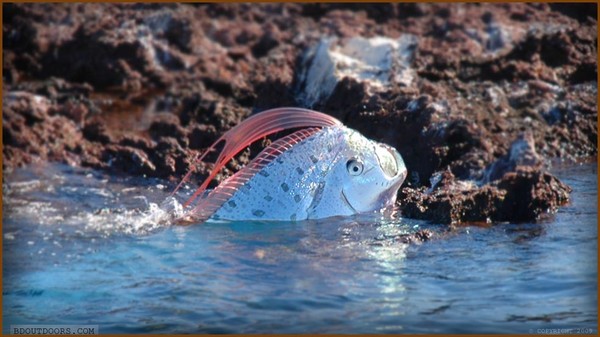
Its pectoral fins are usually stubby, while its pelvic fins are long and oar-shaped. The fish is typically silver with black markings and red fins.
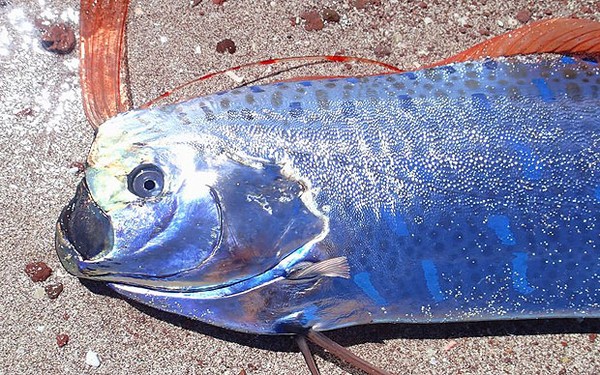
The oarfish has no scales, but it wears a silvery coat containing the chemical guanine, a substance abundant in the scales of some fish. Although it is adapted to survive under high pressure, the oarfish's skin is very soft and easily damaged.
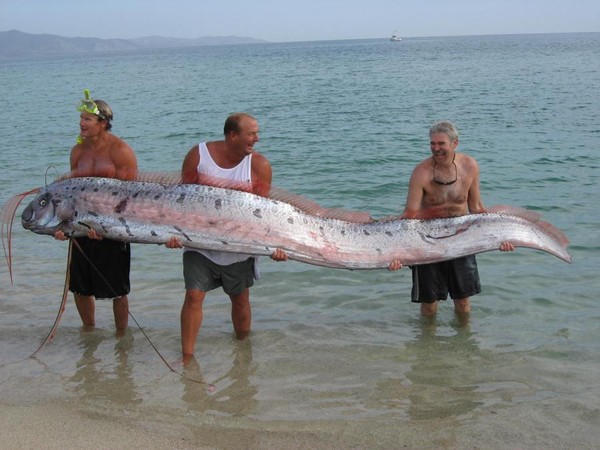
Despite its "giant" body, the oarfish has no teeth and usually catches prey with its gills. It sucks water into its mouth and expels it through its gills, filtering out small food items. Its favorite foods are krill and other small crustaceans, as well as small fish and squid.
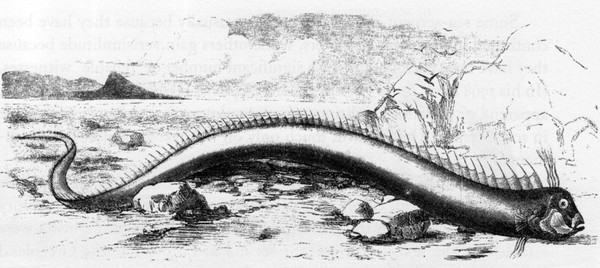
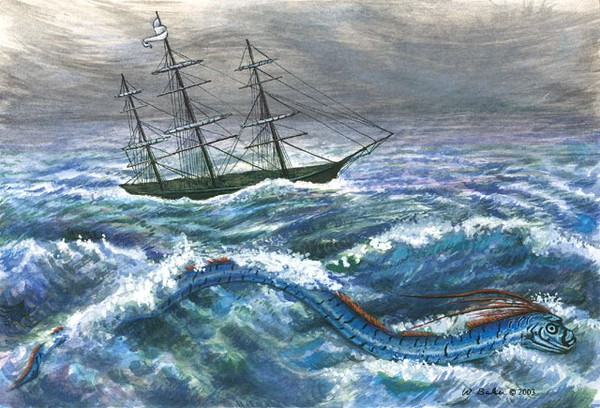
Many Japanese people have long believed that whenever an oarfish carcass washes ashore, it is a sign that an earthquake is coming.
This belief stems from a Japanese legend that says oarfish washed up on the shore are messengers sent from the palace of the sea god.
Many scientists have rejected this claim. They note that some studies have recorded particularly large fluctuations before earthquakes, coinciding with a decline in animal activity observed in the period before the quakes.
One hypothesis holds that positive ions in the air may cause unpleasant side effects in both humans and animals, such as a rise in serotonin in the blood, which leads to restlessness, anxiety and hyperactivity...
In a study involving toads, scientists found that the toads' activity coincided with pre-seismic disturbances in the ionosphere, which were detected using very low frequency (VLF) radio waves.
Even so, the scientists could not draw any conclusions from their research about what caused the toads' unusual behavior.
As for the oarfish, experts say that because it lives at great depths, it may be more sensitive to ground movements than species that live near the surface. However, no scientific study has yet proven whether this fish can actually predict earthquakes.
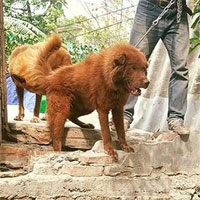
Vietnam's "four great national dogs": Which rare breeds make the list?
Vietnam's four native "national dogs" are the Bắc Hà dog, the Lài dog, the Hmong Bobtail and the Phú Quốc Ridgeback.
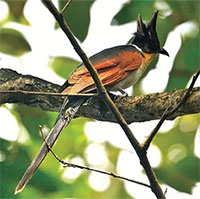
10 of Vietnam's rarest and most unusual birds
Vietnam's rich, diverse ecosystems are home to many rare birds, some with unusual names and distinctive calls.
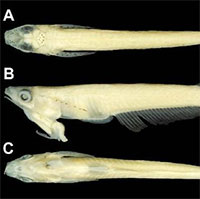
Found only in Vietnam: the bizarrely evolved fish with a truly unique way of mating
The Mekong priapiumfish, endemic to Vietnam, was named one of the world's 10 strangest discoveries by National Geographic in 2012.
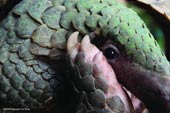
Rare animals rescued in Vietnam
Leopards, yellow-cheeked gibbons, grey-shanked doucs, silvered langurs and Asian black bears are among rare animals rescued by Wildlife At Risk in Vietnam.
"Gan lì cóc tía": The strange animal behind a famous Vietnamese idiom
The fire-bellied toad lives on in the Vietnamese idiom "gan lì cóc tía," yet today almost no one ever gets to see one in the wild.
What to know about Vietnam's rare crocodile newt
Like the Tam Đảo newt, the Vietnamese crocodile newt (Tylototriton vietnamensis) is an exceptionally rare animal found only in Vietnam.