The snake that is gentle with humans but deadly to venomous snakes
A snake species with remarkably unusual scales lives in Vietnam. It is very gentle toward humans, yet it is considered an enemy of venomous snakes.
The sunbeam snake: a snake with extraordinary scales
The snake in question is the sunbeam snake, known in Vietnamese as hổ hành or rắn mống, with the scientific name Xenopeltis unicolor. It belongs to the sunbeam snake family (Xenopeltidae). The family contains a single genus, Xenopeltis, and two species: the sunbeam snake and the Hainan sunbeam snake.
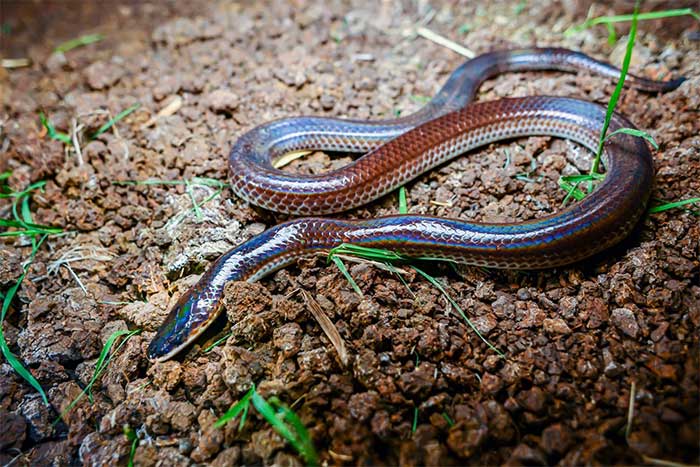
In strong sunlight, sunbeam snakes give off a dazzling, multicolored iridescent sheen.
What the two sunbeam snake species have in common is scales that appear to change color depending on the surrounding light. In strong sunlight in particular, sunbeam snakes give off a dazzling, multicolored iridescent sheen.
Sunbeam snakes are found in China and Southeast Asian countries such as Myanmar, Thailand, Laos, Cambodia, Indonesia, Malaysia, Singapore and Vietnam. Of the two species, Xenopeltis unicolor is the more widespread and more commonly encountered in Vietnam.
Adult sunbeam snakes measure 1 to 1.2 m long, and their heads are not clearly distinct from their necks. The head is slender and pointed, which helps the snake burrow easily into the soil.
Thanks to its distinctive iridescent skin, the sunbeam snake is easy to recognize in the wild, even for people without much knowledge of animals or reptiles.
Juvenile sunbeam snakes look very similar to adults, except that they have a band of white scales around the head, like a collar. This "collar" fades during the young snake's first year.
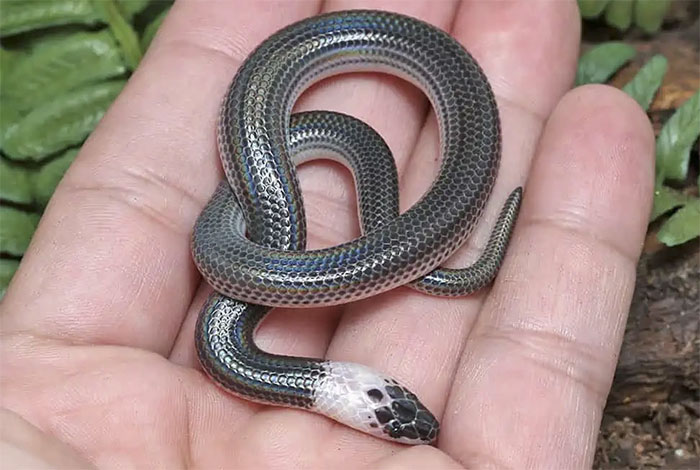
Juvenile sunbeam snakes stand out with a white "collar" on their bodies. (Photo: ThaiNationPark).
Besides its outward coloring, the sunbeam snake can also be identified by its body odor. The snake gives off a rather unpleasant smell, similar to raw onion. The odor is strong enough that many people can detect the snake before they even see it. This may be the origin of its Vietnamese name, hổ hành ("hành" means onion).
In Vietnam, sunbeam snakes are most common in the Tây Nam Bộ region (the Mekong Delta in southwestern Vietnam). They usually hide in dense undergrowth and along lakeshores, where frogs and toads are abundant and provide a plentiful food supply.
Is the sunbeam snake venomous?
Although its Vietnamese name contains the word "hổ", which Vietnamese uses for cobras and their relatives, the sunbeam snake does not actually belong to the "hổ" family (Elapidae), whose members carry deadly venom. As mentioned above, it belongs to the sunbeam snake family and has no venom.
The sunbeam snake: a natural enemy of venomous snakes
Because it has no venom, the sunbeam snake hunts by using the strength of its body to coil tightly around prey and kill it before eating it. This hunting method resembles that of pythons and some other nonvenomous snakes.
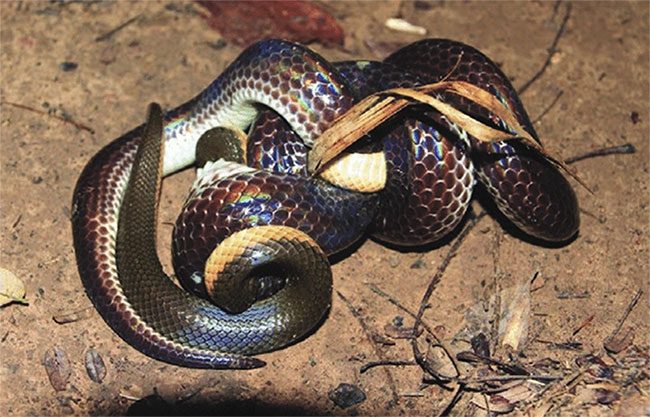
The sunbeam snake uses its muscular strength to constrict and kill its prey. (Photo: ResearchGate).
One special feature that makes the sunbeam snake a more effective hunter is that its teeth are not fixed in place but hinged, able to fold up or down. When it strikes, the teeth sink firmly into the prey and fold backward, holding it tight and making escape difficult. This tooth structure also helps the snake swallow its prey whole more easily.
Another impressive trait of the sunbeam snake is its resistance to the venom of some venomous snakes, including several members of the cobra family such as cobras, banded kraits and many-banded kraits... This allows the sunbeam snake to hunt and eat venomous snakes it encounters.
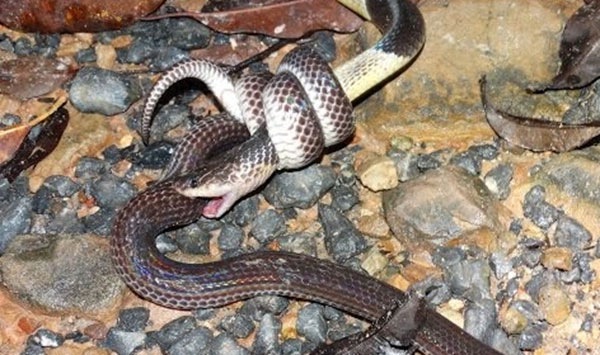
A sunbeam snake constricting a many-banded krait, a deadly venomous member of the cobra family (Photo: TBH).
Of course, sunbeam snakes can only kill and eat venomous snakes smaller than themselves. When they encounter larger venomous snakes, such as king cobras, they are unlikely to defeat and eat them; on the contrary, they may end up as prey themselves.
Many experts say that if you find a sunbeam snake in your garden, you should not kill it or drive it away, but let it stay as a kind of "caretaker," since it can help reduce the number of venomous snakes that may be present.
Besides venomous snakes, the sunbeam snake has a very varied diet, including frogs, toads, lizards and some small mammals.
The sunbeam snake: gentle toward humans
Although it is considered a natural enemy of venomous snakes, the sunbeam snake is very gentle and almost never attacks humans. Even when held in someone's hand, it only tries to get away.
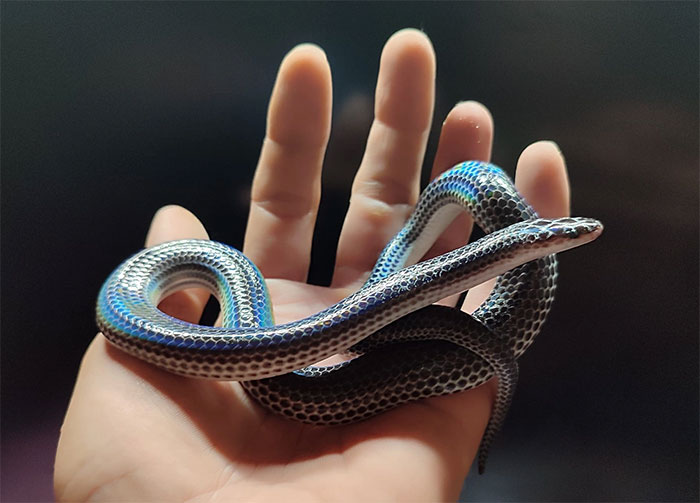
A sunbeam snake spotted in the former Kiên Giang province (now part of An Giang province) in southern Vietnam. (Photo: Trần Trí Dũng).
Many people assume that with such a gentle nature and brilliant colors, the sunbeam snake would be a popular choice as a pet.
However, as mentioned above, the sunbeam snake gives off a distinctive foul smell that many people find unpleasant. In addition, sunbeam snakes often die in captivity, so they are not a suitable choice as pets.
Conclusion
The sunbeam snake is a gentle snake that benefits the ecosystem. It is easy to identify thanks to its distinctive appearance, so if you come across one in the wild, leave it alone and keep your distance.

The Malayan pit viper: A dangerous venomous snake common in Vietnam, dubbed a "living landmine"
Rather than flee from humans, the Malayan pit viper lies still, ready to strike anyone who comes too close or accidentally steps on it.
4 highly venomous snakes most often found on Fansipan
One of them is dubbed "Vietnam's king of warm-blooded prey". Meet four deadly pit vipers that live on Fansipan, Indochina's highest peak.
How to tell the banded krait from the Malayan krait
Vietnam is home to many highly venomous snakes, notably two "siblings": the banded krait and the Malayan krait. Here's how to tell them apart.
The highly venomous Malayan pit viper is easily mistaken for this snake: Here's how to tell them apart
Both belong to the viper family Viperidae, making them easy to confuse. Here are some quick ways to tell them apart.
How to tell the king cobra, the common cobra and the oriental rat snake apart
Many accidents happen because people can't tell these snakes apart. Here's how to identify the king cobra, common cobra and rat snake.
The highly venomous cobras that live in Vietnam
Four cobra species live in Vietnam, and all of them carry potentially lethal venom. Here is how to recognize them and what to do if you meet one.