The Malayan pit viper: A dangerous venomous snake common in Vietnam, dubbed a "living landmine"
Instead of fleeing when it spots a human, this venomous snake stays perfectly still, ready to strike at anyone who comes too close or accidentally steps on it.
The Malayan pit viper: a venomous snake that is easy to identify
The Malayan pit viper (scientific name Calloselasma rhodostoma), known in Vietnamese as chàm quạp and also by other local names such as rắn lục nưa, rắn cà tênh and rắn lục Malaysia, is a venomous snake in the viper family (Viperidae).
Adults typically measure 70 to 90cm in length, occasionally reaching 1m, and females are usually larger than males. The species has a head that is clearly distinct from the neck, with a large, triangular head.
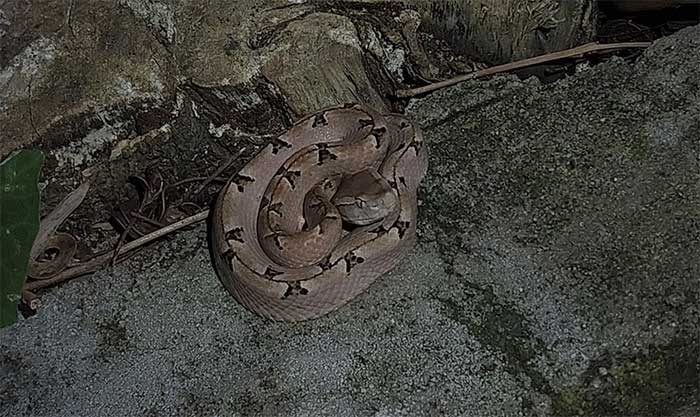
The Malayan pit viper is easy to recognize by the symmetrical triangular markings that form a butterfly-wing pattern on its body (Photo: Nguyễn Chí Lâm).
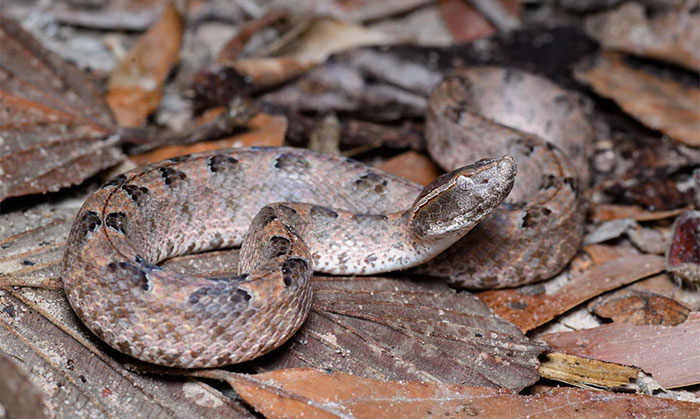
A highly distinctive feature of this snake is the row of symmetrical brown triangular markings running along its spine, forming a shape resembling butterfly wings. Its body is grayish-yellow or brown, which makes it very hard to spot when it lies in piles of dry leaves.
Because the Malayan pit viper is so easy to identify by the patterns and colors on its body, people can actively avoid confrontations or respond appropriately when they encounter it in the wild or around their homes.
The Malayan pit viper is widespread across Southeast Asia, including Vietnam, Thailand, Malaysia, Cambodia and parts of Indonesia.
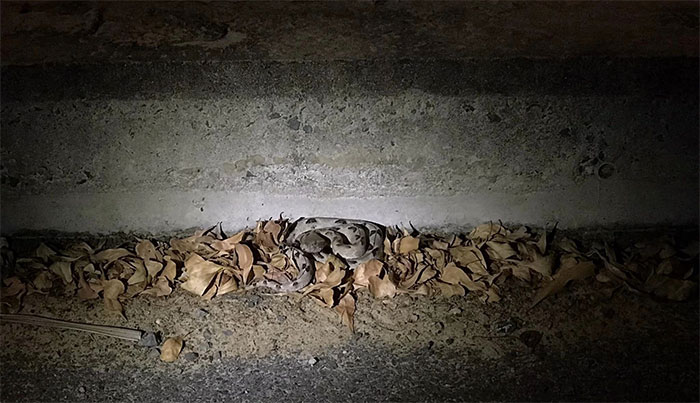
A Malayan pit viper spotted on a roadside in Phan Thiết city, Bình Thuận province, in south-central Vietnam (Photo: SIFASV).
In Vietnam, the Malayan pit viper is found in the South Central Coast (Nam Trung Bộ), the Central Highlands (Tây Nguyên) and the Southeast region (Đông Nam Bộ), and it is most common in Bình Thuận, Ninh Thuận and Bà Rịa-Vũng Tàu provinces and on Núi Cấm (Cấm Mountain) in An Giang province in the Mekong Delta.
Why is the Malayan pit viper called a "living landmine"?
The Malayan pit viper is often found in rubber, melaleuca and eucalyptus plantations, abandoned overgrown farmland and fruit orchards. Notably, it sometimes turns up in areas where people live, because it often follows rats, its favorite prey.
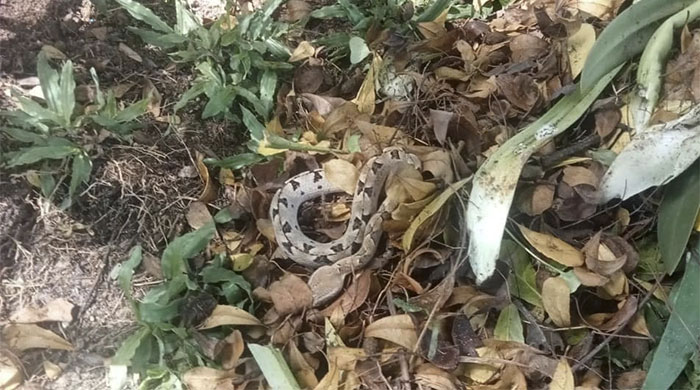
Malayan pit vipers often hide in piles of dry leaves and are very difficult to spot (Photo: SIFASV).
The Malayan pit viper often hides under piles of dry leaves. Thanks to its coloration, it is very difficult to notice the snake in areas thick with fallen leaves, especially on plantations. It can also be found in tree hollows and under rocks.
While other snakes, including venomous ones, usually try to slip away when people approach, the Malayan pit viper coils up and lies motionless in the leaf litter instead of fleeing. If a person unknowingly comes too close or steps on it, the snake strikes, then pulls itself back into position and stays put, ready to attack again.
This habit of holding its ground to defend itself, rather than fleeing when threatened, is what earned the Malayan pit viper its nickname of "living landmine."
How venomous is the Malayan pit viper?
The Malayan pit viper's venom contains enzymes that are cytotoxic and affect the blood (hemotoxic), capable of destroying red blood cells and tissue and causing severe pain and bleeding.
Small prey such as rats and birds bitten by the snake bleed to death. In humans, a bite causes swelling, edema, blisters and bruising. Without prompt emergency treatment, the bite can lead to excruciating pain and necrosis.
If victims reach the hospital too late, the wound can become necrotic, forcing doctors to perform a joint disarticulation.
Anyone bitten by a Malayan pit viper must be taken to a hospital immediately for antivenom treatment. If the victim arrives late, the wound may become necrotic, forcing doctors to amputate at a joint or remove the limb; in severe cases, the bite can be fatal.
According to Phạm Minh Hiếu, a snake expert who runs the YouTube channel "Sứ giả rừng xanh" ("Messenger of the Green Forest"), victims of a Malayan pit viper bite should not be given traditional first aid: do not cut, squeeze or suck the wound or apply herbal poultices, but take the victim to a hospital immediately for antivenom treatment.
Folk remedies or attempts to suck the venom out of the body will only make the bite worse. Above all, never apply a tourniquet to the bitten limb, as this will make the necrosis even more severe.
Conclusion
The Malayan pit viper is one of the most venomous snakes in Vietnam. Because it is widely distributed and lives in a variety of habitats, encounters between people and this snake are quite likely.
If you live or work in areas where the Malayan pit viper occurs, stay alert to avoid being bitten. Wear rubber boots and gloves when entering areas with heavy leaf litter, such as melaleuca forests and rubber plantations.
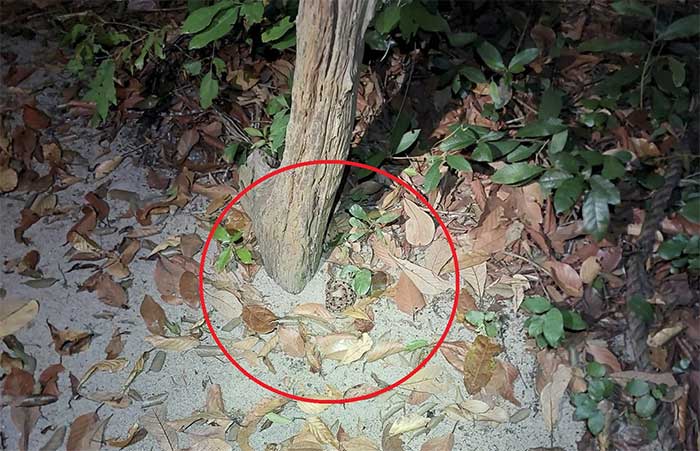
A Malayan pit viper in Vũng Tàu (Photo: Tuệ Đại).
Since the Malayan pit viper is easy to recognize from its body markings, if you come across one, keep well away and do not try to catch it, to avoid being bitten. If a snake shows up inside your home, call the fire department or trained professionals to deal with it and prevent an unfortunate accident.
4 highly venomous snakes most often found on Fansipan
One of them is dubbed "Vietnam's king of warm-blooded prey". Meet four deadly pit vipers that live on Fansipan, Indochina's highest peak.
How to tell the banded krait from the Malayan krait
Vietnam is home to many highly venomous snakes, notably two "siblings": the banded krait and the Malayan krait. Here's how to tell them apart.
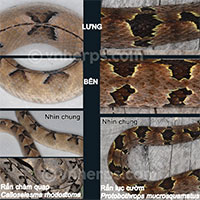
The highly venomous Malayan pit viper is easily mistaken for this snake: Here's how to tell them apart
Both belong to the viper family Viperidae, making them easy to confuse. Here are some quick ways to tell them apart.
How to tell the king cobra, the common cobra and the oriental rat snake apart
Many accidents happen because people can't tell these snakes apart. Here's how to identify the king cobra, common cobra and rat snake.
The highly venomous cobras that live in Vietnam
Four cobra species live in Vietnam, and all of them carry potentially lethal venom. Here is how to recognize them and what to do if you meet one.