

The truth about Vietnam's strange "tie the girl to the post" bird
Beyond its unusual name, the "bắt cô trói cột" bird is one of Vietnam's most curious birds. In Vietnam, the bird, known in English as the Indian cuckoo, is found almost everywhere, from mountain forests to the lowland plains.
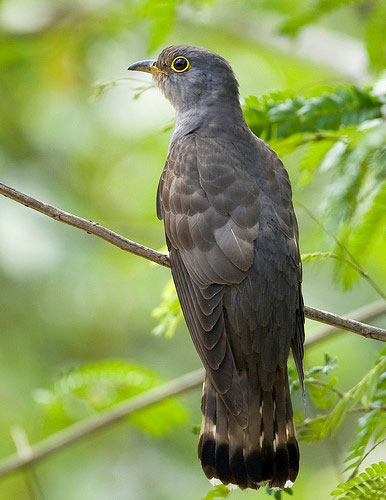
The "bắt cô trói cột" bird goes by the scientific name Cuculus micropterus.
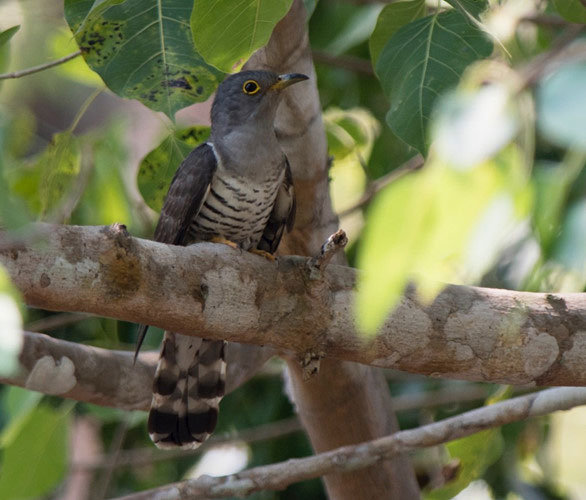
It is a medium-sized cuckoo, and males and females look quite alike.
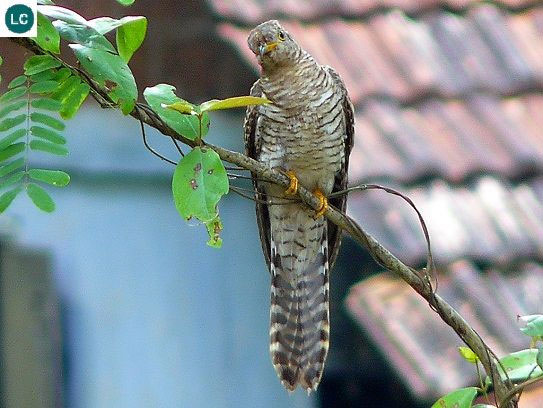
Worldwide, the Indian cuckoo is distributed across Asia, from Pakistan, India and Sri Lanka to Indonesia in the south and China.
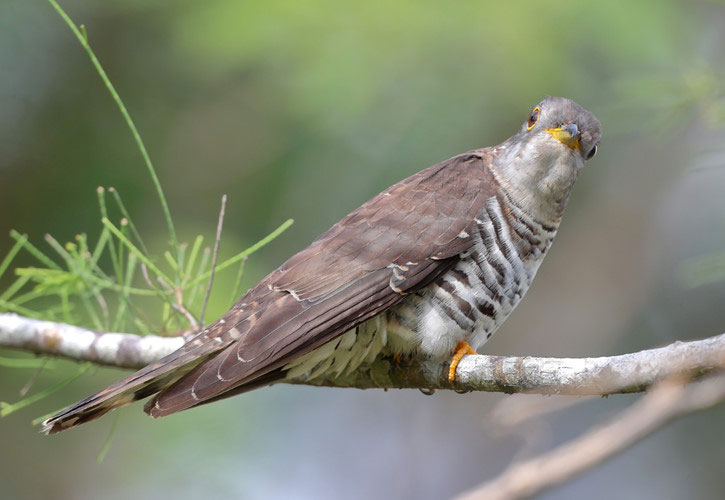
The bird usually lives in forests at altitudes of up to 3,600 m.
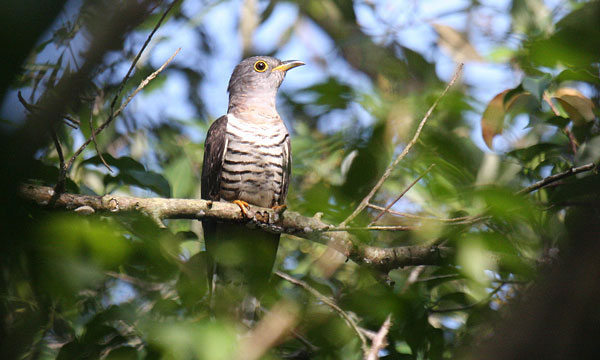
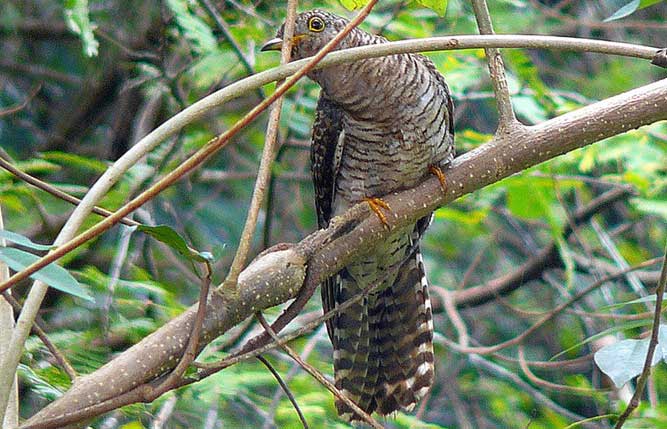
Its upper body is grey, while the lower half is marked with many black-and-white bars.
Nestlings have an orange-red mouth with a yellow rim.
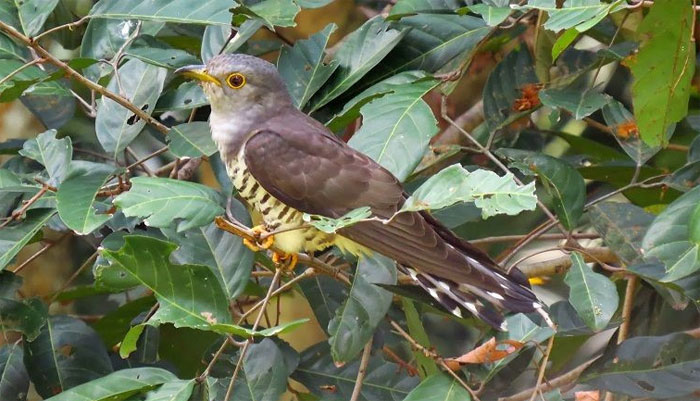
This unusual bird prefers evergreen and semi-evergreen forests, but it also lives in gardens and shrubland.
Listening to the bird's call, Vietnamese people have heard it as many different phrases, such as "năm trâu sáu cột" ("five buffaloes, six posts"), "khó khăn khắc phục" ("overcome hardships"), "chim cu Ấn Độ" ("Indian cuckoo"), "Bắc quang Bắc mục", "bốn cô chín chục" ("four girls, ninety"), "chín cô bốn chục" ("nine girls, forty"), "năm trâu sáu cọc" ("five buffaloes, six stakes"), "trói cô vào cột" ("tie the girl to the post"), "vua quan trói cột" ("the mandarins tie the post")...
Two subspecies are widely recognized. The subspecies Cuculus micropterus sp. micropterus is found on the Asian mainland, while the subspecies Cuculus micropterus sp. concretus S. Müller, 1845, is smaller, has darker plumage and occurs on the Malay Peninsula, Java, Sumatra and Borneo. Birds in the Amur region are larger-bodied, and Swinhoe called this group (from northern China northward) Cuculus michieanus, while Walter Norman Koelz described the form fatidicus from northeastern India.
The legend of the "bắt cô trói cột" bird Once upon a time, a poor farmer worked five sào (a traditional Vietnamese unit of land) of rice fields as a sharecropper for a rich landlord in his village. The landlord was the wealthiest man in the district, with more fields, buffaloes and cattle than anyone could count. Seeing that the farmer was honest and hardworking and always paid his rice dues in full, the landlord also entrusted him with raising buffaloes on a share basis. The farmer threw himself into his work, tending both the fields and the buffaloes, and before long the pair of buffaloes had grown into five. One day, the landlord suddenly... dropped dead, and all his fields, buffaloes and cattle passed to his only daughter. The trouble was that, of the many things the landlord had entrusted to his tenants, some were recorded in proper contracts, while others he had not yet put in writing before his sudden death. The daughter took after her father completely, like father, like daughter. She was also full of petty tricks and would never let even the smallest item go to an outsider. Once the mourning for her father was over, she set out to inspect every part of the estate he had left behind. She arrived at the poor farmer's house just as he was still out herding the buffaloes. She only knew that he raised buffaloes on shares, but not exactly how many; her father had not written it down in his ledgers, and the servants in the house only vaguely recalled that there were five or six or so. In those days, buffaloes were not kept in barns. A row of posts was simply driven into a corner of the yard, and in the evening each animal was tied to one post. When she arrived, she counted six posts and muttered to herself: "Six posts, so that makes six buffaloes." When the farmer drove the buffaloes home, she counted them forwards and backwards, and there were only five. "How strange! Could it be that he heard my father had died, and since my father never had papers drawn up for the buffaloes, he secretly sold one?" With that thought, she said loudly: "Hey, you! Where is the other one?". The farmer was surprised: "What other one do you mean, miss? I only ever raised five for the old master." She smirked slyly: "Now, don't you try to fool me. If there are five buffaloes, why are there six posts? Don't tell me you lost one in the forest." He explained that one post was nearly broken, so he had driven in another, but had been too busy to pull out the old one. She would not listen, and insisted: "Enough talk. If you can't find that buffalo, you'll have a hard time with me. Five buffaloes, so why six posts?" Hearing her mutter "five buffaloes, six posts" over and over, he flew into a rage and snapped: "The only way to make six would be to tie you to the post!". She was no pushover either, and leapt up, hurling every kind of insult at him. He thought: all this time I have dealt honestly with the landlord, and now this girl treats me like a swindler. Upset, he stormed off into the forest, and she followed close on his heels. Whenever she said "five buffaloes, six posts", he replied "tie the girl to the post." The two went deep into the forest and, so caught up in their back-and-forth, died of hunger and thirst. Both turned into birds and lived together in the same forest. They forage from dusk until dawn, one on this side of the mountain, the other on the far side. Their old argument has never ended: when one calls "năm trâu sáu cột" ("five buffaloes, six posts"), the other answers "bắt cô trói cột" ("tie the girl to the post"). |
