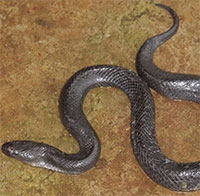
The harmless snake often mistaken for a deadly venomous one in Vietnam
A small, completely harmless snake found in Vietnam is often needlessly killed because of its undeserved reputation as a deadly venomous species.
The golden tree snake: a small climber that often crosses paths with people
The golden tree snake, known in Vietnamese as rắn cườm or rắn lục mè, belongs to the colubrid family. It is a small species, with adults reaching a maximum length of about 1.3 m.
This snake has a distinctive, easily recognizable body, with pale green scales crossed by black bands and a head that is clearly distinct from the neck. Occasionally, however, golden tree snakes come in other colors, such as red, yellow or orange scales… though these are less common.
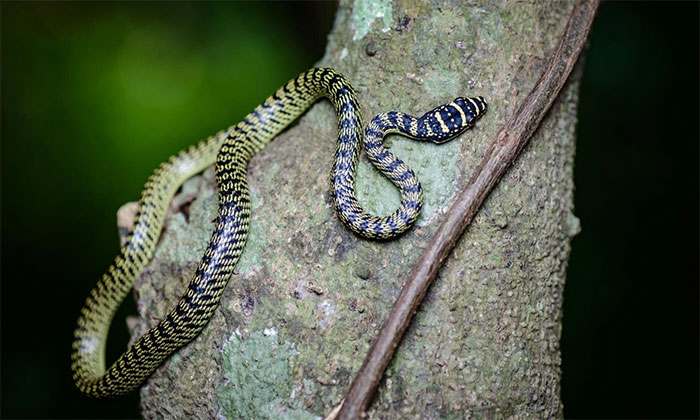
Golden tree snakes are excellent climbers.
The golden tree snake is widespread across Vietnam, in all three regions of the country. It feeds mainly on lizards, small rodents and similar prey... Females lay 6 to 12 eggs. Newly hatched young measure 15 to 20 cm and look like the adults, but with paler colors and patterns.
Golden tree snakes are excellent climbers and can even scale vertical walls that seem to offer no grip, which is why they often turn up on rooftops. Sometimes they even crawl into household air conditioners through the units' drain pipes.
Besides being skilled climbers, golden tree snakes belong to the genus of flying snakes. They can launch themselves from tall trees toward lower spots. In reality, this is a form of "controlled falling", in which the snake can anticipate where it will land. This behavior helps it escape predators or catch prey.
Because the golden tree snake is so common and widespread, it often hunts in areas where people live. In particular, it frequently slips into homes to catch house geckos, one of its favorite foods, so encounters between these snakes and humans are common.
Is the golden tree snake venomous?
The golden tree snake is a colubrid with only a very mild venom that poses no danger to humans. Its bite is not dangerous, although it may cause itching in some sensitive people.
The golden tree snake is beneficial to the ecosystem, helping to control populations of small rodents, lizards, geckos… So if you come across one, there is no need to panic: you can simply shoo it away instead of trying to kill it.
Thanks to its colorful, attractive scales and harmless nature, the golden tree snake is also kept as a pet by many reptile enthusiasts.
A harmful mix-up that gets golden tree snakes needlessly killed
The golden tree snake is not dangerous to humans, but because of its green scales, many people call it "lục cườm". However, "lục cườm" is actually the name of a different snake, a pit viper with deadly venom.
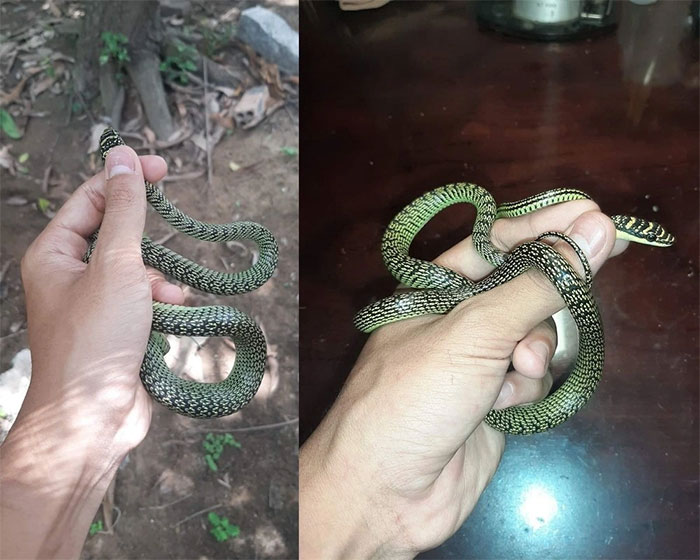
The golden tree snake is harmless to humans and is kept as a pet by many people. (Photo: Facebook).
Even when searching for information about "rắn cườm" on internet search engines such as Google, many results treat "rắn cườm" and "rắn lục cườm" as the same snake, leading many people to believe the golden tree snake is dangerously venomous, while other sources claim that "rắn lục cườm" is a harmless colubrid with no venom.
This information is seriously wrong and can lead to unfortunate accidents.
In fact, the golden tree snake (scientific name Chrysopelea ornata) and the brown spotted pit viper, or "rắn lục cườm" (scientific name Protobothrops mucrosquamatus) are two unrelated species that differ completely in appearance, distribution and toxicity.
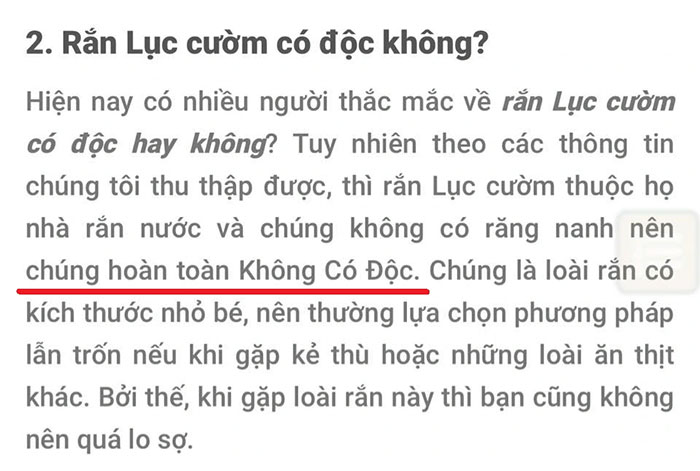
Completely wrong information about the brown spotted pit viper found on Google. (Screenshot).
In Vietnam, the brown spotted pit viper has been recorded in provinces and cities across the north and center of the country, such as Lào Cai, the former Hà Giang province, Cao Bằng, Thái Nguyên, the former Vĩnh Phúc province, the former Bắc Kạn province, Lạng Sơn, Hà Nội, Quảng Ninh, Hải Phòng, the former Hải Dương province, Hà Tĩnh, Quảng Trị, Huế, Ninh Bình, Nghệ An, the former Kon Tum province, Gia Lai…
The brown spotted pit viper lives mainly at elevations of 1,000 m and above, in secondary forests and along rivers and streams, so it rarely encounters people. It feeds on small animals such as frogs, toads, fish, shrimp, bird eggs and some small snakes…
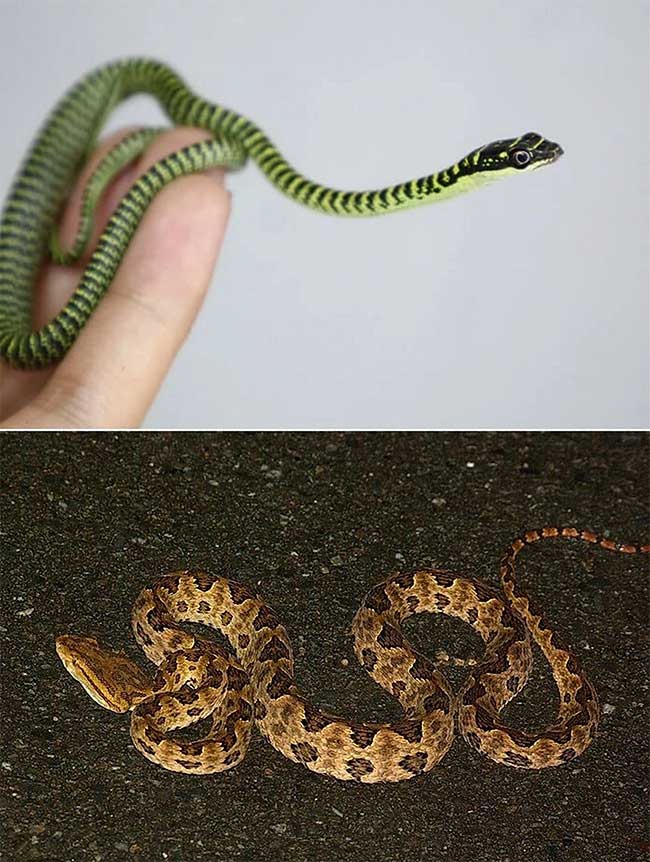
The golden tree snake (top) is completely different from the brown spotted pit viper (bottom), but many people confuse the two.
The brown spotted pit viper's venom can be deadly if the victim does not receive prompt emergency treatment. Mistaking the golden tree snake (harmless) for the brown spotted pit viper (venomous) is therefore an extremely dangerous error that can lead to serious, even fatal, accidents.
Conclusion
Compared with the brown spotted pit viper, the golden tree snake is more widespread and easier to come across. It is easy to identify, harmless and poses no danger to humans, so if you encounter one, you can use a broom or a long stick to chase it away instead of killing it.
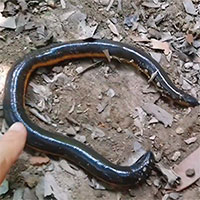
Up close with the ultra-rare legless amphibian found in a Vĩnh Long garden
While gardening, a woman in Vietnam's Vĩnh Long province found a caecilian-like amphibian listed in Vietnam's Red Data Book.
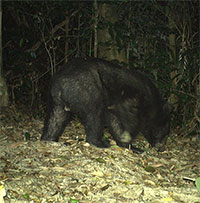
Rare and unusual animals caught on camera in Vietnam's Động Châu-Khe Nước Trong Nature Reserve
Camera traps have revealed many rare and endangered Red List animals, from Asian black bears to pangolins, in a nature reserve in central Vietnam.
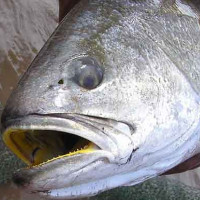
Why is the bronze croaker so expensive?
One bronze croaker can earn a fisherman hundreds of millions of VND, so sailors call it a "swimming lump of gold" or "Vietnam's gift from heaven".
Vietnam's bizarre, super-tiny worm snake
Easily mistaken for earthworms, Vietnam's tiny worm snakes have scales, a forked tongue, and can reproduce without males.
55 bird species ranked from largest to smallest
From the towering ostrich to the tiny bee hummingbird, here are 55 of the world's bird species ranked by size.
Common freshwater fish of Vietnam you should know
Freshwater fish live mainly in rivers and lakes with salinity below 0.05%. Here are the most common freshwater fish species in Vietnam.