The highly venomous cobras that live in Vietnam
Four species of cobra live in Vietnam, and all of them carry potentially lethal venom.
Cobras (scientific name: Naja) are a genus of venomous snakes in the family Elapidae, found throughout Asia and Africa. Cobras do not occur in Australia, the Americas or Europe, although those continents are home to other venomous snakes in the elapid family.
What cobras have in common is a long body, a large head and the ability to spread a hood at the neck to intimidate enemies. Besides biting and injecting venom through their fangs, some cobra species can also spit venom to strike at threats from a distance.
Scientists originally estimated that there were 20 to 22 cobra species, but recent research has shown that the genus contains 38 species. Four of them live in Vietnam, and all carry potentially lethal venom.
Below are the highly venomous cobras found in Vietnam.
Chinese cobra
The Chinese cobra (Naja atra), also known in Vietnam as "hổ mang bành" or "hổ mang thường" (common cobra), lives mainly in southeastern China, Hainan Island, Taiwan, northern Vietnam and a small part of northern Laos.
In Vietnam, the species is common across the northern provinces, extending into the North Central region, with scattered records in Quảng Bình and Quảng Trị provinces in central Vietnam. South of Thừa Thiên-Huế, the former central province around the city of Huế, there are almost no records of the Chinese cobra.
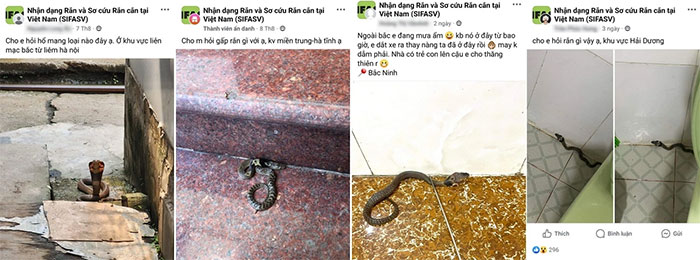
Many social media users have shared photos of Chinese cobras they encountered in residential areas in northern provinces (Photo: Facebook group "Nhận diện rắn và sơ cứu rắn cắn tại Việt Nam" / Snake Identification and Snakebite First Aid in Vietnam).
The Chinese cobra is one of the most common venomous snakes in northern Vietnam. It is found in a wide range of habitats, including grasslands, woodlands, scrubland, marshes, riverbanks and streamsides, and cultivated rice paddies.
The species can even turn up in residential areas and on overgrown vacant lots in cities.
The Chinese cobra is a medium-size venomous snake, measuring about 1.2 to 1.5 m long; individuals of up to 2 m exist but are very rare. It is active during the day but hunts mainly at night. Its main prey includes toads, frogs, lizards, rats and other snakes. Juveniles feed mostly on frogs.
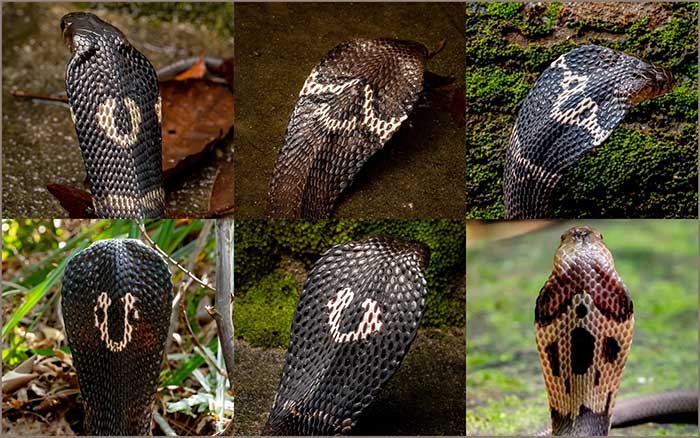
Several different patterns on the back of the Chinese cobra's hood (Photo: HongKong SnakeID).
Adult Chinese cobras mate in late April or early May and lay eggs between June and July. Each clutch contains 6 to 20 eggs, which hatch after 50 to 57 days, meaning hatchlings appear between July and September. This is when young Chinese cobras are most often encountered, even in residential areas.
Monocled cobra
The monocled cobra, known in Vietnam as "rắn hổ đất" or "rắn hổ phì", has the scientific name Naja kaouthia. Its range stretches from India and Bangladesh to a small part of southwestern China, Laos, Thailand and Vietnam.
Unlike the Chinese cobra, the monocled cobra in Vietnam occurs only in the central region, the Central Highlands (Tây Nguyên) and the southern provinces.
Monocled cobras can also be encountered where people live.
The monocled cobra can live in many different habitats, including mangrove forests, rice paddies, marshes, grasslands and farmland. It can also be found where people live, including in cities, so encounters with humans are possible.
The monocled cobra is slightly larger than the Chinese cobra, typically 1.3 to 1.5 m long, and can reach 2.3 m, although this is rare. Its coloration is also usually darker than the Chinese cobra's, sometimes jet black.
When threatened, the monocled cobra rears up and spreads its hood wide. On the back of the hood is a round marking resembling a monocle. Its diet includes rodents, fish, frogs and some other snakes.
The monocled cobra can also spit venom at enemies, but it mainly relies on its fangs to bite and inject venom.
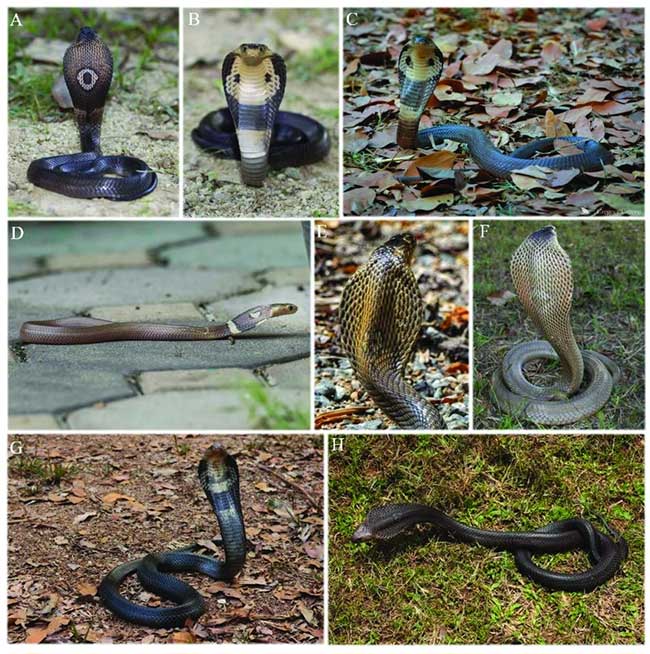
Monocled cobras are usually darker than Chinese cobras (Photo: ResearchGate).
Female monocled cobras usually lay eggs between January and March each year, with 16 to 33 eggs per clutch. Incubation lasts about 55 to 73 days, so hatchlings typically appear between April and June, which may be when monocled cobras are most often encountered.
Fuxi cobra
The Fuxi cobra was originally considered part of the monocled cobra. It was not until 2022, when scientists took a closer look at its morphology and genetics, that it was recognized as a distinct species, Naja fuxi.
The name is said to come from Fuxi, a figure in Chinese mythology regarded as one of the ancestors of humankind and depicted as half human, half snake.
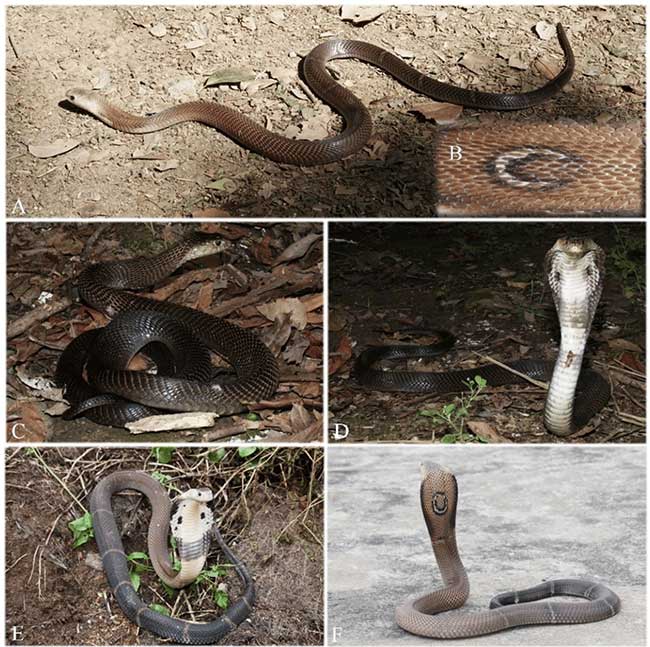
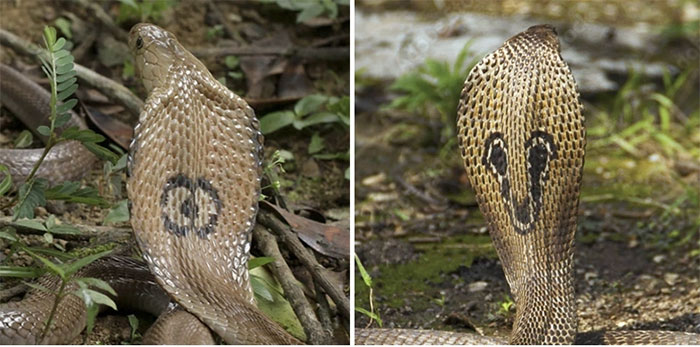
The Fuxi cobra was once considered part of the monocled cobra but was later identified as a separate species (Photo: ResearchGate).
The Fuxi cobra usually lives in forests at elevations of 1,000 to 1,400 m, on gentle slopes or along forest edges. It is found in southwestern China, Myanmar, Laos, Thailand and Vietnam.
In Vietnam, the species is usually found in the mountainous Northwest region.
The Fuxi cobra is medium-size, with a body length of 70 to 140 cm. It is usually brown or dark in color, with juveniles typically darker than adults.
Overall, telling the Fuxi cobra apart from the monocled cobra is far from easy and requires specialist knowledge.
The Fuxi cobra feeds on amphibians, birds, rodents and some other snakes. It sometimes ventures into human settlements to hunt or to prey on domestic poultry.
Indochinese spitting cobra
The Indochinese spitting cobra (Naja siamensis), also called the Siamese cobra and best known in Vietnam as "rắn hổ mèo", is a cobra widely distributed across Southeast Asia. It is found in Vietnam, Thailand, Cambodia, Laos and Myanmar.
In Vietnam, the species is usually found in provinces of the Mekong Delta and the south, such as Tây Ninh, Đồng Nai, An Giang, Tiền Giang and Ho Chi Minh City.
Compared with other cobras, the Indochinese spitting cobra is usually lighter in color, often with white spots and stripes on its body. It measures 0.9 to 1.2 m long and can reach a maximum of 1.6 m.
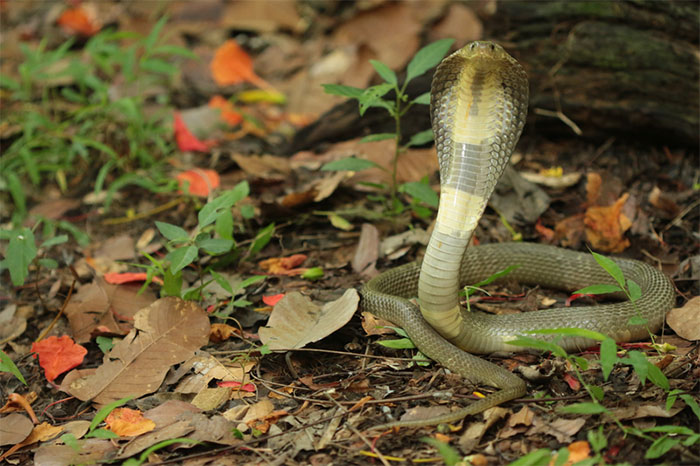
This snake can spit venom as far as 2 m.
True to its name "spitting cobra", besides attacking with its venomous fangs, this snake can spray venom at enemies from a distance, reaching up to 2 m. It usually spits venom to warn off a threat before resorting to biting.
If the venom lands on an open wound in a person or animal, it causes envenomation similar to a bite. Venom sprayed into the eyes causes burning pain, temporary blindness or even permanent blindness. Anyone hit in the eyes should immediately rinse them under continuously running water to wash the venom out.
The Indochinese spitting cobra occupies a wide range of habitats, including lowlands, wetlands, farmland, rubber plantations and orchards, so it may come into conflict with people when it enters human settlements to hunt rats.
Its diet consists of amphibians, rodents, birds and small carnivorous mammals.
Each clutch contains 13 to 20 eggs, which hatch after 48 to 70 days depending on the nest temperature. Newly hatched snakes have venom as dangerous as that of adults, enough to kill a grown person with a single bite.
Why isn't the king cobra on the list of cobras in Vietnam?
After reading the list above, many readers may wonder why only four cobra species are listed for Vietnam. What about the king cobra?
The king cobra (Ophiophagus hannah) is commonly called "rắn hổ mang chúa" ("king cobra") in Vietnam, but it does not belong to the genus of true cobras (Naja); it belongs to the separate genus Ophiophagus.
It is called a cobra because it, too, can rear up and spread a hood to intimidate enemies, but its hood is usually narrower than those of true cobras.
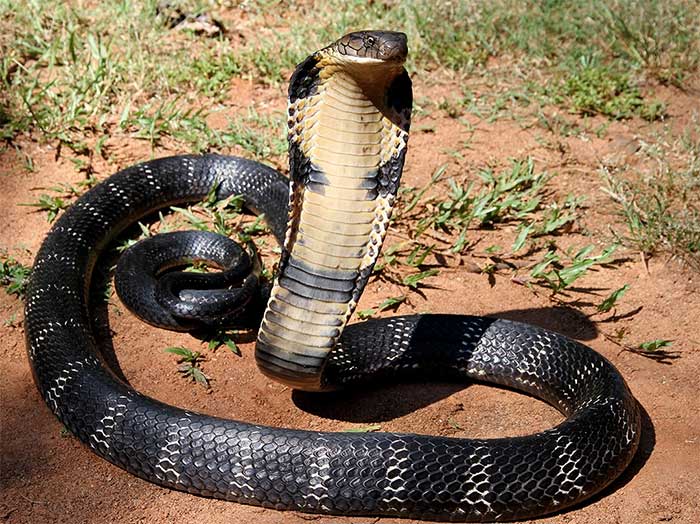
The king cobra is not a true cobra, even though it can spread a hood and rear up (Photo: Wikipedia).
The king cobra also differs from cobras in many aspects of its morphology and biology, such as its larger size and greater length (it is the world's longest venomous snake, capable of exceeding 5 m). King cobras feed on snakes, both venomous and nonvenomous. When food is scarce, they will even eat other king cobras.
King cobras help keep snake populations in check within their range, and they also regulate their own numbers when the local snake population declines.
What to do if a cobra gets into your home
These are the four cobra species found in Vietnam. They share the ability to spread a hood and rear up, and, above all, they all carry potentially lethal venom.
Telling cobra species apart is not easy without specialist knowledge. But if you come across any snake that spreads a hood and rears up, you can be sure it is a cobra, so stay as far away from it as possible.
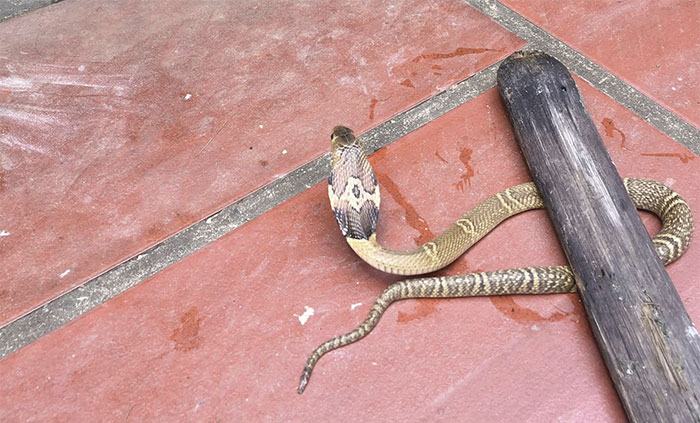
Do not try to catch a cobra that has entered your home, as doing so risks a bite and a dangerous accident (Photo: SIFASV).
If a cobra gets into your home, stay calm, keep a safe distance, and use a phone or camera to take pictures of the snake. Then send the images to snake experts or local rescue services and ask for help.
Photos of the snake are also very useful if someone is unfortunately bitten, as they help doctors plan treatment and choose the right antivenom.
While waiting for rescuers or a snake-rescue team to arrive, keep an eye on the snake at all times so it does not slip out of sight and hide in a hidden corner of the house.
If you cannot reach rescue services or reptile experts, you can use a pole or a long broom handle together with a bin to hold the snake. Use the pole or broom handle to herd or hook the snake into the bin, then close the lid tightly so it cannot escape.
Killing the snake should be considered only as a last resort when there is an immediate threat to human life and it cannot be captured or relocated safely.
Note: the king cobra is a protected species in Vietnam, and cobras are regulated wildlife. Hunting, trading or eating them is illegal.
If someone is bitten, help the victim stay calm and avoid moving around, which speeds up the heart rate. Keep the bite below heart level to slow the spread of venom, then get the victim to a medical facility as soon as possible. Measures such as cutting the wound, sucking out the venom or applying herbal poultices can make the victim's condition worse.
The truth about Vietnam's strange "tie the girl to the post" bird
Beyond its unusual name, the Indian cuckoo, called "bắt cô trói cột" in Vietnam, has many curious traits.
Half frog, half snake, half worm: The bizarre caecilians of Vietnam
Vietnam's 'worm frogs' are legless amphibians so snake-like that many people are startled the first time they see one.
Southeast Asia's treasure: A rare animal found in only 9 countries, and good news from Vietnam
The critically endangered Sunda pangolin lives only in Southeast Asia, including Vietnam, and is among the world's most trafficked mammals.
The harmless snake often mistaken for a deadly venomous one in Vietnam
A small, harmless snake found across Vietnam is often needlessly killed because it is mistaken for a deadly venomous species.
Up close with the ultra-rare legless amphibian found in a Vĩnh Long garden
While gardening, a woman in Vietnam's Vĩnh Long province found a caecilian-like amphibian listed in Vietnam's Red Data Book.
Rare and unusual animals caught on camera in Vietnam's Động Châu-Khe Nước Trong Nature Reserve
Camera traps have revealed many rare and endangered Red List animals, from Asian black bears to pangolins, in a nature reserve in central Vietnam.