

Born without ears, young Vietnamese man pursues a career in science
Born without outer ears or ear canals, Phạm Đức Chinh struggled to hear and was slow to learn to speak, yet he graduated from university with distinction and is determined to become a chemist.
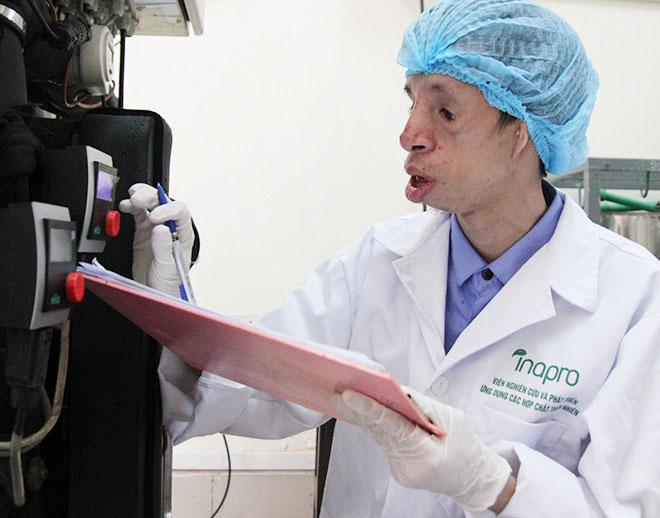
At 7 a.m., Chinh, 26, from Thái Bình (a former province in northern Vietnam, now part of Hưng Yên province), is already in the laboratory of the Institute for Research and Development of Natural Compound Applications at Hanoi University of Science and Technology (Đại học Bách khoa Hà Nội). A typical workday begins with checking that the lab equipment is running properly, while supervising students on their graduation projects or on experiments concentrating fruit juices.
Looking at the young man with a craniofacial deformity, no cheekbones, a cleft palate and no outer ears or ear canals, few would guess that he graduated with distinction, ranked among the top 20 students at his university, and now works as a research assistant at the institute. Chinh's job is one many people dream of, but his path to it was hardly "a bed of roses."
Phạm Đức Chinh cycles to school every day, even though he lives only 1 km away. (Photo: Thùy An).
Chinh has had a congenital birth defect since childhood. Because he has no outer ears or ear canals, hearing is very difficult for him. He only began learning to talk at age three. At 7, when he started first grade, Chinh clearly felt how different he was from everyone else.
"Looking unlike anyone else, with incompletely formed facial structures, I had to learn to adapt and work hard just to be able to go to school," he said. In eighth grade, Chinh was introduced to chemistry and found it fascinating. He became absorbed in it, reading up on basic experiments and chemical reactions, and thought "this is my future." From then on, the young man from Thái Bình suddenly found joy in going to school, and his grades steadily improved. He rose from an average student to a good and then excellent one, with his final chemistry scores always above 9 out of 10.
"Everyone thought I couldn't go to school, and some even said 'the teachers go easy on him because he's disabled.' There were so many insults I couldn't list them all in a day," Chinh said.
When he happened to hear his teachers talk about Hanoi University of Science and Technology, he decided to take the natural sciences entrance exam block in pursuit of his dream of studying at the university's chemical engineering faculty.
With his path set, Chinh worked harder and became stricter with himself. He was also fortunate to have encouragement from his parents, which gave him the motivation to keep going. "Chinh is our only child, and he has been disadvantaged in every way, but we never once thought of giving up on him," said his mother, Vũ Thị Oanh. Thanks to that, Chinh has never felt lost in life.
Besides his parents, Chinh has a close friend, Đoàn Trọng Quang, 25. Quang has gone to school with Chinh since kindergarten. On rainy, windy days, he would come over to give Chinh a ride to school. In class, he often repeated what the teachers said when Chinh couldn't hear clearly, so people called them "the pair who rise together." Quang also calls himself Chinh's loyal "bodyguard," standing up for him whenever others teased him.
"Everyone thinks I'm the one helping Chinh, but in fact it's the other way around. Thanks to Chinh, I've learned how to face challenges, rise above them and live more meaningfully every day," Quang said.
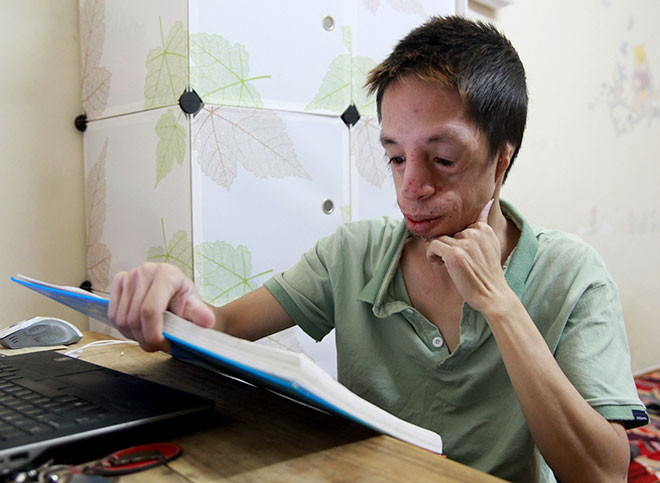
With 8 hours at the university and 2 hours at home, Chinh makes the most of his time reading books, scientific literature and patents to find suitable ways to apply them. (Photo: Thùy An).
In 2012, Chinh was admitted to Hanoi University of Science and Technology with an entrance score of 25.5, including 9 points in chemistry. Knowing that studying far from home would add to his parents' burden, the 1.5-meter-tall young man still wanted to test himself in a new environment. Beyond his own study time, he was supported by friends and helped by lecturers, who would come to his desk to repeat the parts he had not heard.
"Here, I was welcomed, because nobody discriminated against me for being a person with a disability. That meant I didn't need much time to settle in," Chinh said.
In 2017, he graduated with distinction with a GPA of 3.2, ranking among the top 20 at the university. In the first semester of his third year alone, he was one of two students awarded a Grade A scholarship, with a GPA of 3.9/4. Throughout his five years of study, Chinh cycled to school every day without missing a single session, rain or shine. To date, he has written three scientific research papers, including one in an international journal. He plans to continue doing research to develop his abilities and the field he is studying.
Two years later, he returned to the university for a master's degree while working as a research assistant in research and development of natural compound applications. According to Chinh, research work is very demanding and takes a great deal of time. Yet scientific research helps him forget all of life's worries and hardships. The young man immerses himself in experiments because, for him, the joy of a scientist lies in making exciting discoveries.
Chinh at work in the laboratory. (Photo: Thùy An).
In his spare time, Chinh also loves reading to broaden his knowledge. He keeps research books by his bedside, "so I can just reach for one whenever I feel like it". Describing himself as an optimist, Chinh has never felt sorry for himself for being born different. He always reminds himself to adapt and to move forward on his own abilities.
"I don't want to be called a disabled person who overcame adversity. I want to be an ordinary person," Chinh said.
