

Giant rhino fossil reveals Anatolia was not isolated 25 million years ago
French scientists report that Anatolia was not an isolated landmass 25 million years ago (during the Oligocene), contrary to what was previously thought. Anatolia is a peninsula at the westernmost tip of Asia that today forms the Asian part of Turkey (96% of Turkey's land area, with the remaining 4% in Thrace).
The conclusion comes from the analysis of the first fossil bone of a rhinocerotoid, discovered in 2002 at a fossil site in Anatolia during a joint French-Turkish paleontological expedition. The presence of this bone in Anatolia, together with the remains of the associated fauna, points to animal migration between Europe and Asia. The findings, published online in the March 2008 issue of the Zoological Journal of the Linnean Society, call into question the isolation of Anatolia, which until now had been regarded as an archipelago.
This is the first time a fossil bone fragment of a giant rhinocerotoid dating from the Oligocene (a period of intense tectonic activity around the Mediterranean) has been found in Anatolia. Discovered in 2002 during a paleontological expedition in the Çankırı-Çorum region (central
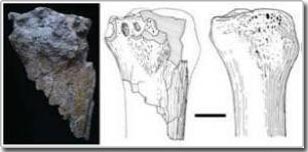 |
Radius fragment of the baluchithere Paraceratherium, discovered in 2002, dating from the Oligocene of central Anatolia (Turkey, 25 million years ago). Left: front view of the specimen. Center: drawing of the same specimen. Right: comparison with the largest known baluchithere specimen (also Oligocene, from Mongolia) |
These herbivores, known as baluchitheres or indricotheres, are considered the largest land mammals that ever lived, as large as the biggest mammoths (about 5 m tall at the shoulder and weighing 15 to 20 tonnes).
Paraceratherium is also known from Pakistan, China, Mongolia and Kazakhstan; remains of rodents were also found at the site. They make it possible to date the deposit to about 25 million years ago and reveal close affinities with the faunas of Asia and/or Europe. This observation is especially surprising because Anatolia was still thought to be an archipelago at the time, separated from both Europe and Asia by a sea called the Paratethys, of which today's Black, Caspian and Aral seas are only remnants.
The discovery therefore demonstrates the existence of a land connection and of faunal affinities between Europe (including France) and Asia (China, Mongolia, Pakistan) during that period. During the Oligocene, then, Anatolia was not isolated by the sea but was linked by at least an isthmus: animals could cross overland from mainland Asia into Anatolia.
On the other hand, the discovery also confirms that Anatolia was indeed separated from Africa, since no species of African origin from the Oligocene has yet been found in Anatolia.
