

New powder absorbs CO2 more effectively than trees
A powder could soak up carbon dioxide even more effectively than planting trees, according to a study published Oct. 23, 2024 in the journal Nature.
A typical tree, as it grows, can pull up to 40 kg of carbon dioxide out of the air over the course of a year. Now, scientists at the University of California, Berkeley say they can do the same job with about 200 grams of a fine yellow powder.
According to the study published Oct. 23, 2024 in Nature, the powder's particles are riddled with tiny pores that can trap the greenhouse gas. The researchers can then extract the gas from the powder and store it somewhere it can no longer contribute to global warming. In tests, the material still performed well after 100 such cycles.
Omar Yaghi, a reticular chemist at UC Berkeley and senior author of the study, said it works very well: "Based on the stability and behavior of the material right now, we think it will go to thousands of cycles."
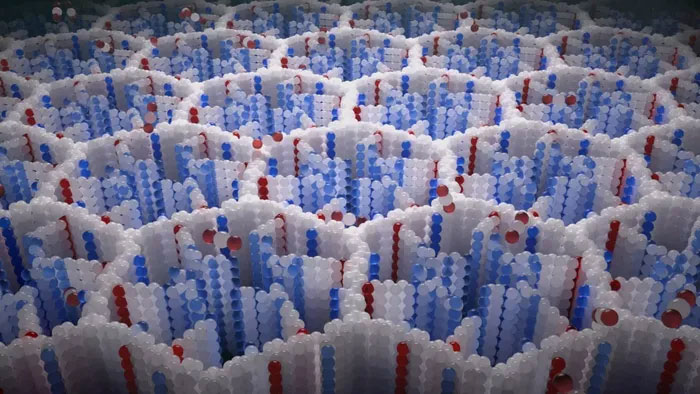
The molecular structure of COF-999.
Dubbed COF-999, the powder could be deployed in the kind of large-scale direct air capture plants that are beginning to come online to reduce the amount of carbon in the atmosphere.
Scientists say keeping the concentration of carbon dioxide in the atmosphere below 450 parts per million (ppm) is necessary to limit global warming to 2 degrees C above pre-industrial levels and to prevent some of the most catastrophic consequences of climate change. Measurements taken at the Mauna Loa Observatory in Hawaii show that CO2 concentrations currently stand at about 423 ppm.
Yaghi, who is also chief scientist at UC Berkeley's Bakar Institute of Digital Materials for the Planet, said: "You have to take the CO2 out of the air — there's no way around it. Even if we stop emitting CO2, we still need to take it out of the air. We don't have any other options."
Klaus Lackner, founding director of the Center for Negative Carbon Emissions at Arizona State University, agreed that direct air capture will become an important tool for sequestering carbon and cooling the planet once some significant hurdles are overcome. He said the advances in the new study could help.
Lackner, who was not involved in the research, said: "We are opening a door to a whole new range of approaches."
Viewed under an electron microscope, the powder's grains look like tiny basketballs with billions of holes, said study leader Zihui Zhou, a materials chemist working on his doctorate at UC Berkeley.
The structures are held together by some of the strongest chemical bonds in nature, including the ones that turn carbon atoms into diamonds. Compounds called amines are attached to the framework between those bonds.
When air flows through the structures, most of its components pass through undisturbed. But the amines, which are basic, grab onto the carbon dioxide molecules, which are acidic.
Those CO2 molecules stay put until scientists loosen them by applying heat. They can then vacuum them up and pump them deep underground so they cannot escape into the atmosphere.
Once the carbon dioxide has been removed from the powder, the whole process can start again. To test COF-999's carbon-scrubbing abilities, the researchers packed the powder into a stainless steel tube about the size of a drinking straw and exposed it to outdoor air for 20 straight days.
As it entered the tube, Berkeley's air contained CO2 at concentrations between 410 ppm and 517 ppm, Zhou said. When it came out the other end, the scientists could not detect any carbon dioxide at all.
According to COF-999's creators, the powder has several advantages over other materials. Its porous structure increases its surface area, meaning there are more places to hold on to CO2 molecules. As a result, COF-999 captures carbon dioxide at a rate "at least 10 times faster" than other materials used for direct air capture.
Another plus is that COF-999 loosens its grip on CO2 when it is heated to about 60 degrees C. Comparable materials must be heated to 120 degrees C to extract the carbon, which takes a lot of energy, and producing that energy is itself more likely to release greenhouse gases, Zhou said.
The powder is also more durable. Zhou said the team has tested a newer version that lasted 300 cycles before the experiment ended.
Lackner said that is an encouraging sign. "Getting to 100 cycles and not seeing any degradation suggests you can get to thousands of cycles," he said. "We don't even know yet whether you can get to hundreds of thousands of cycles."
Team members have continued to refine the material and are on track to double its capacity in the next year. Deploying it on an industrial scale will require designing a large metal box that lets air pass through without blowing all the powder away, Zhou said. Those boxes would need to be grouped together in numbers similar to a modern chemical plant or oil refinery.
Yaghi said a version of COF-999 could be ready for direct air capture plants within two years. He could not estimate what it would cost to produce in large quantities, but said it does not require any expensive or exotic materials.
Yaghi has founded a company, Irvine-based Atoco, to commercialize his research on carbon capture and other technologies. Atoco helped fund the new study. In addition, UC Berkeley has filed a patent application for COF-999 that names Yaghi and Zhou as inventors.
Lackner said the entire direct air capture process will have to become "10 times cheaper than it is now." Only then could the technology make a real dent in the hundreds of billions of tons of carbon dioxide that scientists want to remove from the atmosphere.
A material that is more efficient at collecting CO2 would be helpful, but Lackner said he spends more time worrying about issues such as how much energy it takes to put the carbon underground, because that energy use itself also warms the planet. "There are a thousand things that go into this," he said.
