The Great Pyramid of Kheops can concentrate radio waves, physicists calculate
German and Russian physicists have studied the properties of the Great Pyramid of Kheops and concluded that the structure can draw electromagnetic energy into its inner chambers and concentrate it in the quiet spaces deep inside the pyramid. Their findings were published in the Journal of Applied Physics.
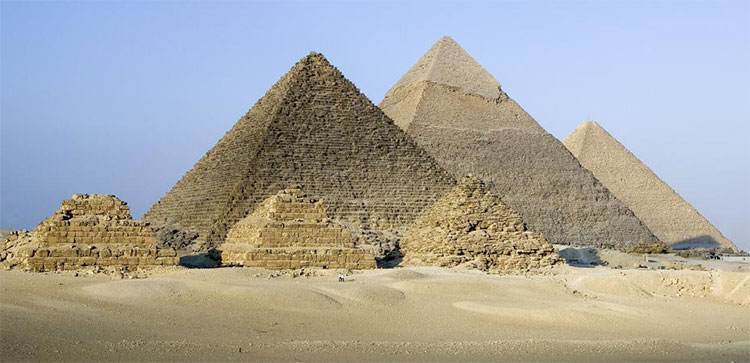
The Pyramid of Kheops.
"Given the great interest in the pyramids, we decided to look at the Kheops structure as a resonant scatterer of radio waves. We obtained a number of interesting results that could find important practical applications," said Andrei Evlyukhin, the research coordinator from ITMO University (Saint Petersburg National Research University of Information Technologies, Mechanics and Optics).
The calculations showed that the Pyramid of Kheops does indeed interact with "amateur" radio waves, concentrating energy in the pharaoh's burial chambers and in a region directly beneath the pyramid's base, where the third chamber is located. These are theoretical model calculations of how the structure scatters radio waves; they do not suggest that the pyramid has any special or mystical "energy" properties.
The Pyramid of Kheops (also known as the Pyramid of Khufu or the Great Pyramid of Giza) was built in the middle of the third millennium B.C. as the tomb of Pharaoh Khufu (Kheops). Standing 145 meters tall, 230 meters wide and 230 meters long, it remains one of the largest and most massive structures ever built by humans.

8 fascinating facts about Sơn Đoòng, the world's largest cave
Sơn Đoòng, in Vietnam's Phong Nha-Kẻ Bàng National Park, is widely regarded as the largest natural cave ever discovered. Here are 8 facts about it.