

Vietnamese scientist creates artificial blood vessels that do not cause clotting
Lê Nguyễn Mỹ An, a master's-degree researcher, has found a way to make artificial blood vessels 3-6 mm in diameter that overcome the problem of blood clotting, and is preparing to test them in animals.
Artificial blood vessels had been studied and developed since 2012 by Associate Professor Nguyễn Thị Hiệp of the Department of Biomedical Engineering at Trường Đại học Quốc tế (International University), part of Vietnam National University, Ho Chi Minh City, using biopolymer materials. At the time, the materials met the requirements for structure and physical properties. However, when the vessels were implanted in laboratory tests, blood clots formed inside them after one month, and the trial failed.
Building on that work, in late 2017 Associate Professor Nguyễn Thị Hiệp supervised Lê Nguyễn Mỹ An, MSc (25, who previously worked at International University, Vietnam National University, Ho Chi Minh City), in tackling the clotting problem in artificial vessels.
This time, in addition to the hydrophobic polymers polyurethane (PU) and polycaprolactone (PCL) , which offer good elasticity, stretchability and biocompatibility, the team added the polymer poloxamer at a ratio of 3-8%. The hydrophilic nature of this material reduces the adhesion of platelets in the blood and keeps blood flowing through the vessel, thereby preventing clots from forming.
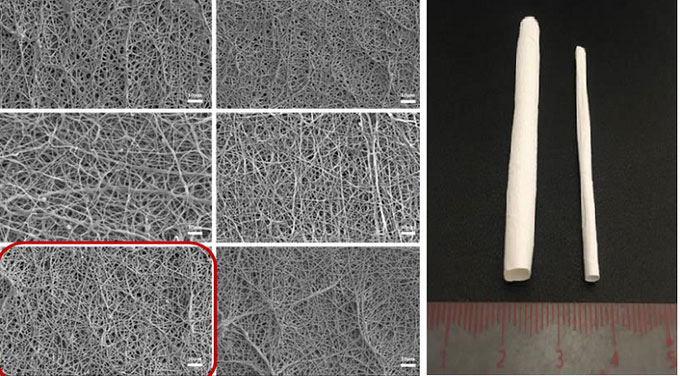
The nanofiber structure of the artificial blood vessel seen under a scanning electron microscope. (Photo: Research team).
To make the vessels, instead of traditional methods such as mixing substances and casting them in a mold, An used electrospinning technology to turn the raw materials into fine nanoscale fibers, increasing the contact area between the material and cells so that the cells attach well.
According to An, artificial blood vessels are implanted to replace damaged sections of vessels, helping to restore transport and circulation functions. An artificial vessel must be elastic, withstand the pressure of blood flow and be highly biocompatible so that it adapts to conditions inside the body and is not rejected by the immune system after implantation, which would cause inflammation or infection. Above all, the materials must not cause blood clotting.
Typically, the smaller the diameter of an artificial blood vessel (under 6 mm), the higher the risk of clotting. This stems from the inner and outer surfaces of the materials not having been treated and improved. According to the team, the artificial vessel developed by Associate Professor Hiệp and An is the first work to successfully produce small (3-6 mm) artificial vessels that do not cause clotting.
An said that with this technology, the quality and size of the fibers depend on the rotation speed and the strength of the applied electric current. If the rotation is too fast, the fibers tend to stick together and form smooth layers of film, making it hard for blood cells to attach. By comparing many different conditions, the team found the right rotation speed to make nanofibers uniform in size and arrangement.
The nanofibers are sprayed onto a fixed tubular frame, forming artificial blood vessels with small diameters of 3-6 mm. The outside of the vessel consists of hydrophobic PU and PCL fibers, while the inside contains additional poloxamer fibers to prevent clotting.
The vessels have a sufficiently fine structure and good stretchability and elasticity. The team tested them on bovine endothelial cells in the laboratory, and the results showed the artificial vessels had biocompatibility above 80%, indicating they are not toxic to cells, and no blood clots appeared.
In Vietnam, artificial vessels used in medicine are imported products. Several international research groups (in China and the US) have successfully made artificial blood vessels, but they have mainly focused on the mechanical and physical properties of the materials. The team says the artificial vessel research led by Associate Professor Hiệp and developed by An is the first work to successfully produce small artificial vessels that do not cause clotting. The vessels have so far been tested only on cells in the laboratory and are not yet an approved medical product.
Following the success of these initial tests, An and her colleagues plan to implant the vessels in mice, then move on to tests on human tissue, step by step bringing the product into practical use. "If successful, this artificial vessel could go into pilot production and be supplied to some hospitals in Vietnam to reduce dependence on imported products," An said.
