Vietnamese scientists describe a new plant species from central Vietnam
Six years ago, a team of scientists found a pink-flowered plant growing on a rock face, and were surprised to learn it was a species new to science.
In late July, Phytotaxa, a respected botanical journal indexed in the SCI citation system, published the description of a new plant species found in Quảng Nam, a former province in central Vietnam that is now part of Đà Nẵng city.
The species is Phyllagathis phamhoangii V.T.Pham, T.C.Vu & Ranil (Vietnamese name: Me nguồn Phạm Hoàng Hộ), in the genus Phyllagathis of the Melastomataceae family. It is named after the late Professor Phạm Hoàng Hộ, author of many reference works on Vietnam's flora. The plant is a rhizomatous herb about 25cm tall, with bright pink inflorescences that rise above the leaves, and it grows on damp rock faces in Quảng Nam.
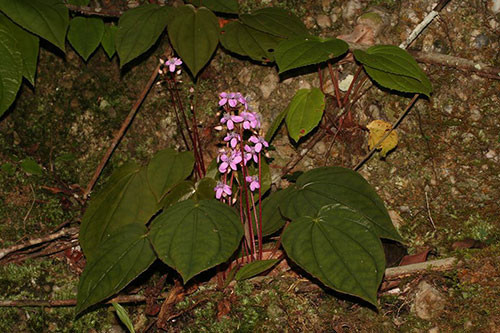
The new species was found in Quảng Nam. (Photo: Phạm Văn Thế).
In March 2011, a team from the Vietnam Academy of Science and Technology (Viện Hàn lâm Khoa học và Công nghệ Việt Nam), together with colleagues from Russia and Sri Lanka, carried out a project to assess plant diversity in some of the remaining primary forests along the Hồ Chí Minh Road, in the stretch from Quảng Bình (now part of Quảng Trị province) to Quảng Nam.
The fieldwork lasted two months. The team started in Quảng Bình, then moved through Quảng Trị and Thừa Thiên Huế (now Huế city) to the final survey site in Quảng Nam. In a remnant patch of primary forest at Đại Hồng, in the former Quảng Nam province, the experts discovered the plant growing on a rocky mountainside just a few dozen meters from the survey route.
"The species has pink flowers, a tuber-like rhizome and many stiff hairs. It's quite distinctive, and most of us had never seen or heard of any species with similar features," recalled Phạm Văn Thế, a member of the research team.
Suspecting it might be new to science, the team recorded and collected it meticulously. Thế also dissected and photographed every part of the plant in detail, paying particular attention to the reproductive organs, and carefully noted its dimensions and colors.
Back in Hà Nội, the team looked into the genus and family in Vietnam and neighboring countries such as China, Thailand and Laos. They found no species matching the specimens they had collected. "Even so, we still weren't sure it was a new species. Even I, the person who examined the specimens directly, wasn't confident in my own assessment," Thế said.
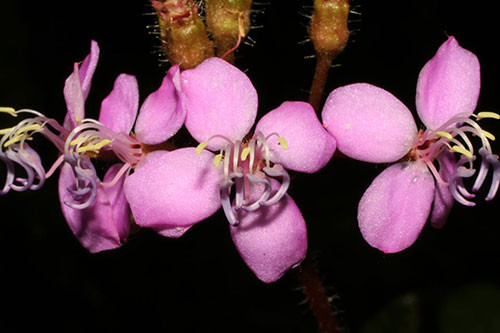
The new species has bright pink flowers. (Photo: Phạm Văn Thế).
Thế then went back through old collecting records and found a similar specimen gathered in Quảng Bình in 2008. Tracking down that specimen was laborious and time-consuming. He sent the data to several colleagues and contacted international experts about publishing it, but they declined, because there is relatively little literature on the Melastomataceae of Vietnam.
The data and specimens were complete, but confirming it as a new species was not straightforward, and team members had all but given up. Only five years later did Thế get in touch with a researcher studying Vietnam's Melastomataceae, who confirmed that "the species had never been known before."
A colleague in Sri Lanka also said: "No species in the world has been found that looks like this."
The scientists then decided to write a paper for a specialist journal to describe the new species. The manuscript was submitted in early 2017, accepted at the end of June and published in late July.
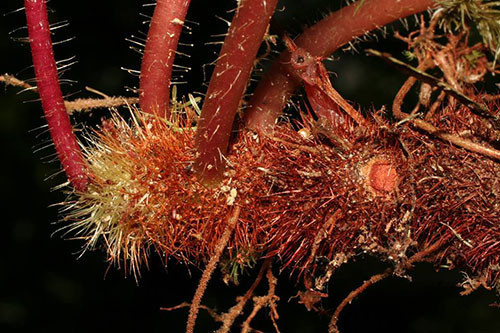
The tuber-like, bristly rhizome of the new Phyllagathis species. (Photo: Phạm Văn Thế).
The area where the species was found is under heavy pressure: because it lies outside any special-use forest, it is frequently logged. The team has therefore recommended conserving the species and classifying it as Vulnerable.
The discovery adds a new plant species to the world's and Vietnam's flora. Experts may now look into its potential as a medicinal plant or as an ornamental for propagation, and it may also prove to be a valuable genetic resource.
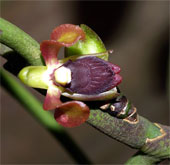
The black orchid queens of the deep forest
Vietnam is home to more than 1,000 orchid species, including a few rare ones whose flowers are jet black or blackish purple.
The strange world of orchids
Orchids are famed for their elegance, but some species look like monkey faces or smell of rotting meat to attract insects.
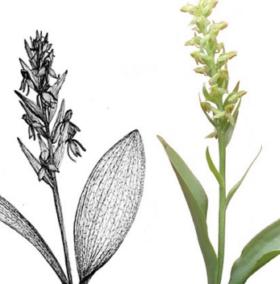
World's rarest orchid found on remote Atlantic island
Kew botanists have found one of the world's rarest orchids on a volcanic island in Portugal's Azores, first seen by a German explorer in 1838.
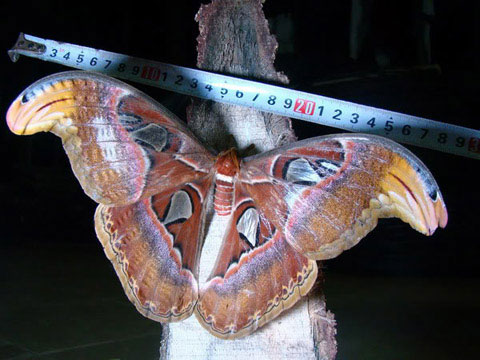
Giant moth found in Vietnam
This moth's wings can span up to 30 cm, with brilliant yellow coloring and striking, intricate patterns.