New cave discovered in Vietnam's former Hà Giang province
Authorities in Mèo Vạc, formerly a district of Hà Giang province in northern Vietnam (now part of Tuyên Quang province), have discovered a new cave: Sán Tớ Cave. Located right next to National Highway 4C, about 5 km from the center of the former Mèo Vạc town, it is easily accessible for visitors.
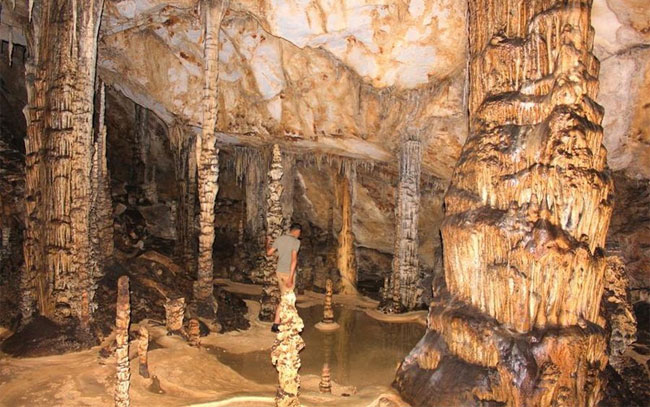
The cave contains many beautiful stalactite formations resembling an ancient castle. (Photo: Quỳnh Lưu).
The cave is divided into three branches. Branch No. 3 is more than 600 m long, with passages 20 to 40 m wide and a ceiling about 30 m high. The entrance covers about 60 m2, making it easy to move in and out.
Compared with Rồng Cave (former Tả Lủng commune) and Nhím Cave (former Pả Vi commune) , Sán Tớ Cave is longer, more beautiful and richer in formations. Its most striking feature is branch No. 3, which is split into three sections; each widens into a chamber filled with formations of many shapes, such as terraced rice fields, coral forests, stone xylophones, herds of elephants, Christmas trees, sky-propping pillars, orchid clusters, papayas, and Balanophora plants,…
The most beautiful, however, is section No. 3 at the far end of the cave. It holds a lot of water and has been likened to a castle or a stone labyrinth, as it has the densest concentration of stalactites. In addition, the fossil of a beetle-like insect has been found at one spot on the cave ceiling, which could be valuable for geological research.
With its pristine beauty, its many magnificent stalactites and its unusual shapes, the cave offers a rare natural spectacle compared with other caves discovered in the former Hà Giang province.