Australia's largest pterosaur discovered, with a wingspan of up to 7 meters
A fossil more than 100 million years old from the state of Queensland has revealed a new species of giant flying reptile with an estimated wingspan of up to 7m.
Pterosaurs, or flying reptiles, were a remarkably successful group of reptiles that lived from about 228 million to 66 million years ago. Some, such as the azhdarchids, grew taller than a giraffe and had wingspans of more than 9 m, making them the largest animals ever to fly on Earth.
In Australia, pterosaur fossils are exceptionally rare. Fewer than 20 specimens have been found so far, in Queensland, New South Wales, Victoria and Western Australia, and most of them are fragmentary, isolated bones from the Cretaceous period.
The new specimen was unearthed in the Eromanga Basin in Queensland. In a report published Aug. 9 in the Journal of Vertebrate Paleontology, paleontologists from the University of Queensland said it belongs to an entirely new pterosaur species, larger than any previously found in Australia, which they named Thapunngaka shawi.
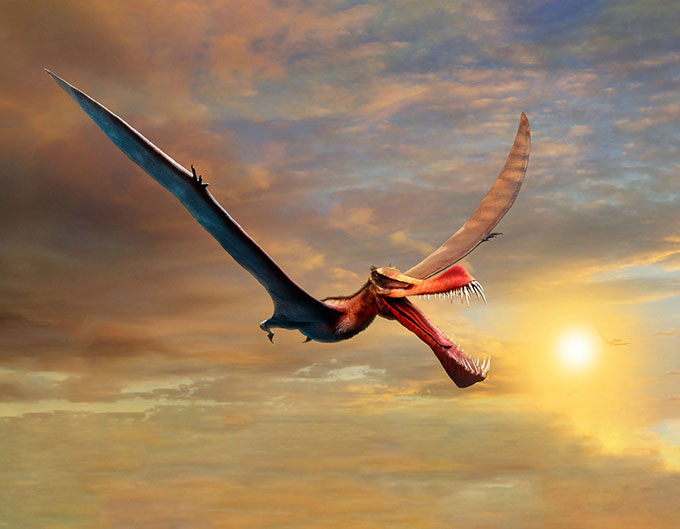
Artist's reconstruction of the pterosaur Thapunngaka shawi. (Image: Richards et al.)
The creature had a wingspan of up to 7m and may have been capable of preying on juvenile dinosaurs. However, its spear-shaped mouth was better suited to catching marine fish. Thapunngaka shawi is thought to have ruled the skies over Australia during the Cretaceous, 100 million to 110 million years ago.
Because they were flying animals, pterosaurs had very light bones, largely hollow and thin-walled. That is why their fossils are rarely well preserved.
"Australia's pterosaur fossil record is very poor. The new specimen is astonishing and greatly expands our understanding of the diversity of flying reptiles", said lead author Tim Richards, a doctoral researcher at the University of Queensland.
The Thapunngaka shawi fossil is now on display at the Kronosaurus Korner museum in the town of Richmond, Queensland, Australia.
Cave packed with bones hoarded by hyenas for thousands of years, including prehistoric human remains
Researchers believe a huge pile of bones in a Saudi Arabian lava tube was dragged there by striped hyenas over thousands of years.

9,000-year-old grave of a young female hunter could rewrite prehistory
A 9,000-year-old grave in Peru holds a woman aged 17-19, buried with the stone tools she carried on her hunts.

Stunning discovery behind secret doors inside Egypt's Great Pyramid
Two secret "doors" inside the Great Pyramid of Giza may conceal a hidden chamber of the pharaoh Khufu, but their true purpose remains a mystery.
Oldest evidence of mammals feeding on dinosaurs found on Mamenchisaurus fossil
Tooth marks on a 160-million-year-old Mamenchisaurus neck rib from China are the oldest known evidence of mammals feeding on dinosaurs.
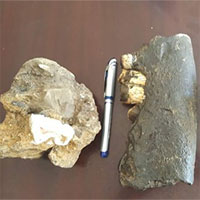
Rhinoceros sinensis fossils found near Rục community in Vietnam
Two Rục men found three Rhinoceros sinensis fossils, 30,000 to 50,000 years old, in a cave in Phong Nha-Kẻ Bàng National Park, Vietnam.
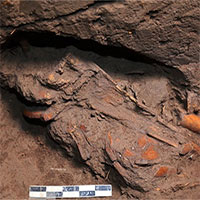
Prehistoric human remains unearthed in Southeast Asia's largest volcanic cave system
Archaeologists have uncovered dozens of ancient human remains in Vietnam's Chư Bluk volcanic caves, the largest volcanic cave system in Southeast Asia.