Cave packed with bones hoarded by hyenas for thousands of years, including prehistoric human remains
Scientists investigating a dry lava tube in northwestern Saudi Arabia were stunned to discover an enormous pile of bones belonging to horses, donkeys and even humans. It looked like a feast that had gone on for generation after generation, and the researchers who excavated the site think they know the identity of the hungry animals behind this surprise.
"We think it's striped hyenas. Striped hyenas are prolific bone accumulators," said Mathew Stewart, an archaeologist at the Max Planck Institute for the Science of Human History.
Although hyenas are threatened in Saudi Arabia, they were once one of the keystone species in the lava fields of the country's northwest, and they roamed the region for much of the Holocene epoch, the period from which the bone collection in the lava tube is thought to date. Stewart and his team's analysis of the site was recently published in the journal Archaeological and Anthropological Sciences.
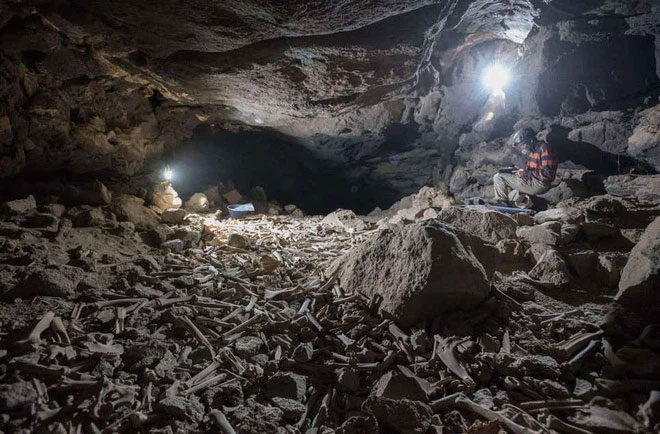
One of the bone accumulations in the Umm Jirsan lava tube in Saudi Arabia.
Although the kilometers-long lava tube was discovered in the mid-2000s, earlier researchers had not ventured very deep into the cave. Some research teams reported hearing growls inside the lava tubes, a warning sign that Saudi Arabia's threatened hyena population might still be lurking inside.
In the latest work, however, they found a huge number of bones, running into the thousands of fragments, representing at least 40 different species and dating from about 7,000 years ago up to the Victorian era, collected in the back part of the lava tube.
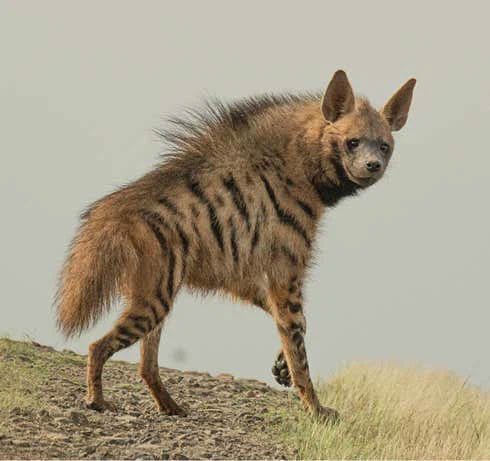
A striped hyena.
The researchers identified hyenas as the culprits after cataloging all the bones and examining the cut marks, tooth marks and signs of digestion on them, as well as the way the bones had been broken apart. Stewart said one sign that striped hyenas were the main culprits was distinctive damage seen only on the human remains, and hyenas are known scavengers with a habit of digging into human graves for flesh.
"It's always the skull caps that are left with striped hyenas," he said. "They don't seem to be really interested in the top of the skulls. We found maybe five or six skull caps with gnawing marks on top at this site, but only the skull caps. Nothing else."
The research was carried out as part of the Palaeodeserts Project, an effort to understand the ancient environment of what is now the Arabian Peninsula and how it changed over time. Key to that investigation is understanding the movements of humans and animals in the region. Because of Saudi Arabia's harsh conditions, few animal remains survive long enough for experts to analyze. Bones, for example, can become so brittle that they fall apart when handled, which makes the hyenas' den a valuable store of knowledge.
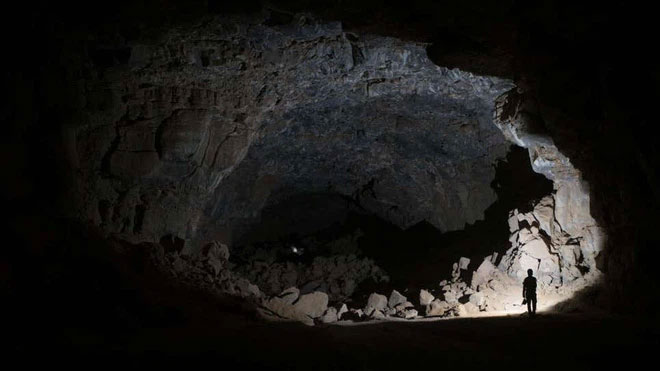
An opening in the Umm Jirsan lava tube, lit by a researcher's flashlight.
"The most surprising thing was how well preserved the material was and how much material there was, because in Saudi Arabia there really are no animal remains at all," Stewart said. He added that usually, when the team does have remains to examine, the bones tend to be so degraded that very little can be determined about them, forcing the researchers to rely on other evidence, even rock art depicting ancient life in Saudi Arabia, to get a basic picture of what lived in the region and when.
With such a large archive of animal history in hand, the team hopes to extract genetic information from the bones. They also think it may be possible to learn about the animals' diets and migrations from the isotopes in their ancient teeth.

9,000-year-old grave of a young female hunter could rewrite prehistory
A 9,000-year-old grave in Peru holds a woman aged 17-19, buried with the stone tools she carried on her hunts.

Stunning discovery behind secret doors inside Egypt's Great Pyramid
Two secret "doors" inside the Great Pyramid of Giza may conceal a hidden chamber of the pharaoh Khufu, but their true purpose remains a mystery.
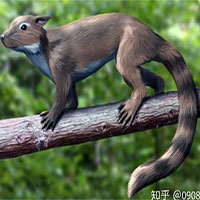
Oldest evidence of mammals feeding on dinosaurs found on Mamenchisaurus fossil
Tooth marks on a 160-million-year-old Mamenchisaurus neck rib from China are the oldest known evidence of mammals feeding on dinosaurs.
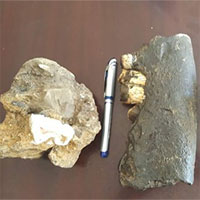
Rhinoceros sinensis fossils found near Rục community in Vietnam
Two Rục men found three Rhinoceros sinensis fossils, 30,000 to 50,000 years old, in a cave in Phong Nha-Kẻ Bàng National Park, Vietnam.
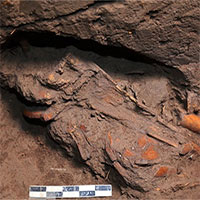
Prehistoric human remains unearthed in Southeast Asia's largest volcanic cave system
Archaeologists have uncovered dozens of ancient human remains in Vietnam's Chư Bluk volcanic caves, the largest volcanic cave system in Southeast Asia.
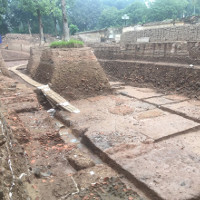
Traces of Early Lê dynasty palace unearthed at Hanoi's Imperial Citadel of Thăng Long
A 2017 dig east of Kính Thiên Palace in Hanoi revealed 4.5m of cultural layers and glazed roof tiles from Early Lê dynasty palaces.