Stunning discovery behind secret doors inside Egypt's Great Pyramid
Secret "doors" inside the Great Pyramid may conceal a hidden chamber of the pharaoh Khufu.
Egyptian explorers have found two secret "doors" inside the Great Pyramid of Giza, which some archaeologists believe could be hiding a mysterious chamber — but their true purpose has raised more questions than answers.
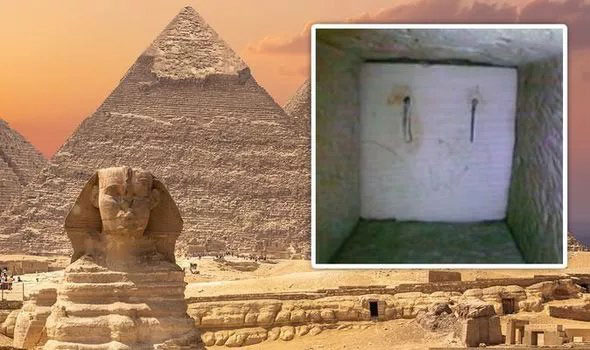
The pyramid is the oldest and largest of the three ancient monuments on the Giza Plateau and is thought to have been built for Pharaoh Khufu over a period of about 20 years. It contains three main chambers — the Subterranean Chamber, the Queen's Chamber and the King's Chamber — and the King's Chamber has two air shafts connecting the pyramid with the outside world. Strangely, however, two tunnels about 20 cm wide run from the north and south walls of the Queen's Chamber and stop at stone blocks before they reach the outside of the pyramid.
The function of these tunnels and blocks is still unknown, but some believe that one or both could lead to a secret chamber.
Egyptologist and former Minister of Antiquities Zahi Hawass has revealed how they were first discovered.
He wrote: "Rudolf Gantenbrink designed a robot called Upuaut to investigate the air shafts in the third chamber. The robot was also sent into the shafts leading from the Queen's Chamber and made interesting discoveries in both of the chamber's shafts.
In the southern shaft, Upuaut was stopped in front of a door, or small stone slab, with two copper handles. The left handle had partly broken off in antiquity, and the piece lay about 6 feet in front of the door. The northern shaft in the Queen's Chamber was also blocked."
But Dr. Hawass went on to explain that the existence of the tunnels had been known long before, and why some people think there could be a secret chamber behind the door.
In an article for Guardian's Egypt, he added: "The history of the investigation of these shafts began in September 1872, when the British engineer Waynman Dixon discovered the openings of the north and south shafts of the Queen's Chamber."
"Dixon pushed a wire through the joints in the masonry of the south wall and realized there was an empty space behind it. He then chiseled through the wall, revealing the shaft. He looked for a shaft in the corresponding area of the north wall and found one there too. When he lit a candle and placed it in the southern shaft, there was a slight draft."
In 1993, a robot probed about 63 meters into the tunnel in the south wall and found what appeared to be a small stone door with metal pins, but Dr. Hawass said this raised many questions about the mystery behind these doors.
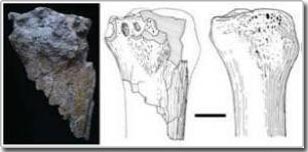
Oldest evidence of mammals feeding on dinosaurs found on Mamenchisaurus fossil
Tooth marks on a 160-million-year-old Mamenchisaurus neck rib from China are the oldest known evidence of mammals feeding on dinosaurs.
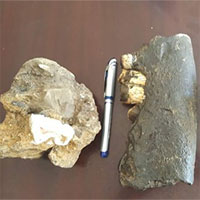
Rhinoceros sinensis fossils found near Rục community in Vietnam
Two Rục men found three Rhinoceros sinensis fossils, 30,000 to 50,000 years old, in a cave in Phong Nha-Kẻ Bàng National Park, Vietnam.
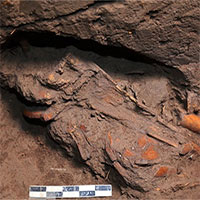
Prehistoric human remains unearthed in Southeast Asia's largest volcanic cave system
Archaeologists have uncovered dozens of ancient human remains in Vietnam's Chư Bluk volcanic caves, the largest volcanic cave system in Southeast Asia.
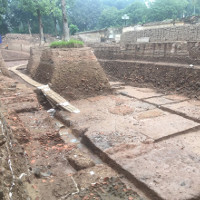
Traces of Early Lê dynasty palace unearthed at Hanoi's Imperial Citadel of Thăng Long
A 2017 dig east of Kính Thiên Palace in Hanoi revealed 4.5m of cultural layers and glazed roof tiles from Early Lê dynasty palaces.
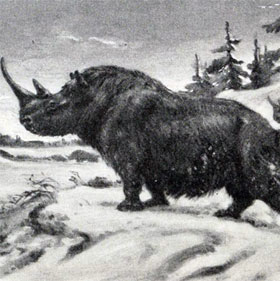
Rhino fossil more than 100,000 years old found in Russia
Russian scientists have unearthed a fossil of the ancient Merck's rhinoceros, which lived about 120,000 years ago in the Ural Mountains.
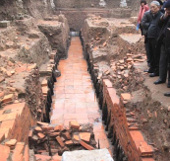
Giant ancient water channel unearthed beneath Vietnam's Imperial Citadel of Thăng Long
Near the Đoan Môn Gate, archaeologists unearthed layered Lý, Trần, Lê and Nguyễn remains, including a giant brick water channel.