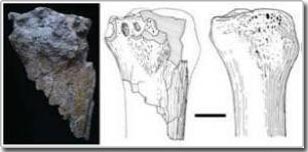
Rhino fossil more than 100,000 years old found in Russia
Russian scientists have unearthed a fossil of the ancient Merck's rhinoceros, which lived around 120,000 years ago in the Ural Mountains.
The find is considered a surprise, overshadowing a 2012 excavation in which scientists discovered an ancient porcupine tooth in the same area.
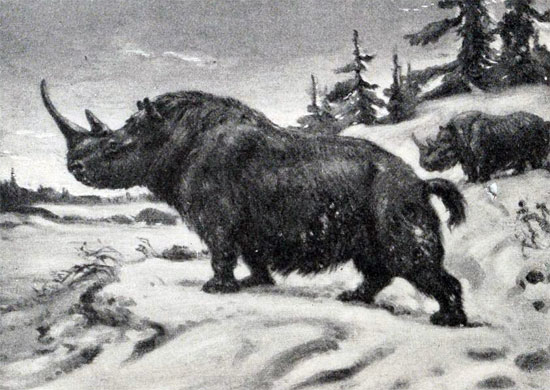
Photo: commons.wikimedia.org
Pavel Kosintsev, head of the paleoecology laboratory at the Institute of Plant and Animal Ecology in the Urals, said that while finding mammoth remains in permafrost has become commonplace, the discovery of a Merck's rhinoceros fossil came as a surprise, especially in the Urals.
Fossils of this animal are usually found in southern Western Europe, where the climate was better suited to rhinos. During warmer periods, however, they migrated east as far as southern Siberia, as shown by the bones occasionally found there. But most of those remains turn up on riverbanks, away from their original burial sites, which makes it very difficult to obtain biological data for research.
According to Kosintsev, the newly discovered fossil is roughly 120,000 years old, suggesting that the Urals' climate at the time was warmer than today. The Merck's rhinoceros find offers a chance to reconstruct the environment of the last interglacial period, helping scientists study the rhino's biology more fully and understand why it went extinct.
Merck's rhinoceros lived in forested, hilly environments and favored shrubs and tall grasses. It was a solitary animal standing 1.5 m tall and measuring more than 3 m long. One hypothesis holds that changes in climate and vegetation drove it to extinction. The last of these rhinos are thought to have lived in what is now Italy during the Paleolithic. Merck's rhinoceros fossils from Italy are about 200,000 years old. However, the Russian scientists' find shows that the animal survived later, until about 120,000 years ago.
Giant ancient water channel unearthed beneath Vietnam's Imperial Citadel of Thăng Long
Near the Đoan Môn Gate, archaeologists unearthed layered Lý, Trần, Lê and Nguyễn remains, including a giant brick water channel.

Ancient Roman sewer uncovered at Herculaneum reveals clues to daily life
An 86-meter sewer and skeletons found at Herculaneum, Italy, shed light on the diet and daily life of Romans 2,000 years ago.