Giant ancient water channel unearthed beneath Vietnam's Imperial Citadel of Thăng Long
Near the Đoan Môn Gate of the Imperial Citadel of Thăng Long in Hanoi, archaeologists have unearthed more remains from the Lý, Trần, Lê and Nguyễn dynasties, layered one on top of another. Most striking is a giant brick water channel unlike anything previously found at any archaeological site in Vietnam.
>>> Photos: the archaeological site at the Imperial Citadel
Following UNESCO's recommendation that archaeological research continue at the Imperial Citadel of Thăng Long after its inscription as a World Heritage site, archaeologists have spent the past six months excavating 500m2 at the heart of the Forbidden City (Cấm Thành), with the deepest pit reaching 4.2m.
According to excavation results announced on the morning of December 26 by the Institute of Archaeology (Viện Khảo cổ học) in Hanoi, the uncovered remains reveal multiple interwoven cultural layers spanning the Lý to the Nguyễn periods. Architectural traces from the Lý dynasty include a large water channel built of square bricks, edging bricks and wooden stakes that runs the full east-west length of the site, measuring 2m wide and 2m high, along with numerous wall foundations.
Trần-dynasty architectural traces include bands of lime-blossom decoration lying on top of Lý-era wall foundations, a drainage system and rectangular edging bricks. Lê-era remains survive in the form of square-brick and vồ-brick floors on the western side of the excavation pit. Such brick floors have also been found stretching from the foundation of the Kính Thiên Palace to Đoan Môn.
The Nguyễn dynasty also left its mark in the form of drains, each with two side walls built of bluestone and gray vồ bricks.
According to Associate Professor Tống Trung Tín, director of the Institute of Archaeology, there had previously been many hypotheses that the excavation area was the site of the Thiên An main hall of the Lý-Trần period and the Càn Nguyên main hall of the Lý dynasty. Pits dug in 2011 had uncovered only traces of the column foundations of the Kính Thiên Palace platform, while the area of the hall floor itself remained a mystery.
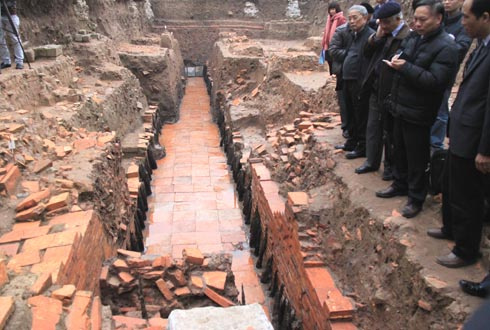
Scientists examine the giant water channel at the excavation site. (Photo: Đoàn Loan)
In this excavation, archaeologists found a courtyard paved with vồ bricks that extends from the Đoan Môn area across the entire large space up to the Kính Thiên Palace. They also found the foundation structure of a Lê-era "Ngự đạo" (imperial path), along with many ceramic fragments from the Early Lê and Revival Lê periods. The finds also show how the foundation was built up to raise the Great Audience Courtyard of the Early Lê period beneath the layer of vồ bricks.
Archaeologists also found Lý-dynasty architectural traces north of Đoan Môn, including the large water channel built of square bricks. Running parallel to it are the remains of a 1.6m-wide Lý-era wall foundation reinforced with stoneware shards. The channel is 2m wide and 2m high, with wooden stakes driven in for reinforcement. It is a giant brick water channel unlike any seen at any other archaeological site in Vietnam.
Tống Trung Tín said the channel may have been used to drain water from the Lý-dynasty Forbidden City, or it may be a spiritual structure related to feng shui at the center of the Lý royal palace.
As for preserving the excavated area, Tín said the remains would have to be reburied to prevent damage, though some have suggested leaving the site open for the public to view, to enrich the cultural offerings at the heart of the Imperial Citadel.
Many historians have offered interpretations of the underground channel and proposed preserving the excavation pits under glass or roofing so the public can visit. According to Professor Nguyễn Quang Ngọc, chairman of the Hanoi Historical Association (Hội Sử học Hà Nội), no Lý-era traces had previously been found at the center of the Imperial Citadel, but the discovery of the Lý-era channel suggests that King Lý Thái Tổ may have built the Càn Nguyên Hall in this area, together with the Long Trì courtyard. To shed more light on the main hall, the excavation would need to be extended toward Nguyễn Tri Phương Street.
"We can identify this as the main hall area of the Imperial Citadel, so the archaeological site should be kept open for everyone to come and see. That, too, is a way of preserving this relic," Ngọc said.
Dr. Trần Đức Cường, former vice president of the Vietnam Academy of Social Sciences (Viện Khoa học Xã hội Việt Nam), said the large channel could have been a conduit for water, but it might also have been a reservoir or a feng shui structure. "It would be a great pity to visit such a famous heritage site and not be able to see what researchers have found, so there must be a way to preserve it long-term, such as glass covers or a roof. Reburial is a last resort. Our relic lies in the middle of the capital, so there is no reason to restrict the public from enjoying it," Cường said.

Ancient Roman sewer uncovered at Herculaneum reveals clues to daily life
An 86-meter sewer and skeletons found at Herculaneum, Italy, shed light on the diet and daily life of Romans 2,000 years ago.