X-rays help scientists save cannonballs from the Mary Rose
Researchers are using powerful X-rays to probe the inside of cannonballs recovered from the Tudor warship Mary Rose.
They are trying to find a way to preserve the cannonballs, which corrode when put on display.
The 1,200 cannonballs, recovered from King Henry VIII's flagship, have recently been kept in low-humidity containers, away from public view.
According to Dr. Eleanor Schofield, the aim is to preserve them for future generations. “We have a lot of cannonballs in storage. If we can understand the process better, we can develop new treatments and they can last longer.”
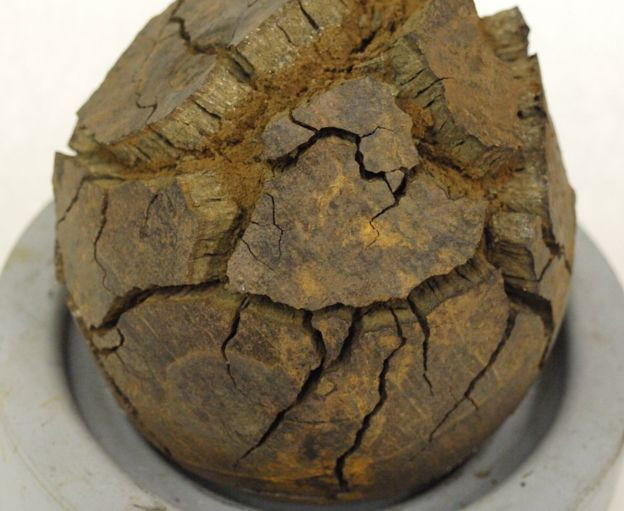
The cannonballs crack and corrode when exposed to air. (Photo: The Mary Rose Trust)
The Mary Rose sank in 1545 and was raised from the seabed in 1982. Its cannonballs are very difficult to conserve because chlorine seeped into them while they lay on the seabed. The chemical penetrated right to their core, which means the cannonballs corrode when exposed to air.
Dr. Schofield's team tried to remove the chlorine by soaking some of the cannonballs in a solution. But the researchers found that although some of it was extracted, they could not remove it all. They discovered this when the cannonballs began to deteriorate after being put on display.
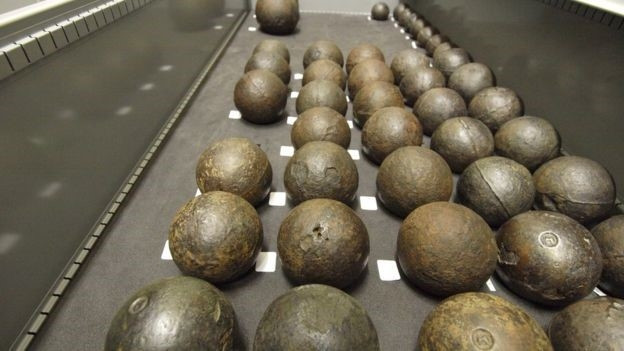
The cannonballs are stored in low-humidity containers. (Photo: The Mary Rose Trust)
Dr. Schofield then set up a research project to find out what was happening inside the cannonballs.
She examined them using a powerful X-ray facility, the Diamond Light Source in Didcot, Oxfordshire. Dr. Schofield will use it to see how many ions and how much chlorine remain inside the cannonballs, and where deterioration has begun. But to examine them, the precious objects had to be cut into pieces. After consulting the custodians of the Mary Rose, in 2016 the team decided to cut up six cannonballs, some of which were already showing signs of damage, in order to preserve the rest.
In a newly published paper, the X-ray results revealed detailed maps of the elements involved in the deterioration process, offering unprecedented insight into conservation at the molecular scale.
Hayley Simon of University College London and the Diamond Light Source said the results are a first step toward developing new conservation techniques. “Next, we will carry out a long-term experiment, observing changes in corrosion products that have been immersed for long periods in conservation treatments, to monitor their effects.”

Rhino fossil more than 100,000 years old found in Russia
Russian scientists have unearthed a fossil of the ancient Merck's rhinoceros, which lived about 120,000 years ago in the Ural Mountains.
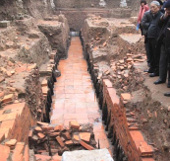
Giant ancient water channel unearthed beneath Vietnam's Imperial Citadel of Thăng Long
Near the Đoan Môn Gate, archaeologists unearthed layered Lý, Trần, Lê and Nguyễn remains, including a giant brick water channel.

Ancient Roman sewer uncovered at Herculaneum reveals clues to daily life
An 86-meter sewer and skeletons found at Herculaneum, Italy, shed light on the diet and daily life of Romans 2,000 years ago.