Scientists search for the true nature of time and space
Researchers have uncovered a potential link between general relativity and quantum mechanics. The discovery could force physicists to rethink the nature of space and time.
The nature of space and time
In 1915, Albert Einstein published his general theory of relativity, which describes gravity as a fundamental property of spacetime. He put forward a set of equations describing how spacetime is warped by energy and momentum.
According to Einstein, gravity is not simply an ordinary force, as the physicist Isaac Newton had described it. Instead, gravity can be thought of as a curvature of spacetime caused by the mass of objects.
Einstein's theory also explains the properties of black holes, where gravity is so strong that not even light can escape. Relativity further holds that gravity warps time: the stronger the gravity, the more slowly time passes.
In the 1970s, physicists Stephen Hawking and Jacob Bekenstein noted a connection between the surface area of black holes and their microscopic quantum structure. This marked the first glimpse of a link between Einstein's general relativity and quantum mechanics.
Less than three decades later, theoretical physicist Juan Maldacena observed another link between gravity and the quantum world. That connection led to a model built on the idea that spacetime can be created or destroyed by changing the entanglement between different surface regions of an object. In other words, it implies that spacetime is a product of entanglement between objects.
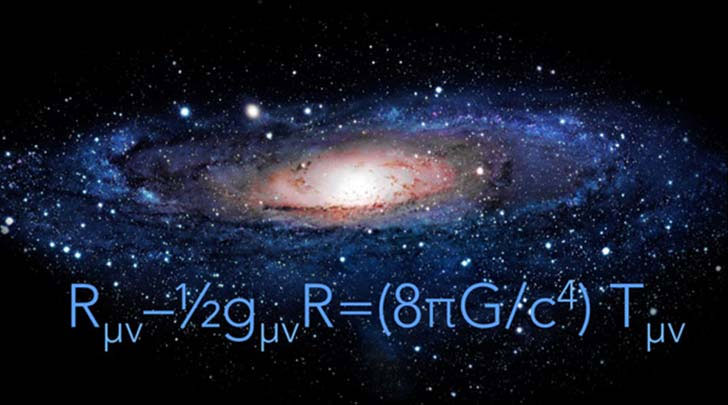
There is a link between general relativity and quantum mechanics. (Photo: Internet).
To learn more, researchers ChunJun Cao and Sean Carroll of the California Institute of Technology carried out a series of tests. They wanted to see whether they could recover the properties of gravity (as known from general relativity) using a framework in which spacetime emerges out of quantum entanglement. Their study was published on the preprint server arXiv.
Using an abstract mathematical concept called Hilbert space, Cao and Carroll found similarities between the equations governing quantum entanglement and Einstein's equations of general relativity. This supports the idea that spacetime and gravity emerge from entanglement.
The next step in the research, Carroll said, is to determine whether the assumptions they made are correct. "One of the most obvious things is to check whether the symmetries of relativity emerge in this framework — specifically, the idea that the laws of physics don't depend on how fast you are moving through space," he said.
The theory of everything
Today, almost everything we know about the physical aspects of the universe can be explained by either general relativity or quantum mechanics. General relativity does an excellent job of explaining how objects behave on very large scales, such as planets or galaxies. Quantum mechanics, meanwhile, helps us understand the very small, such as atoms and subatomic particles.
However, the two theories appear to be incompatible with each other. This has driven physicists to search for a "theory of everything" — a single framework that could explain it all, including the nature of space and time.
Scientists are rethinking the nature of time and space. (Photo: Internet).
Because gravity and spacetime are an important part of "everything," Carroll believes the research he and Cao carried out could advance the pursuit of a theory reconciling general relativity and quantum mechanics. However, he noted that this is a challenging task.
"Our work doesn't yet say much about the other forces of nature, so we're still a long way from the final result," Carroll said. Still, if such a theory can be found, it could answer some of the biggest questions scientists face. We might come to understand the true nature of dark matter, dark energy, black holes and other mysterious objects in the universe.
Currently, researchers are harnessing the capabilities of the quantum world to improve computer systems, and a theory of everything could speed up that progress by revealing new insights into a field that remains poorly understood.
According to Carroll, as theoretical physicists pursue a theory of everything, every new study — successful or not — brings us closer to the mysteries of the universe.

9-year-old Malaysian boy wins NASA's Moon toilet design contest
Zyson's design uses only mechanical forces, with no electronic components, to reduce the chance of breakdowns in space.