

Pluto has had a vast ocean for the past 4.5 billion years
Images collected by NASA's New Horizons mission suggest that Pluto was very hot when it first formed. That heat would have produced liquid water that may persist to this day.
According to scientists, the dwarf planet was extremely hot at birth, and water may lie beneath its icy crust, possibly harboring life.
The finding has important implications for assessing the potential habitability of other icy worlds that may also host hidden oceans, and perhaps even aliens.
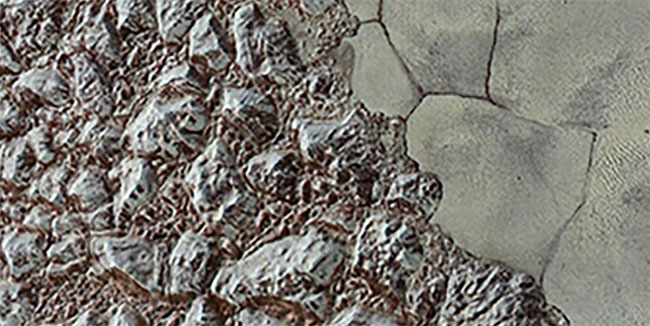
An image showing Pluto's icy surface.
Planetary scientist Carver Bierson said: "Even out in the cold environment far from the Sun, all these worlds could have formed fast and hot, with liquid oceans."
It was previously thought that Pluto began as a solid snowball and then slowly melted over time due to radioactive decay.
"Pluto has had an ocean that has been slowly freezing for the entire history of the solar system. We're pretty sure water is one of the ingredients for life. Having water around for longer allows it to react with the rocky core below, supplying more chemicals," Carver Bierson said.
The research team at the University of California, Santa Cruz compared geological observations from 2015 with thermal model simulations of Pluto's evolution.
Lead author Carver Bierson explained: "By examining the features of Pluto today, from ice mountains more than 3 km high to smooth plains and dunes, we can begin to understand its birth 4.5 billion years ago."
As Pluto was forming, new chunks of rock and ice were crashing into it. Each of these impacts acted like an explosion, warming the surrounding area. If Pluto had formed slowly, its surface could have cooled between collisions.
The study suggests that Pluto formed rapidly, in less than 30,000 years. The ice became so warm that it began to melt. After this early period of melting, the subsurface ocean would then gradually freeze again.
Co-author Professor Francis Nimmo added: "The oldest surface features on Pluto are harder to find, but it looks like there is both ancient and modern extension of the surface. The findings suggest that other objects at the edge of the solar system were also once hot, with oceans. Some may still have them today."
