Giant space rocks hit Earth more often than we thought
A new study claims that giant space rocks have struck Earth far more often than previously estimated. The finding is stirring debate among scientists.
The controversial new research suggests that Earth may have been pummeled by large impactors more frequently than once thought, raising the possibility that an extinction-level impact could come sooner than we expect.
The study was presented at the annual Lunar and Planetary Science Conference in The Woodlands, Texas. It focuses on the largest known impact craters formed over the past several million years.
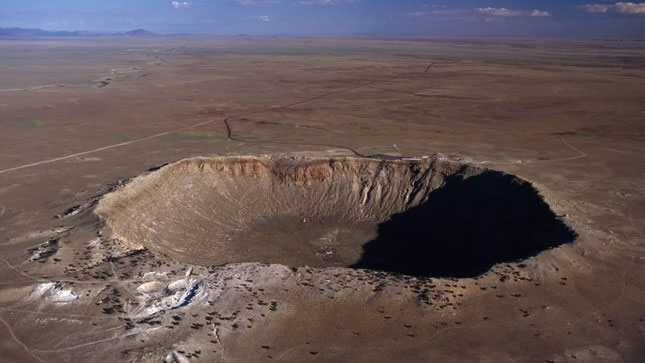
Meteor Crater in Arizona is one of the best-preserved impact craters on Earth, with an estimated age of about 50,000 years. A new study of larger, less pristine craters raises new questions about how many major impacts Earth experiences in a given span of time.
Using new high-resolution imagery, the authors argue that these craters were originally much larger than they appear today. If they are right, asteroids or comets more than 1 km across have hit Earth dozens of times in just the past million years. That is a far higher rate than the previous estimate of one such impact every 600,000 to 700,000 years.
Impact craters on Earth disappear quickly
Unlike those on Mars or the moon, impact craters on Earth vanish relatively quickly because of erosion by water and wind.
Garvin and his colleagues used new high-resolution satellite data to examine the remnants of craters on Earth.
Using this approach, the researchers found at least four impact craters with outer rims far larger than previously measured.
Specifically, Pantasma crater in Nicaragua was previously estimated to be 14 km in diameter, but Garvin and his colleagues detected an outer rim 35.2 km across. Bosumtwi crater in Ghana was thought to be about 10.5 km wide, but the new study revealed a ring-like ridge 26.8 km in diameter. And the 13.6-km-wide Zhamanshin crater in Kazakhstan may actually measure 30.4 km across. Meanwhile, Iturralde crater in Bolivia has a rim 30.4 km wide.
According to Garvin and his team, the impacts that created these craters would have released the equivalent of 400,000 to 730,000 megatons of TNT — enough to blow part of Earth's atmosphere into space and fling impact debris across the globe.

9-year-old Malaysian boy wins NASA's Moon toilet design contest
Zyson's design uses only mechanical forces, with no electronic components, to reduce the chance of breakdowns in space.