The beauty of Vietnam's wild pheasants and junglefowl
Vietnam's wild fowl belong to the pheasant family (Phasianidae), a group of birds found throughout the world. Most are medium-sized, with very few large or small species.
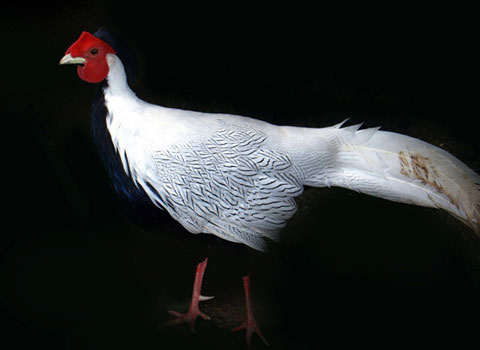
Silver pheasant (Lophura nycthemera). Its preferred habitat is primary and secondary evergreen forest at elevations of 500 m and above. Scientists and farmers have encountered it at 500–1,000 m, and even on mountain peaks at 1,200–1,800 m. It forages on the ground and roosts in trees at night. (Photo: Phùng Mỹ Trung)
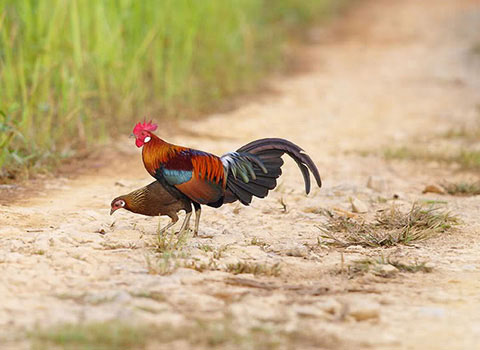
Red junglefowl (Gallus gallus). A large bird with a wing length of 200–250 mm, weighing 1–1.5 kg. The male has reddish-orange feathers on the head and neck, a deep red back and wings, and a black breast, belly and tail. The female is smaller than the male and dull brown all over. The eyes are brown or orange-yellow; the bill is horn-brown or lead-grey; the comb and wattles are red; the legs are pale grey. Red junglefowl are resident birds found in many types of forest. Their preferred habitat is secondary forest near upland fields, or woodland mixed with climbing bamboo and nứa bamboo. They live in flocks and are active at two times of day: early morning and late afternoon. In the evening they seek out trees under 5 m tall with broad canopies to roost, and they like to sleep in thickets of climbing bamboo and nứa bamboo with plenty of fallen trees. (Photo: Tăng a Pẩu)
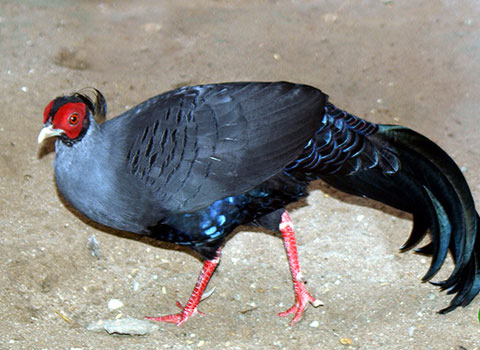
Siamese fireback (Lophura diardi). The adult male has a crest 70–90 mm long, usually held erect, colored a steely blue-black. The head, chin and throat are black. The lower back is metallic golden-yellow, while the rump and upper tail are steel blue and purplish-red. The rest of the plumage is generally bluish. The adult female lacks a crest, but the feathers on the crown are longer. The species is commonly found in various types of forest and scrub, including open areas and along trails, at elevations below about 750 m. It travels alone or in small groups and occurs only from Hà Tĩnh province in north-central Vietnam southward. The species is listed in the Vietnam Red Data Book. (Photo: Phùng Mỹ Trung)
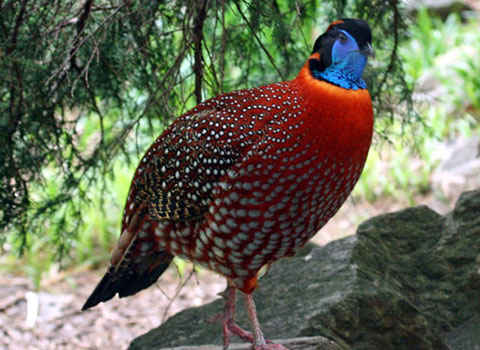
Temminck's tragopan (Tragopan temminckii). The adult male has strikingly colorful plumage in shades of fiery red, reddish-brown and brown mixed with black. Most feathers bear broad grey-blue spots in the center. The eyes are brown, the bill black, and the skin around the eyes sky blue; the legs are pink. One-year-old young males resemble females but are slightly larger. The female is mottled with blackish-rufous and white and looks coarser than the male. In Vietnam, the species is usually found only in Lào Cai province in the far north, at elevations of 2,000–3,000 m. It is listed in the Vietnam Red Data Book. (Photo: Dick Daniels)
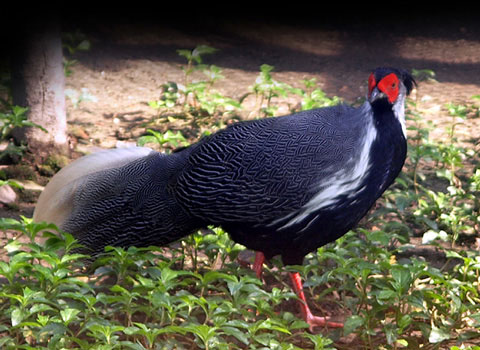
Lophura nycthemera annamensis, a subspecies of the silver pheasant. It has a long crest, and the chin, throat and entire underparts are black. A conspicuous feature is a broad white band running down each side of the neck. The wings are black with a few white markings, and the black tail has many narrow white bars. The eyes are orange-brown or yellow; the bill is black or horn-grey; the skin around the eyes is bright red, and the legs are purplish-red. This pheasant is found in the forests of south-central Vietnam, on the Lâm Viên Plateau (in Lâm Đồng province), in areas north of Pleiku (Gia Lai province) and in the northeastern part of southern Vietnam. It is a subspecies endemic to Vietnam. (Photo: Phùng Mỹ Trung)

Edwards's pheasant (Lophura edwardsi). The adult male is generally dark blue overall, with a white crest of feathers on top of the head. The eyes are reddish-orange; the bill is pale yellowish-green or horn-colored; the legs are purplish-red. It was first discovered in dense forest around the limestone mountains between the former Quảng Bình province and Quảng Trị province (both now part of Quảng Trị province) in central Vietnam, in secondary forest at elevations of 50–200 m. The species is listed in the Vietnam Red Data Book. (Photo: Phùng Mỹ Trung)
The "deadly" beauty of Vietnam's rainbow-colored snake
Despite its small size and alluring colors, the red-necked keelback is a dangerous snake with fairly potent venom.
Remarkable photos of colonial-era Vietnam
Fascinating images of colonial-era Vietnam from J. P. Dannaud’s 1962 book “L’Indochine Profonde” (Deep Indochina).
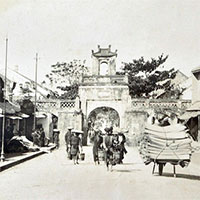
Rare photos of old Hanoi through the lens of a French photographer
Rare photos of Hanoi in 1890–1895 from an album by Raphaël Moreau, a French photographer based in colonial-era Hanoi.

The oldest known photographs of Hải Phòng
Photos of Hải Phòng from 1888, printed in an old French book, are believed to be the oldest known images of the northern Vietnamese port city.