Which country in the world has no traffic lights?
Bhutan is the only country in the world without traffic lights, even in its capital. Instead, police officers direct the flow of vehicles. It is also one of the few countries with negative CO2 emissions.
Questions
1. Which country has no traffic lights?
A. Bhutan
B. Brazil
C. The Bahamas
D. Bulgaria
2. Where does this country rank in the world for average elevation?
A. 1
B. 2
C. 3
D. 4
3. Why does this country have negative CO2 emissions?
A. Its people rarely travel by plane
B. Most of its land is covered by forest
C. Its high altitude makes the air thin
D. It uses seaweed to absorb CO2
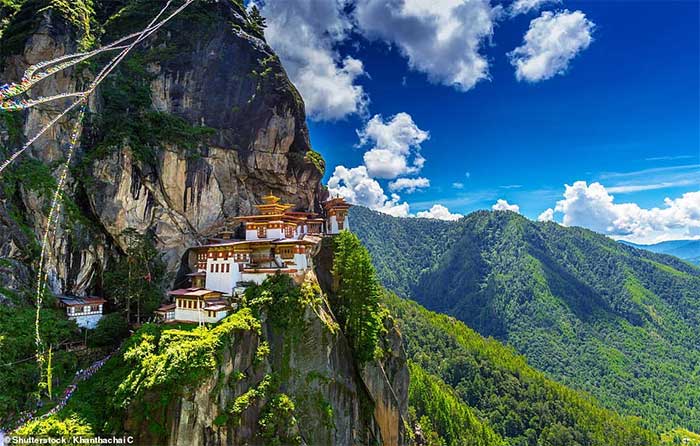
Bhutan is the only country in the world without traffic lights.
4. Which animal appears on this country's national flag?
A. A lizard
B. A dragon
C. A salamander
D. A lion
5. What do people in this country get for free?
A. Exemption from income tax
B. Free education
C. Free healthcare
D. Free education and healthcare
Answers
Question 1: A - Bhutan. Bhutan is a landlocked country in Asia that borders China and India. The country has no traffic lights. Thimphu, Bhutan's capital and largest city, was once the only place in the country to have a traffic light — for just 24 hours. Residents objected, so the light was quickly removed and traffic police went back to their job, directing vehicles on the road with white-gloved hands.
Question 2: A - 1. Bhutan has the highest average elevation of any country in the world, at about 3,280 meters above sea level. The north of the country is dominated by the high peaks of the Himalayas, the tallest of which is Gangkhar Puensum at more than 7,570 m. The south consists of hills, plateaus and valleys and is home to most of Bhutan's population. However, Thimphu is not the highest capital — that title belongs to the capital of Bolivia.
Question 3: B - Most of its land is covered by forest. Bhutan was the world's first country with negative CO2 emissions. That is because 72% of the country is covered by forest. Bhutan's constitution also requires that at least 60% of its total land area remain forested at all times. The whole country produces 2.2 million tonnes of CO2 a year, but its forests absorb three times that amount of CO2. In other words, Bhutan is "a carbon sink of more than 4 million tonnes of CO2 a year."
Question 4: B - The dragon. Bhutan's flag is divided diagonally into yellow and orange halves, with a white dragon in the middle. The white dragon symbolizes purity and loyalty, while the jewels it holds represent wealth, security and the protection of the people of Bhutan. Bhutan is known by the nickname "Land of the Thunder Dragon."
Question 5: D - Free education and healthcare. Although Bhutan's GDP is low, the government maintains free healthcare not only for Bhutanese citizens but also for people residing in the country. As for education, students pay no tuition and receive free meals, as well as books, uniforms and school supplies.