22 stunning new caves discovered in Vietnam's Quảng Bình
The British Cave Research Association has discovered 22 new caves with a combined length of 11.7 km during a cave-survey expedition in Quảng Bình, a former province in north-central Vietnam that is now part of Quảng Trị province.
According to the management board of Phong Nha-Kẻ Bàng National Park, a UNESCO World Heritage Site in central Vietnam, after three weeks of exploring caves in the Phong Nha-Kẻ Bàng area and the former Tuyên Hóa and Minh Hóa districts, the British Cave Research Association (BCRA), together with explorers from the UK, Australia and New Zealand, found 22 new caves in western Quảng Bình.
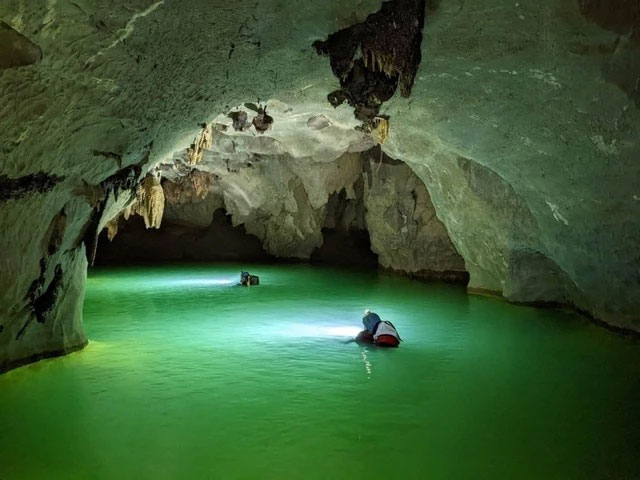
A stunning lake inside one of the caves.
The three-week survey by the scientists from the UK, Australia and New Zealand was split into three trips across the former Minh Hóa and Tuyên Hóa districts, with support from several tour guides in Phong Nha and their friends among the local residents.
In Lâm Hóa commune (former Tuyên Hóa district) and Hóa Sơn and Hóa Phúc communes (former Minh Hóa district), the scientists found 20 caves. On this expedition, the BCRA also discovered two more caves in the former Bố Trạch district, within Phong Nha-Kẻ Bàng National Park, bringing the total number of caves explored on the trip to 22, with a combined length of 11.7 km.
Of these, 20 caves were found in Lâm Hóa commune (former Tuyên Hóa district) and Hóa Phúc and Hóa Sơn communes (former Minh Hóa district). The remaining two were discovered in the Phong Nha-Kẻ Bàng area.
Howard Limbert, leader of the BCRA cave expedition team, said: "Most of these caves are wet caves. They are small but quite interesting, especially compared with many of the caves we have found in Quảng Bình."
The team leader added that while Sơn Đoòng, Hang Én and many other caves have only one main entrance, this new cave system has many different entrances and exits.
Some of the caves are also interconnected, creating many side passages that make loop trips through their interiors very exciting.
However, before the newly discovered caves can be developed for tourism, explorers, scientists and local authorities will assess their safety, water flow, geomorphology and geology.
Howard Limbert and his BCRA colleagues were expected to return to Lâm Hóa the following summer to continue their research and survey work.
Howard Limbert and his wife, along with the BCRA, have for decades worked closely with Phong Nha-Kẻ Bàng National Park, a natural World Heritage Site, exploring, studying and discovering its caves. They have played a major role in finding and documenting the more than 300 caves recorded in Phong Nha-Kẻ Bàng, contributing greatly to the growth of tourism in Quảng Bình.
Earlier, from 12 to 16 March, the BCRA expedition had also discovered five more wet caves, some with dry branches, with a combined length of 3,349 m in Lâm Hóa commune, former Tuyên Hóa district, in the former Quảng Bình province.
Why a 3,900-square-kilometer iceberg broke apart
Shifting ocean currents in the Southern Ocean may have caused the giant iceberg A68a to break apart, a Princeton University study suggests.
New cave discovered in Vietnam's former Hà Giang province
A new cave, Sán Tớ, has been found in Mèo Vạc in northern Vietnam's former Hà Giang province, about 5 km from the town center and easy for visitors to reach.